Epic Fury and India’s Airpower Moment
Survivability, Coherence, Sovereignty

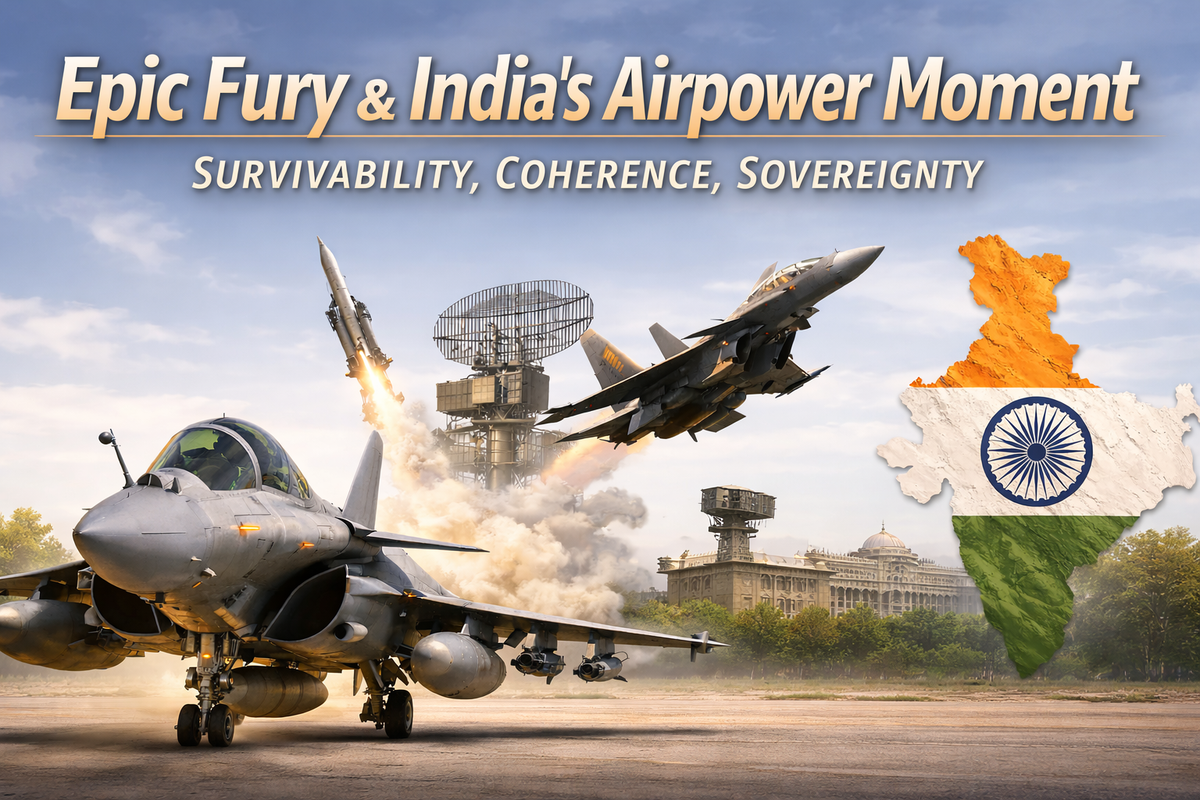
An American F-35 was hit over Iran on March 19. Five weeks earlier, India committed ₹3.25 lakh crore to a non-stealth aircraft. One day earlier, it told Parliament it needed sixth-generation capability immediately. No one has asked the Ministry of Defence to reconcile these three facts. This piece does.
In earlier articles, Nitividya has argued that India's aerospace capability problem is structural rather than procedural — rooted in how we design capital and authority, not merely how we run procurement processes. Three events in the last five weeks make that argument impossible to defer. What follows is an attempt to place them in the same frame.
What Does the F-35 Strike Tell Us?
On the night of March 19, 2026, Iranian air defences struck a USAF F-35 conducting a combat mission over central Iran. The aircraft diverted to an American base in the region. The F-35 — damaged but not destroyed — had survived.
This detail matters: the confirmation came not from Tehran, not from Iranian state television, not from footage of dubious provenance. It came from US Central Command. CENTCOM confirmed the aircraft was “flying a combat mission over Iran” when it was hit.
That single sentence should make every defence planner in New Delhi stop cold.
Not because stealth is dead. It is not. Not because the F-35 was shot down. It wasn’t. But because what CENTCOM confirmed — without intending to — is historic in a precise and uncomfortable sense. In the entire operational history of fifth-generation stealth aircraft — the F-22, the B-2, the F-35 — no adversary air defence system had previously achieved a confirmed weapons engagement. March 19 ended that record.
It ended it in a specific way that matters. A second-tier adversary, likely equipped with Chinese-supplied detection architecture fused with passive terminal guidance, achieved that engagement while the F-35 was protected by EA-18G Growler jamming support, Airborne Warning and Control System (AWACS) coverage, and full American Suppression of Enemy Air Defences (SEAD) packages — the complete supporting infrastructure the United States specifically deploys to protect stealth platforms operating in contested airspace. The most capable version of that infrastructure, deployed by the most capable military in the world, was insufficient to prevent the engagement.
India is proposing to address a more sophisticated version of that same threat architecture without Growlers, with three AWACS, with six tankers — using aircraft that are not stealth.
The F-35 survived. India’s central procurement assumption — that a non-stealth platform, with relatively limited enabling infrastructure, can address the threat environment its own Ministry of Defence has acknowledged requires sixth-generation capability — may not.
What the Physics Actually Means
The instinctive response from India’s defence establishment will be familiar: stealth was never invisibility. The F-35 wasn’t shot down. Iran is not China. Move on.
Each of those statements is technically true. None of them is the point.
Stealth technology has always been a probability reduction, not a disappearing act. It works by shrinking the detection window — compressing the time an adversary has to identify, track, and engage a target — across specific radar frequency bands, primarily the X and S band fire-control radars that most surface-to-air missile systems use for terminal guidance. Against the Soviet-era integrated air defence systems for which stealth was originally conceived, and against the degraded air defence architectures over which American airpower has operated largely uncontested since 1991, that window compression was so decisive as to be effectively absolute.
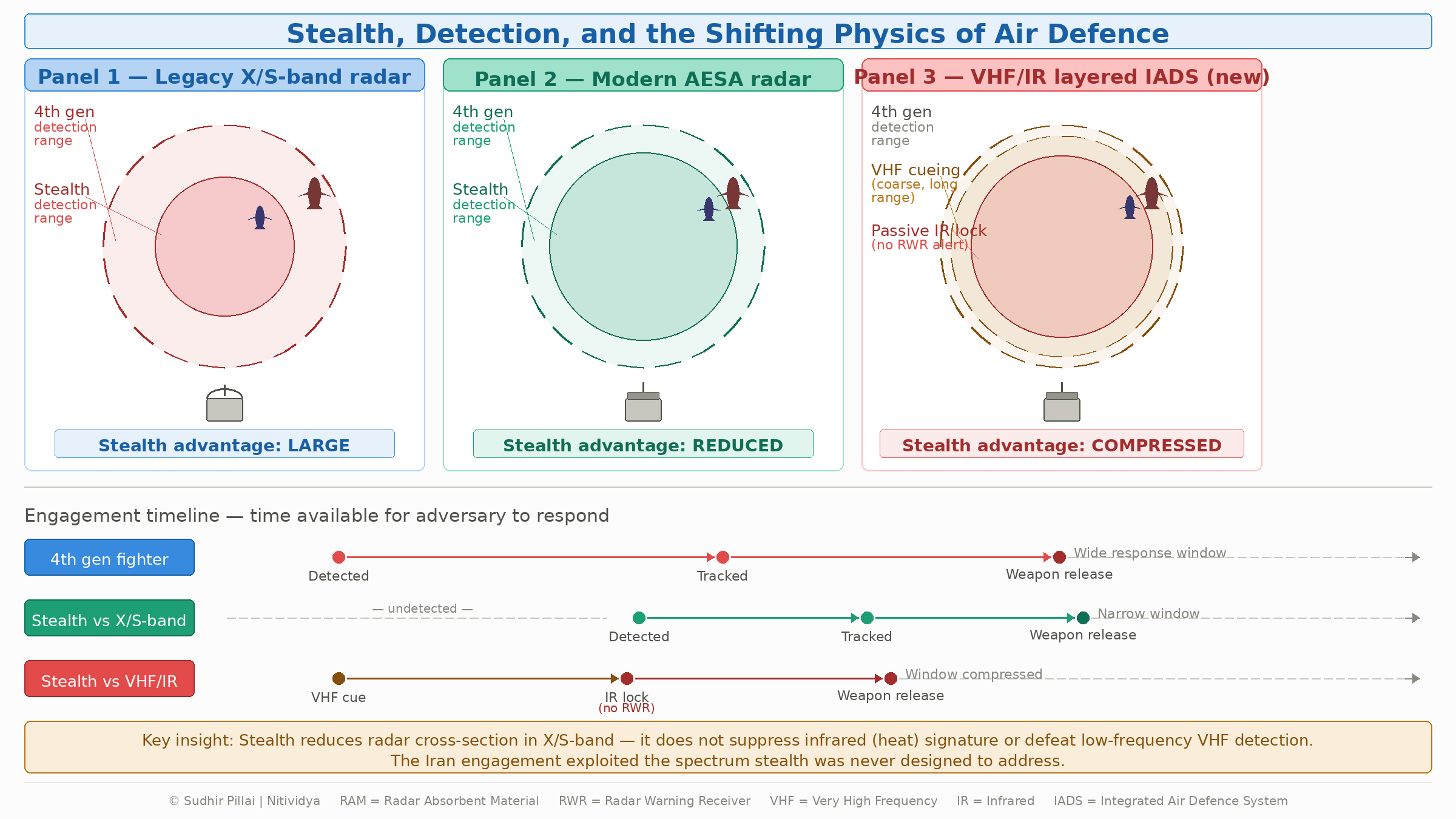
What March 19 confirmed — operationally, not theoretically — is that the window compression is no longer absolute.
Iran’s engagement chain did not use a single magical radar. It appears to have been the result of a layered architecture whose precise kill chain remains under CENTCOM investigation — but whose constituent elements are not in dispute: surveillance systems operating at very-high-frequency wavelengths that stealth shaping and radar-absorbent coatings cannot optimise against, reportedly including Chinese-supplied systems specifically designed to detect low-observable aircraft; Russian-lineage radar-guided SAM batteries that survived weeks of American suppression through mobility and emissions discipline; and Iranian indigenous systems that may include passive infrared terminal guidance generating no radar emission the F-35’s electronic warfare suite could detect. Whether the terminal weapon was radar-guided or infrared-guided, the strategic conclusion is identical: a layered, multi-sensor, multi-spectral Integrated Air Defence System (IADS) retained lethal capability against the world’s premier stealth platform after the most intensive suppression campaign the United States has conducted in decades.
This is not a vulnerability unique to the F-35. It is a structural vulnerability in the concept of stealth as currently practised — and it has been deliberately engineered, most comprehensively by China, over fifteen years of studying precisely how to defeat it.
That China developed this capability and its architecture appears in Iran is not incidental. It is the signal India should be reading.
A former Chief of the Air Staff, Air Chief Marshal BS Dhanoa (Retired), in an interview published this week in The Indian Express, offered a different reading. Measuring Iran’s performance by sortie-loss-rate — one hit in an estimated 6,000 US and Israeli sorties, a rate of 0.0166 per cent — he concluded that what Iran is demonstrating is “nuisance value” and “propaganda,” not meaningful military achievement. The arithmetic is not wrong. But the question it answers is not the question India needs to ask.
The sortie-loss-rate argument measures Iran’s ability to degrade American airpower over Iran. It does not measure — and cannot measure — what non-stealth aircraft face in a Chinese integrated air defence environment that is architecturally related to but vastly more sophisticated than anything Iran fields. It does not measure what India’s loss rate would be flying comparable missions without Growler jamming support, without adequate AWACS, without stealth. And it measures aggregate campaign performance across thousands of sorties — a metric that tells you little about whether specific mission profiles, flown by specific platforms without fifth-generation supporting infrastructure, are survivable at all.
The 0.0166 per cent loss rate is a US number achieved with US tools. India is proposing to address a Chinese threat with French aircraft and three AWACS. The sortie-loss-rate arithmetic could look very different in that configuration.
Three Days That Should Be Read Together
Consider three events that occurred within weeks of each other in early 2026, and that no single analysis in India’s strategic media has yet placed side by side.
On February 12, India’s Defence Acquisition Council (DAC) granted an Acceptance of Necessity (AoN) for 114 Rafale fighters under the Multi-Role Fighter Aircraft (MRFA) programme — the largest single defence procurement in the country’s history, valued at approximately ₹3.25 lakh crore. The IAF vice chief told a press briefing that the Rafale had been “the hero of Operation Sindoor.” The narrative was triumphant. The momentum was irresistible.
On March 18 — five weeks later — India’s Ministry of Defence (MoD) tabled a 152-page budget report before the Parliamentary Standing Committee on Defence (Committee). Buried within it was a passage that received remarkably little attention given its implications. The Committee had been informed, the report stated, that two international consortia were developing sixth-generation combat aircraft. It further stated that the IAF would “try to join forces with one of the consortia right away” — with a view to ensuring that India did “not lag behind in achieving the target for advanced aircraft.”
One day later, on March 19, an American F-35 was struck over central Iran.
Read separately, each event has a coherent institutional logic. The Rafale AoN addresses a real and urgent crisis in IAF squadron strength. The sixth-generation declaration reflects a real and legitimate concern about long-term capability. The Iran incident is a real but contested data point in an ongoing war.
Read together, they reveal something the establishment has not been asked to explain: in the space of five weeks, India committed to its largest-ever procurement of a non-stealth fourth-generation aircraft, told Parliament it needs sixth-generation stealth capability immediately to avoid falling behind, and watched the world's premier stealth aircraft get hit by a detection architecture built by its primary strategic adversary.
An Institutional Contradiction
The IAF, the Standing Committee was informed, needed to join a sixth-generation programme “right away.” The reasoning was explicit: to ensure India did not “lag behind in achieving the target for advanced aircraft.” The language of urgency was unambiguous. Modern air combat, the document stated, made air dominance “extremely decisive” — and India’s current trajectory was insufficient to achieve it.
This was not a leaked internal assessment. It was not a retired air marshal speaking at a seminar. It was the MoD, in an official document tabled before Parliament, telling the country’s elected oversight body that the IAF needed stealth capability of a kind it did not possess — and needed to begin acquiring it immediately.
Three weeks earlier, the same MoD had granted an AoN for 114 non-stealth fourth-generation aircraft at a cost of ₹3.25 lakh crore.
Has the Ministry reconciled these two positions? If so, where is the doctrine that connects them? What is the published theory of how a non-stealth platform — reportedly procured without source code, without the electronic warfare update rights that source code would enable — addresses a threat environment that the Ministry itself has acknowledged requires sixth-generation capability?
These are not rhetorical questions. They are the questions that a defence procurement of this scale — India’s largest in history — should be required to answer before substantial public resources are committed. Have they been asked? Have they been answered?
What exists instead is a typical procurement momentum — the most dangerous substitute for strategy in defence procurement.
The GCAP/FCAS Trap
India's interest in joining the Global Combat Air Programme (GCAP) or the Future Combat Air System (FCAS) has been reported as an aspiration. It deserves to be examined as a transaction — and the terms of that transaction, on current evidence, are considerably less favourable than the headline suggests.
Take GCAP first. Given that GCAP’s design authority and core workshare are now embedded in Edgewing’s three‑way structure, India’s realistic entry point is likely to be as a limited partner or observer — gaining technology intelligence and some industrial opportunities, but without true design authority, core workshare or a guaranteed procurement path. That is not partnership; it is an expensive window seat on someone else’s aircraft. The GCAP demonstrator is planned to fly in 2027. Entry into service is targeted for 2035. India, as an observer, could get visibility into the process. Can India join the aircraft programme on terms it has a say over?
FCAS offers a more open door — precisely because it is barely standing. Berlin and Paris have been at loggerheads over leadership and workshare, and German politicians and media have repeatedly aired the possibility of Germany walking away. If FCAS continues to fracture, France will effectively need a replacement partner with industrial weight and financial depth. India, mid-way through a ₹3.25 lakh crore Rafale commitment with Tata already manufacturing Rafale fuselage sections in Hyderabad, could be a likely candidate. But the terms on which India might enter FCAS as France’s replacement German partner deserve the same scrutiny that the Rafale deal does.
The Rafale deal, as this publication has noted, likely excludes source code transfer for key electronic systems. The question that must be asked before India enters any FCAS arrangement is whether a sixth-generation partnership with France would replicate this dependency at a higher technological level. Would India co-develop the Next Generation Fighter’s mission systems — or fund their development? Would India have co-owned status to the combat cloud architecture — or access it on French terms? Would India’s weapons, such as BrahMos and Astra, be integrable without French permission? These questions have not been publicly posed. The February 2026 India-France Defence Dialogue, at which India expressed interest in FCAS, produced no public answers to any of them.
Both GCAP and FCAS are explicitly conceived around Manned–Unmanned Teaming (MUM‑T) and high levels of combat autonomy, with manned aircraft directing networks of unmanned systems that are expected to act at machine decision speeds in contested environments where human reaction time is a tactical liability. India has not publicly articulated a doctrine for autonomous combat or AI‑enabled loyal wingmen, nor has the IAF, in its open doctrine or rules of engagement, clarified what role human agency must play when an AI‑enabled wingman is prosecuting a Beyond Visual Range (BVR) target while the manned aircraft it supports is engaged elsewhere. These are not peripheral questions; they are the operational foundation on which sixth‑generation platforms are being designed.
To enter GCAP or FCAS without first developing India’s own doctrinal answers to these questions is, in effect, to buy into a system whose underlying logic India has not validated, on terms it will struggle to shape, out of a finite capital budget it cannot realistically spend twice. The technology would arrive, but the doctrine to employ it would lag. That is not a sixth‑generation strategy; it is the Rafale dependency problem restated at a higher technological frequency, now compounded by an autonomous‑warfare dimension that Indian strategic thinking has only begun to engage.
This is not a critique that IAF leadership is unaware of the unmanned dimension. Former Chief of the Air Staff Air Chief Marshal RKS Bhadauria has explicitly identified manned-unmanned teaming as the coming “breakthrough” — arguing that unmanned platforms will take high-risk missions and extend the reach of manned aircraft, while insisting the human in the cockpit remains necessary until artificial intelligence can match human judgement in complex warfare. Current Air Marshal-level statements speak of building an unmanned ecosystem — CATS, swarm drones, collaborative combat aircraft — and an IAF Air Marshal has placed high-end MUM-T maturity at ten years away. The platform ambition is genuine and documented. What these public statements do not contain — and what a search of publicly available IAF doctrine does not reveal — is a formally articulated doctrine for manned-unmanned teaming in contested airspace. Where must human agency sit when an unmanned system prosecutes a target at machine decision speed? What rules of engagement govern a loyal wingman acting beyond its manned controller's reaction time? The IAF endorses MUM-T as a platform capability. It has not yet defined MUM-T as a doctrine. That distinction matters precisely when the programmes India is seeking to join have been designed around answers to questions India has not yet publicly posed.
From LCA to AMCA: Four Decades, Same Story?
India has been here before. The pattern is worth naming because it has repeated itself with enough consistency to constitute what can be called an institutional character.
In the early 1980s the IAF identified the need for an indigenous modern fighter. The Light Combat Aircraft (LCA) programme was born. It became the Tejas. The Tejas took four decades from conception to meaningful squadron service. During those four decades India bought MiG-27s, Jaguars, Mirage 2000s, Su-30MKIs, and Rafales. Each procurement was individually defensible. Each one consumed the fiscal space, the political attention, and the institutional energy that the indigenous programme needed to accelerate. Each one was accompanied by the same assurance: this is a bridge and the indigenous programme is coming.
The AMCA is now the LCA of the 2020s. Its first flight has slipped from 2020 to 2028 to — optimistically — 2029. Production entry is projected for the mid-2030s at best, and by the pattern of every predecessor programme, that estimate should be treated with the scepticism it has earned. The GCAP and FCAS conversations risk becoming the next iteration: not a genuine leap to sixth-generation capability, but another foreign programme that defers the hard institutional work of building sovereign design capability while consuming the financial and political bandwidth that the AMCA needs.
The bridge, in India’s aerospace history, has always been longer than the river.
What a Coherent Response Actually Looks Like
None of this is an argument against the Rafale. It is an argument about how many Rafales, at what cost to everything else, and on what doctrinal basis.
A coherent response to what March 2026 has revealed would have three components, each of which requires a decision that Indian procurement processes are structurally disinclined to make.
First, reduce the MRFA to a number that addresses the real requirement — Pakistan deterrence, limited China contingencies, nuclear delivery — rather than a number that addresses the institutional desire for a single solution to every problem. Sixty to seventy-two additional Rafales, taking the total fleet to approximately one hundred, is sufficient for those missions. The difference between that number and one hundred and fourteen aircraft — roughly ₹80,000 to ₹1,00,000 crore in committed liabilities — should be redirected immediately to AMCA production funding and to the force multipliers that Epic Fury has made non-negotiable: AWACS, tankers, and a serious standoff strike architecture built around extended-range BrahMos.
Second, develop an autonomous warfare doctrine even as India seeks to sign anything with GCAP or FCAS. Join neither programme until India has answered, in writing, what it believes about human agency in machine-speed combat.
Third, treat the AMCA not as a parallel programme running alongside imports but as the central commitment from which import decisions are derived. Every foreign platform should be justified by reference to what the AMCA cannot yet do — not the other way around.
Technology acquired ahead of doctrine is not capability. It is inventory.
These are not radical propositions. They are what strategy looks like when it precedes procurement rather than following it.
The F-35 that limped back to its base on March 19 will be repaired. The assumptions it carried into Iranian airspace — about stealth, about detection, about the adequacy of existing doctrine against a threat architecture China built and transferred — will be harder to restore. India is about to commit its largest ever defence allocation on the basis of assumptions that an American aircraft, over a second-tier adversary, has just placed in serious doubt. The question is not whether the MoD has noticed. The question is whether MoD has the institutional architecture to act on what it should know — before the contracts are signed, the liabilities are committed, and the bridge turns out, once again, to be longer than the river.
Published on Substack, 28 March 2026.