AMCA and the IP Risks India Cannot Ignore
Engines, software, and foreign-controlled EDA tools—the hidden IP battles that will decide whether AMCA delivers strategic autonomy or another licensed dependency.

The Strategic Context
The Advanced Medium Combat Aircraft is no longer a distant aspiration. With the Cabinet Committee on Security (CCS) approving ₹15,000 crore for the prototype phase, the Aeronautical Development Agency (ADA) issuing Expressions of Interest, and Tata Advanced Systems, Larsen & Toubro, and Bharat Forge qualifying at the EoI stage, AMCA has moved decisively from concept to execution. Hindustan Aeronautics Limited (HAL), notably, did not qualify at this stage, and the shortlisted private consortia are now expected to receive the Request for Proposal (RFP) for the costed prototype build.
In practical terms, this makes AMCA India’s most consequential defence-industrial undertaking since the launch of the Light Combat Aircraft (LCA) programme in 1983. Five flying prototypes and a structural test article are planned under the current sanction. A maiden flight is targeted around 2029, with induction envisaged in the 2034–35 timeframe. The Indian Air Force has indicated a requirement of roughly 120 aircraft, organised across six squadrons.
What distinguishes AMCA from earlier programmes is not just its technological ambition, but the scale of institutional choices now being made. The decisions taken in the next phase—on procurement logic, programme governance, risk allocation, and intellectual property—will shape India’s combat aircraft ecosystem for decades, long after the first prototype leaves the runway.
But the celebratory rhetoric around Atmanirbharbharat obscures an uncomfortable structural reality: India’s Intellectual Property (IP) position across the multiple technology layers that constitute a fifth-generation fighter remains fragile, and in some domains, perilously dependent on foreign ownership. The IP challenge is not a single problem — it is a layered, systemic vulnerability that spans engines, design software, mission-critical source code, radar semiconductors, stealth materials, and the broader innovation ecosystem. Each deserves hard-headed examination.
Layer 1: The Engine — The Crown Jewel and the Hardest IP Battle
The jet engine remains the most tightly guarded IP domain in global aerospace, and it is the technology that has left India with the most painful historical scars. DRDO Chief Dr Samir V. Kamat has candidly acknowledged the Kaveri debacle: “The mistake we made was to develop an engine and platform together. That’s never done. You design a platform around the available engine — that was a rookie mistake”. The Kaveri, after decades of investment, delivered only 72 kN, short of the 83–85 kN the Tejas needed, and was quietly delinked from the LCA programme in 2008.
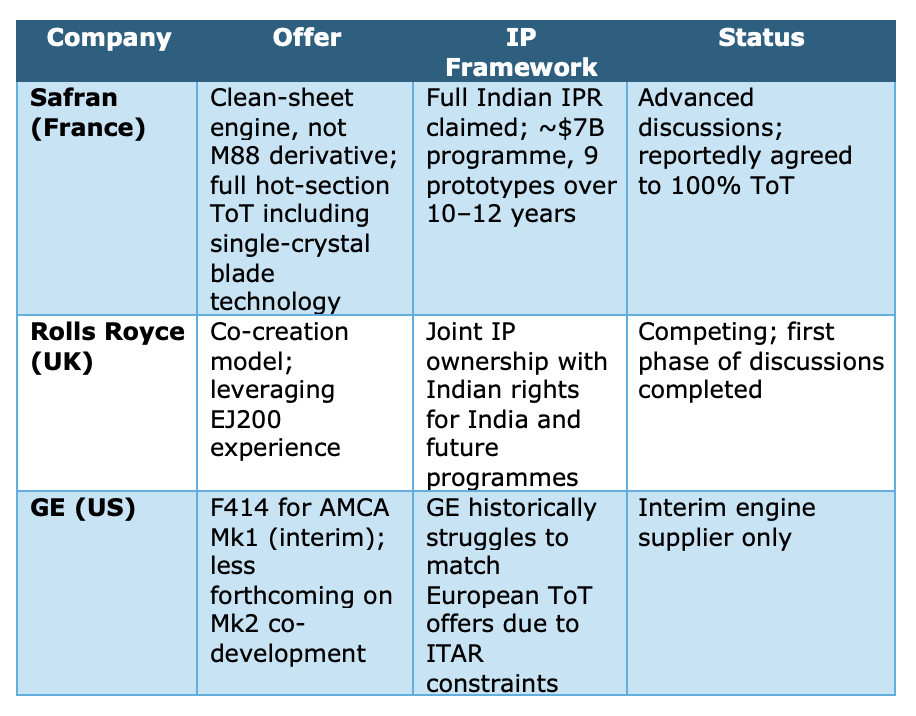
For the AMCA, Gas Turbine Research Establishment (GTRE) has set non-negotiable terms: 100% IPR and complete Transfer of Technology (ToT) for any co-developed engine. The stakes are enormous — the AMCA Mk2 needs a 110–130 kN class powerplant capable of supercruise, stealth compatibility, and thermal management for future directed-energy weapons.
Three contenders have been in the frame:
This is where independent analysts need to distinguish between attribution and inference, rather than dismissing claims outright for lack of formal documentation.
According to an anonymous former GTRE official, the Kaveri–M88 hybrid discussions during the 2009–2013 period stalled in significant part over Safran’s insistence on retaining IP rights over the M88-2 engine core. While this claim cannot be independently verified from publicly available records, it is plausible and consistent with how global aero-engine OEMs have historically safeguarded hot-section design, materials, and manufacturing processes.
That said, pinning the collapse of the collaboration solely—or “precisely”—on IPR retention misses the bigger picture. What actually derailed the effort was a combination of factors: unease about locking India into a single foreign vendor, an unresolved thrust shortfall, hard disagreements over commercial terms, and the Kaveri programme’s own stop-start history, which lurched repeatedly between revival and near-abandonment.
To put numbers on that problem: a 2015 CAG report recorded the Kaveri’s achieved thrust at about 70 kN against a requirement of 81 kN. Later figures—72 kN and, after further iterations, 83–85 kN—were cited by DRDO Chairman Dr Samir V. Kamat in February 2026. Even taking those improvements at face value, the engine still sat well below the IAF’s Mk-2 requirement band of roughly 90–96 kN. In other words, the partnership did not fail because of a single IP dispute; it failed because too many technical, commercial, and institutional gaps remained unresolved, at the same time.
Safran is also reported to have demanded a minimum order of 300 engines, misaligned with IAF requirements, and a so-called “technical audit” of Kaveri during the 2016 Rafale deal was viewed with suspicion by GTRE insiders. The subsequent 2016–2018 engagement under Rafale offset obligations—culminating in a Safran audit that cleared Kaveri for flight testing—temporarily revived expectations. Yet some GTRE personnel have privately characterised this phase as largely performative, aimed at meeting offset optics rather than resolving foundational capability constraints.
While such accounts remain anecdotal and lack formal corroboration, they reflect a persistent institutional scepticism within India’s aero-engine ecosystem toward foreign technology-transfer commitments—an accumulated judgement that policymakers would be unwise to ignore.
The question India must ask is not whether a foreign partner offers full IPR, but whether the contractual, technical, and institutional architecture exists to enforce it. The difference between “100% ToT” as a headline and “100% ToT” as an auditable, legally enforceable, technology-milestone-linked contractual obligation is the difference between sovereignty and dependence dressed up as partnership.
Layer 2: The Silent Dependency — Design and Simulation Software
This is arguably the most underappreciated IP vulnerability in the entire AMCA programme. India is the world’s second-largest market for Dassault Systèmes’ CATIA and Siemens NX. Every AMCA airframe design, every computational fluid dynamics simulation, every finite element analysis of structural loads — all run on foreign-owned software platforms.
The tools in question are not commodities. CATIA (Dassault Systèmes, France), ANSYS (US), Siemens NX (Germany), and the electronic design automation (EDA) suites from Cadence and Synopsys (both US) collectively form the digital spine of Indian aerospace engineering. India owns none of the IP behind these tools. A revocation of export licences — whether through ITAR-adjacent controls, entity-list designations, or even commercial disputes — could freeze critical programmes.
Some dismiss this as overblown. As one commentator on the Indian defence forums noted, “3D CAD solutions are readily accessible from multiple vendors, and many offer lifetime licences”. This is technically true but strategically naive. The issue isn’t access to a generic CAD package — it’s the ecosystem lock-in: decades of design data, validated simulation models, custom toolchains, and institutional knowledge all encoded in proprietary formats. Migrating mid-programme from CATIA to an alternative would be akin to changing the language of a PhD thesis halfway through.
India did once create something remarkable in this space. The Aeronautical Development Agency (ADA) developed AUTOLAY, a composites design software built in-house for the LCA’s composite structures, which was good enough to beat international competitors in Airbus benchmarking and be exported along with its IP. In 2001, AUTOLAY was licensed for use on the A380 programme in a US$3.2 million deal routed through Parametric Technology Corporation (PTC), after ADA had already transferred the product and its intellectual property rights to Infosys for global commercialisation.
But ADA was not the right institutional vehicle for commercialising and evolving a software product. Autolay was allowed to wither as commercial CAD vendors built their own composite modules. That missed opportunity represents a broader pattern: India generates pockets of world-class IP but lacks the institutional ecosystem to sustain, scale, and protect it.
Layer 3: Source Code Sovereignty — The Rafale Lesson
The Rafale programme offers a textbook case study in what happens when you buy hardware without owning the software IP. Dassault Aviation has refused to share the Rafale’s source code — the software governing the RBE2 AESA radar, the Modular Mission Computer, sensor fusion, and weapons integration. The consequences are direct and operational:
– India cannot integrate the Astra BVRAAM or Rudram anti-radiation missile without French assistance
– Every software-level modification requires going back to Dassault, adding cost and delay
– Dassault’s commercial incentive (protecting MBDA’s missile sales) directly conflicts with India’s sovereign weapons integration goals
For the AMCA, this lesson must be internalised at the foundational design stage. The mission computer architecture, sensor fusion algorithms, electronic warfare libraries, and weapons integration software must all be developed under Indian IP ownership — not as an afterthought or contractual addendum, but as a core programme requirement.
Notably, even within the Indian system, source code ownership has been contested. HAL does not own the source code for the Tejas mission computer — ADA retains it, and the transfer process for even minor modifications has been institutionally cumbersome. The AMCA programme, by engaging private sector firms like Tata and L&T as development partners, introduces an additional layer of complexity: who owns what IP when the development is funded by the state, executed by private industry, and the design authority sits with ADA?
Layer 4: Radar, Semiconductors, and the GaN Frontier
DRDO’s development of an indigenous Gallium Nitride (GaN)- based AESA radar (the Uttam family, including the Virupaksha variant for the Super Sukhoi programme) is one of India’s genuine IP success stories. GaN technology offers higher power efficiency, greater detection range, improved jamming resistance, and better thermal management than older Gallium Arsenide (GaAs) systems. The AMCA will carry this indigenous radar.
But the Rafale fleet cannot be retrofitted with the indigenous GaN radar because French IPR on the airframe and its avionics integration architecture prohibit such modifications without Dassault’s consent and re-certification. This is a vivid illustration of how foreign IP constraints can persist for decades after procurement.
Deeper in the stack, India’s semiconductor IP position remains structurally weak. India employs nearly 20% of the world’s semiconductor design workforce, but most of the IP they create belongs to multinational corporations. The Design Linked Incentive (DLI) scheme has sanctioned 23 chip-design projects and enabled indigenous RISC-V microprocessors (Shakti from IIT Madras, Vega from C-DAC), but the EDA tools themselves — Synopsys, Cadence — remain foreign-owned. Minister of Electronics and IT, Mr Ashwini Vaishnaw, has flagged sovereign access to EDA tools via C-DAC as a priority, but the gap between policy aspiration and deployed capability remains wide.
For the AMCA’s AESA radar, electronic warfare suite, and mission systems, the question is: how deep does indigenous IP go? Owning the radar design is necessary but not sufficient if the GaN MMIC fabrication process, the signal processing algorithms, or the packaging technology relies on foreign-controlled IP at any critical node.
Layer 5: Stealth — An Indigenous Bright Spot with Caveats
Stealth coating is among the most closely guarded technologies globally — only the US, China, and Russia have operationally deployed it. India’s progress here is genuinely impressive. IIT Kanpur has developed Anālakṣhya, a metamaterial-based radar-absorbing coating that absorbs over 90% of radio waves across a broad frequency spectrum, with over 90% of ingredients sourced domestically. DRDO has also developed specialised chemical-handling processes to maintain stealth coatings under operational conditions. The technology has been handed to Meta Tattva Systems Pvt Ltd. for production.
However, stealth is not just coating — it is an integrated system: airframe shaping, edge alignment, internal weapons bay design, infrared signature management, engine exhaust masking, and maintenance protocols. The IP challenge in stealth is that validated performance data (actual RCS measurements across frequency bands and aspect angles) is extraordinarily sensitive and difficult to benchmark without access to adversary or allied stealth programmes for comparison. India is building its own RCS measurement infrastructure (DRDO’s Orange facility), but the validation cycle will be long.
The Comparative Lens: How Others Have Handled Fighter IP
India’s IP challenges look sharper when juxtaposed with how peer nations have structured their fifth- and sixth-generation programmes:
South Korea’s KF-21 Boramae adopted a pragmatic dual-path approach — combining indigenous development with proven international subsystems. Critically, KAI localised and internationally standardised the aircraft’s middleware layer, which acts as a translator between hardware and mission applications. This middleware architecture allows the KF-21 to bypass restrictive ITAR regulations by enabling integration of non-US components with reduced technical friction. The result: a capable 4.5-gen fighter at 30–40% lower unit cost than Rafale or Eurofighter.
The GCAP programme (UK-Japan-Italy) was explicitly designed as a reaction to the F-35’s IP limitations. Its foundational principles are Freedom of Action (FoA) and Freedom of Modification (FoM), which guarantee each partner full operational and technological sovereignty over the core platform. Italy, which had only a 21% share in Eurofighter and faced “black boxes” in F-35, insisted on an equal 33.3% partnership with full technology access. The GCAP Joint Venture (BAE Systems, Leonardo, JAIEC/MHI) co-owns all core IP, and each nation can modify the aircraft without the other partners’ veto.
Turkey’s Kaan programme, born from expulsion from the F-35 programme over the S-400 purchase, demonstrates both the opportunity and the difficulty of forced IP independence. Turkey is developing an indigenous engine (the TEI TF-35000) but is temporarily relying on GE engines. The programme has already secured a $10 billion, 48-aircraft export deal with Indonesia. Indonesia, having watched Turkey’s expulsion from the F‑35 and the leverage US export controls create, is now explicitly demanding an ITAR‑free KAAN configuration to escape American veto power over its own fleet. demonstrating that IP ownership translates directly into export freedom.
The Structural Deficit: India’s Innovation Ecosystem
The AMCA’s IP challenges cannot be divorced from India’s broader innovation ecosystem, which has systemic weaknesses:
– R&D spending at 0.67% of GDP compares poorly with South Korea (4.8%), China (2.4%), and even the global average
– 74% of patents granted in India go to foreign entities, reflecting that India remains primarily a site of execution rather than the origination of IP
– Average patent approval time is 58 months — versus 20 months in China and 21 months in the US
– 42-month patent pendency and complex licensing create regulatory friction that discourages domestic IP filing
- India’s defence-industrial base has historically been optimised for licence production and assembly, not for originating and owning core technology
The gap between China’s J-20 programme (approximately 250 aircraft produced, with production rates of 30–100 per year) and India’s AMCA (the first prototype still years away) is not merely one of schedule — it reflects a fundamentally different scale of national investment in the IP-to-production pipeline.
What Keeps This Analyst Awake: Five Unresolved IP Questions
1. Contractual enforceability of engine ToT: When Safran or Rolls-Royce promises “full IPR,” what happens at Technology Readiness Level 6–7 when the most sensitive metallurgical and manufacturing process IP is due for transfer? What are the contractual penalties for non-delivery, and does India have the institutional capacity (within GTRE or a private partner) to absorb and replicate the technology?
2. Software sovereignty in a cloud-dependent world: As aerospace design tools increasingly move to cloud-based, subscription-licensed models (Dassault’s 3DEXPERIENCE, Ansys Cloud), the dependency deepens. A licence isn’t just a product — it’s a service that can be turned off. What is India’s contingency plan?
3. IP ownership in the ADA–private sector partnership: With Tata, L&T, and Bharat Forge as development partners, how will background IP, foreground IP, and sideground IP be allocated? Will the private partner own the manufacturing process IP? Will ADA retain design authority IP? Who controls export rights for derivative technologies?
4. Semiconductor supply chain for AESA and EW: India’s GaN MMIC fabrication at GAETEC is a beginning, not an arrival. The packaging, testing, and qualification infrastructure for defence-grade semiconductors is still nascent. A single foreign-controlled node in the semiconductor supply chain can negate years of radar development.
5. The time factor: China’s J-20 is operational. The J-35 is being offered to Pakistan. The J-36 has been tested. India’s AMCA won’t enter service before 2035 at the earliest. Every year of delay is a year during which the adversary’s IP matures, and the threat environment evolves. IP acquisition is not just a legal and commercial challenge — it is a race against strategic obsolescence.
The Way Forward: From Aspiration to Architecture
The AMCA programme has, to its credit, made IP ownership a stated priority across engines, radar, and stealth. But stated priorities and structural outcomes are different things. India needs:
– An IP governance framework for AMCA analogous to GCAP’s FoA/FoM principles — legally binding, milestone-auditable, and with teeth. This does not exist today in any publicly articulated form.
– A national aerospace software sovereignty roadmap that goes beyond C-DAC, providing EDA tool access to actually funding Indian-origin alternatives for critical design and simulation chains — learning from the Autolay failure.
– Deep institutional reform at GTRE to transform it from a research lab into an organisation capable of absorbing, industrialising, and iterating on transferred engine IP. The Kaveri programme proved that receiving technology and operationalising it are entirely different capabilities.
– A classified IP audit of the entire AMCA programme, node by node, identifying every point where foreign-controlled IP could become a chokepoint — and a funded mitigation plan for each.
– R&D investment commensurate with ambition: A country spending 0.67% of GDP on R&D cannot sustainably own the IP for a fifth-generation fighter ecosystem. The structural deficit in risk capital, patent infrastructure, and STEM talent pipeline is the foundation on which all other IP challenges rest.
The AMCA is not just an aircraft. It is a test of whether India’s defence-industrial ecosystem can transition from being a sophisticated assembler of imported IP to a genuine originator of sovereign technology. The engine deal headlines will come and go. The real measure of success will be whether, in 2040, an Indian engineer can modify the AMCA’s mission software, swap a radar module, or redesign an engine turbine blade — without asking anyone’s permission.
In an earlier essay in The Print, I argued that India needs a Defence Finance Corporation (DFC), an institution that converts annual budgetary allocations into structured, auditable, long-term capital for defence projects — with appraisal up front and money released only against milestones, not political hype. A DFC, I wrote, is a way of building credit and discipline, not just arsenals, so that Indian ambitions are channelled through governance rather than wishful thinking.
The AMCA programme needs an equivalent discipline on the technology side. Just as a DFC would scrutinise cashflows and risk before funding a shipyard or a missile line, India needs a formal IP and technology filter before it signs away the next three decades of engine, software, radar, or semiconductor dependence. The point is not to reject foreign partnerships, but to subject them to an institutional test: does this deal increase India’s freedom of action, or quietly mortgage it? If the DFC idea was about moving from “spending” to structured investment, an AMCA IP regime must move us from generic “indigenisation” to enforceable sovereignty. That, ultimately, is the only check and balance that counts.