Part 1 - From Everest Rhetoric to Design Authority: How India Uses Aerospace JVs
Part 1 of 2 – Helicopters, Assembly Lines, and the Old JV Reflex

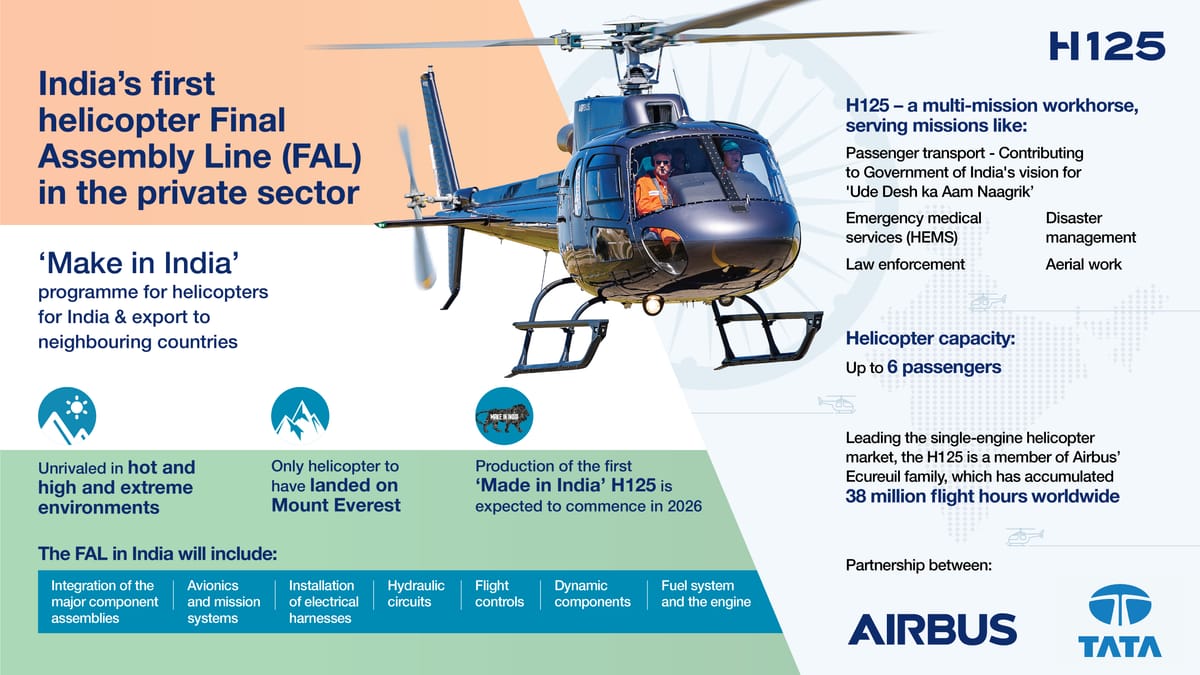
From Everest rhetoric to assembly line production
When Prime Minister Narendra Modi and President Emmanuel Macron virtually inaugurated the H125 helicopter line in Karnataka, the soundbite wrote itself: India and France would build in India “the world’s only helicopter capable of flying to the heights of Mount Everest” and export it to the world.
The spectacle neatly fused national pride, Make in India and the romance of high‑altitude flying. But if we stay in the realm of slogans and service‑ceiling arguments, we miss the more consequential story: India is quietly re‑wiring its aerospace partnerships.
What we decide now—on H125s, C295s, Russian transports and the AMCA engine—will determine whether these deals lead to learnings in design and certification or just shiny certificates of participation in someone else’s supply chain. The H125 is the clearest entry point into that question.
The H125: workhorse, not miracle
The H125 is not a miracle machine, nor is it uniquely capable of “Everest heights” as the political rhetoric suggests. It is, however, exactly what India’s over‑stretched rotary‑wing fleets have desperately needed: a modern, high‑hot light helicopter that can do the everyday, unglamorous work safely.
For decades, the Indian military has flown Cheetah/Chetak fleets that are 30–50 years old, accumulating a grim safety record and reputation as they aged, despite their yeoman service. These machines were never meant to be immortal; keeping them aloft through endless life extensions carries a human cost that rarely figures in budget spreadsheets. The H125, by contrast, brings FADEC engines, better power margins, modern avionics, improved operational and safety performance and global support experience to missions India actually flies: Siachen support, casualty evacuation, logistics and liaison, not stunt landings on 8,848‑m peaks.
That matters. Law‑enforcement agencies, EMS operators, tourism companies and military units in more than 30 countries already use the H125 family as a standard workhorse, including U.S. Customs and Border Protection, which chose it as a dedicated law‑enforcement upgrade. Even if one quarrels with the Everest hyperbole, replacing aged airframes and engines with a widely proven, supportable workhorse is an operational relief India can no longer postpone.
The H125 (AS350 B3e) is already a best‑selling light single in China’s general aviation market, with over 120–125 H125/H130 family helicopters in operation and close to half the light‑single turbine segment. What China does not have, so far, is an H125 Final Assembly Line (FAL). Airbus’s helicopter FAL in China is for the H135, not the H125. That is the contrast with India: China is a significant H125 customer and support hub, but India is where Airbus is now locating an H125 FAL for regional supply. For the uninitiated, a FAL is the facility where major sub‑assemblies are brought together, integrated, tested and flight‑certified before delivery.
Existing H125 FALs are located in Marignane (France), Columbus, Mississippi (United States), and Itajubá (Brazil), with Vemagal in Karnataka now hosting the fourth such facility. The Indian FAL is mandated to assemble, integrate and test H125s for the domestic market and for exports to South Asian customers, following the same processes and EASA‑standard quality benchmarks as Marignane. Its planned throughput begins at roughly 10 helicopters a year, with a cumulative target of about 500 aircraft over the next two decades—a projection that is explicitly market‑driven and will depend on realised demand from civil, parapublic and defence users in India and the wider South Asian region.
The natural next question is: what does this new capacity sit alongside in India’s wider aerospace landscape?
Karnataka and Vadodara: two assembly lines, one industrial question
The H125 line at Vemagal is India’s first private‑sector helicopter FAL destined for Indian (and South Asian) civil and security customers, with a military H125M variant also being pitched from the same site.
Coupled with the C295 transport programme in Vadodara—where Tata Advanced Systems (TASL) and Airbus are building the first complete aircraft production system deployed by Airbus outside its home countries—the H125 line puts Tata at the heart of India’s emerging aerospace manufacturing base.
Taken together, the two programmes mark Tata’s evolution from an offset beneficiary to a structurally integrated Airbus partner across both fixed‑ and rotary‑wing segments, participating in the global supply chain rather than just in India‑specific assemblies.
Airbus, for its part, already sources roughly $1.5 billion in components and services annually from more than 40 Indian suppliers and has signalled plans to double this as order books swell. These suppliers range from aerostructures to engineering services; Mahindra, for example, is building aerostructures for helicopter programmes that feed into global H125/H130 lines. In other words, the H125 and C295 lines are not stand‑alone tokens—they sit atop an expanding stack of Indian companies quietly climbing Airbus’ value chain.
None of this, by itself, delivers indigenous design authority, and the “assembly cul‑de‑sac” risk is real. But it does put multiple Indian firms on higher rungs of the ladder—positions that could, if we insist on it, be leveraged into design and certification capability rather than frozen as permanent build‑to‑print shops. To see why that matters, it helps to set this new Tata–Airbus pattern against the older HAL–Russia reflex.
HAL’s Russian detour: the old JV reflex
While the Tata–Airbus story signals a new pattern, Hindustan Aeronautics Limited (HAL) seems to be walking a familiar path with Russia. The now‑terminated Multi‑Role Transport Aircraft (MTA/Il‑214) was once pitched as a joint Indo‑Russian medium‑transport that would replace India’s An‑32s, with HAL promising 45 aircraft for the IAF, 105 for Russia, and exports beyond. The programme never got off the ground, and India eventually turned to the C295 instead.
Yet fresh Russian proposals keep surfacing—re‑imagined Il‑276 transport aircraft, new pushes for Russian medium‑lift solutions, and, more concretely, HAL’s 2025 MoU to assemble and localise the Sukhoi Superjet‑derived SJ‑100 regional jet in India. Under that pact, HAL is to obtain production rights and technical data, with Russia providing design support and access to its line. Officials present this as another Aatmanirbhar success, while veterans cannot forget the stillborn MTA.
Structurally, these HAL–Russia arrangements follow the classic PSU‑led Joint Venture (JV) template: a foreign design, Indian series‑production rights, optimistic talk of exports, and relatively opaque details on Intellectual Property (IP), digital tools and the certification authority.
They are heavy on promises of “full technology transfer” but light on verifiable milestones that would tell us whether HAL is actually gaining the ability to design and certify a new aircraft family end‑to‑end.
The Ka‑226T saga shows how that template collides with the hard realities of engines, sanctions and IP.
Kamov‑226T: a cautionary tale in three flags
A decade before the H125 line in Karnataka, India had already “chosen” its Cheetah/Chetak replacement—and it wasn’t an Airbus helicopter. In 2015, the defence ministry shortlisted the Kamov Ka‑226T, a compact, contra‑rotating light utility helicopter, as the Indo‑Russian solution for high‑altitude and utility roles, with a plan to build 200 machines under a Make in India JV. A HAL–Russian Helicopters JV was registered in India, tasked with final assembly, overhaul and integration of an Indian supply chain, and early statements talked of rolling out up to 35 helicopters a year from a new facility.
On paper, the Ka‑226T with its coaxial rotor system promised good performance in high‑altitude, confined‑area operations; it was already flying in Russia with modern avionics; and the Indo‑Russian JV structure looked like a familiar, politically comfortable template. The catch lay in the engine. The “T” in Ka‑226T is for Turbomeca: the helicopter is powered by twin Safran/Turbomeca Arrius 2G1 engines, which gave it a performance edge but also brought a third flag—France—into what had been sold as a straightforward bilateral JV.
That third flag turned into a veto. As India pushed for high indigenous content and technology transfer, it became clear that the Arrius engines were outside the core Indo‑Russian ToT package and that Safran was unwilling to provide deep engine technology transfer for a Russian airframe, particularly once Western sanctions on Russia tightened after 2014 and again post‑2022. Moscow, for its part, could not offer what it did not own, and New Delhi was no longer willing to sign another long‑term assembly deal with a black‑box engine and no clear localisation path. The result was a stalemate: JV on paper, site visits and handshakes, but no production line.
Today, Russia is trying to revive the offer by proposing a re‑engined Ka‑226 variant with the indigenous VK‑650V engine, promising that this would finally allow full localisation in India. But the moment has largely passed. The Army and Air Force are converging on HAL’s indigenous Light Utility Helicopter (LUH) and on new H125‑class options. The Ka‑226T has become a textbook example of how not to structure Make in India, with engine and IP questions left to the fine print, ToT treated as a slogan rather than a negotiated matrix, and a three‑cornered dependency (India–Russia–France) that no one fully controlled.
That brings us back to the H125 and LUH, and to what we should really be comparing.
H125, Cheetah/Chetak and LUH: asking the right comparison
Even if one chooses to benchmark it against India’s legacy high‑altitude workhorses—the Cheetah, Chetak and the upgraded Chetal—the H125 more than holds its own. It combines a modern engine–rotor system, proven “Everest‑sector” credentials, and a far more capable overall airframe.
The Chetal, after all, is essentially a re‑engined Cheetah fitted with the more powerful Turbomeca TM 333‑2M2 and upgraded avionics. It was designed to claw back payload and safety margins for Siachen‑type conditions, yet it remains constrained by its ageing Lama‑derived fuselage and legacy transmission limits.
The more meaningful comparison, therefore, is not with these retiring platforms but with HAL’s Light Utility Helicopter (LUH)—purpose‑designed as their successor and itself validated in Ladakh–Siachen hot‑and‑high trials. LUH itself was pushed through a long, HAL‑dominated monopoly pipeline into what is effectively a MoD monopsony, with the services as captive customers. It now has to earn its place on merit: until it racks up a clean operational record, reliability and trust remain perceptions to be earned, not presumptions to be granted.
In that peer set:
LUH offers higher payload margins and greater cabin volume, optimised for military utility missions.
H125 delivers superior range and cruise speed, along with access to a mature, global civil support ecosystem.
The real question, therefore, is not whether the H125 outperforms the Cheetah family. It appears to do so. The strategic issue is whether India is comparing like with like: a legacy replacement on one side and a wider ecosystem choice on the other, and what role the “Made in India” H125 might play in injecting long‑absent competition into a historically protected defence‑industrial system.
This is where the discussion naturally shifts from individual helicopters to the deeper question of who controls engines, tools and certification.
Industrial sovereignty dimension
Beyond performance metrics lies the deeper question of industrial sovereignty.
If the H125 line in India remains primarily an assembly node within Airbus’ global architecture, then India gains production exposure but not design authority, certification control or core intellectual ownership. By contrast, LUH—whatever its current limitations—anchors aerodynamic design, systems integration and future upgrade pathways within India’s own ecosystem.
In other words, the comparison is not simply about payload, range or altitude performance. It is about whether India wants to remain a highly capable participant in someone else’s production chain, or progressively build the institutional competence to define and evolve its own rotorcraft lineage over decades.
Set against that backdrop, the H125 line in Vemagal and the LUH’s slow but real progress are not just new programmes; they are course corrections. They reflect, however imperfectly, an emerging recognition that engines, digital design tools and certification authority must be solved up front, and that any future JV—whether for helicopters, transports or AMCA’s engine—must be built around those hard questions, not wrapped around them.
Before we turn to IMRH and AMCA, it helps to look at the one place where India has already tried to climb that ladder: Shakti.
Shakti: India’s first engine on the learning ladder
Before turning to IMRH and AMCA, it is worth recalling that India and Safran have already travelled part of this road.
The Shakti turboshaft, derived from Safran’s Ardiden 1H1, was co‑developed by Turbomeca (now Safran Helicopter Engines) and HAL’s Aero Engine Research and Design Centre (AERDC). It powers the ALH Dhruv (later series), the Rudra, the Light Combat Helicopter (LCH) and the Light Utility Helicopter (LUH). Production and MRO were progressively localised in Bengaluru as part of a long‑running partnership. By the mid‑2020s, several hundred Shakti engines had been produced in India. Local content had steadily increased. New Delhi and Safran had announced plans for a deeper technology‑transfer package. Official rhetoric even points toward near‑complete domestic manufacture of the Ardiden 1H1/Shakti family over time—including critical hot‑section components and control systems.
Shakti is not an Indian clean‑sheet design. Nor has its evolution been rapid. Yet it is far removed from screwdriver assembly. India has progressively moved from integrating imported core modules to domestically machining and casting key components, qualifying parts under Indian industrial standards, operating joint Safran–HAL support structures, and running dedicated engine test cells in‑country.
Unlike certain Russian‑origin fleets and joint ventures that have experienced sanction‑induced supply disruptions and programme delays, Shakti sits on a progressively localised production and MRO base in India, designed to mitigate that kind of sustainment paralysis—even if the system has yet to be stress‑tested under comparable geopolitical pressure.
Taken together, H125, LUH and the Kamov saga show that India has finally begun to ask harder questions about engines, IP and who truly owns a platform’s future—without yet fully answering them. The Shakti turboshaft hints at one possible path up the learning ladder, but it also exposes how slow and partial that climb has been.
Part 2 turns to the emerging ‘middle’ of India’s helicopter plans—IMRH and its naval sibling—and to the AMCA engine debate, to ask whether New Delhi is now prepared to hard‑wire design authority and learning milestones into its biggest aerospace partnerships from the very start.