Part II - India’s Defence Budget in an Age of Strategic Compression
The Continental Bias We Rarely Acknowledge

Reading the Defence Budget Through Access
In Part I, I argued that the India–EU FTA is strategic infrastructure—a hedge against a world in which access can be denied. The question now becomes harder: are we funding the capability required to insure that hedge?
When we look beneath the aggregate, however, a familiar pattern reappears.
Capital outlay may have crossed ₹2.19 lakh crore in 2026–27 — a healthy increase over the previous year. Roughly ₹1.85 lakh crore is earmarked for capital acquisition — the aircraft, ships, submarines and systems that actually shape future capability. The Ministry of Defence receives about ₹7.85 lakh crore overall, just under 2% of GDP and around 15% higher than last year’s Budget Estimates.
On paper, this is not a starved budget. It is a modernising one. Structure matters more than aggregates.
In 2026–27, out of a total capital outlay of ₹2,19,306 crore, the single largest capital head is aviation : aircraft and aero‑engines receive ₹63,734 crore — about 29 per cent of the defence capital budget — funding fighters, transports, helicopters and UAVs. Army modernisation, largely under the broad “other equipment” category, accounts for roughly 36 per cent of capital outlay — around ₹80,000 crore — covering artillery, air defence, drones and networked systems. By contrast, the naval fleet head — which must finance surface combatants, submarines and support vessels — stands at about ₹25,000 crore, or 11 per cent of the capital budget, significantly smaller than the aviation allocation.
Because capital spending is organised under functional heads, these figures are category-based rather than strictly service-wise. In practice, though, aviation spending is largely Air Force-driven, while the fleet head overwhelmingly funds the Navy. Annual numbers will always reflect payment cycles and contracts signed years earlier. But when the capital mix repeatedly tilts in certain directions, it begins to say something about priority. Budgets may be technical documents — but over time, they reveal where the state is willing to place sustained weight.
How marginal capital is distributed, year after year, often reveals more than formal strategy documents, particularly when those documents are absent or ambiguous.
Aviation’s large share in recent defence capital plans has to be read in the context of impending MRFA decisions and the AMCA pathway. The really heavy MRFA and AMCA outflows lie ahead, once contracts and production lines are locked in. In the interim, a substantial portion of capital has flowed to HAL and aviation projects, sometimes faster than industrial absorption can comfortably handle. HAL is understood to have not progressed beyond the EOI stage in the AMCA case because its existing order book and capacity constraints were judged too heavy.
If this current pattern is a bridge to recapitalising a shrinking fighter fleet and building genuine design authority at home, it may be strategically justifiable. If it hardens into a long cycle of import‑heavy or single‑vendor‑heavy absorption later, it could quietly squeeze maritime expansion and investment in emerging domains just when they, too, may need momentum.
Even the headline numbers thin out once we strip away the optics. A defence outlay hovering around 2% of GDP is politically defensible, but strategically minimalist once adjusted for inflation, rupee depreciation, and the reality that a significant share of the capital budget is pre‑committed to past contracts. “Committed liabilities” and foreign‑currency exposure quietly consume much of what appears to be fresh modernisation space. What looks like expansion is often more rollover rather than renewal.
Reading the defence budget solely by its aggregate increase is, therefore, as misleading as reading the India–EU FTA solely through projected export gains.
The structure is the story. And the structure reveals something deeper. India thinks continentally.
We instinctively visualise security through land borders, mountains, and territorial defence. Partition, repeated wars with Pakistan, the unresolved boundary with China, and the trauma of 1962 have reinforced that instinct. It is not irrational. It is inherited.
But India lives maritimely.
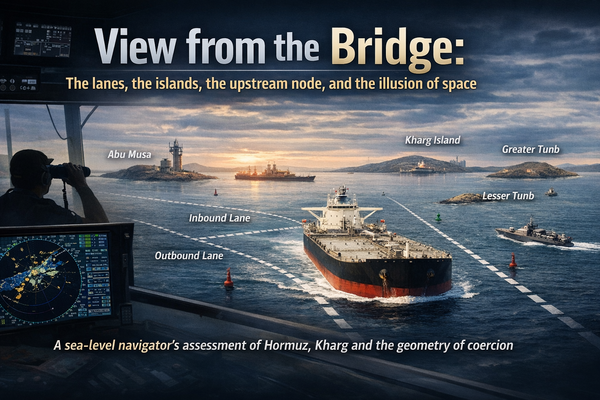
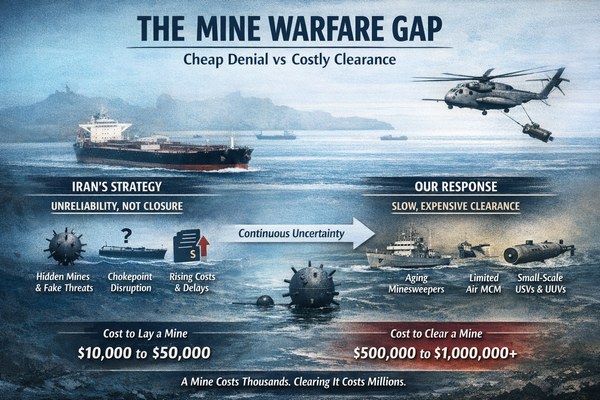
Energy flows through the Strait of Hormuz and the Malacca Strait. Undersea cables carry our digital economy. Pharmaceutical exports, services revenues, and manufacturing ambitions are all lashed to sea routes. Europe, East Asia, Africa — all connect to us through water.
The Indo‑Pacific is not a slogan. It is our economic bloodstream.
Yet when we examine the internal structure of our defence spending, the gravitational pull remains continental. Recent budgets have increased overall outlays and accelerated aviation modernisation. Land infrastructure — particularly roads to the northern borders — has rightly received attention. Border connectivity has improved.
All of this is defensible. What is missing is proportionality.
When we place the naval share of capital spending against the scale of our trade exposure and our own Indo‑Pacific rhetoric, a deeper question emerges.
Are we aligning economic strategy with the security of access? Or are we celebrating maritime agreements while funding primarily continental reflexes?
The issue is not that any particular service is “over‑funded” or “under‑funded” in isolation. The issue is that the mental map driving allocation appears anchored in yesterday’s vulnerability pattern.
We still behave, fiscally, as if India’s principal strategic risk is a replay of 1965 or 1971 — a conventional land conflict at scale — rather than a prolonged, system‑wide contest over sea lanes, chokepoints, undersea infrastructure, and the coercive use of interdependence.
That is not an inter‑service critique. It is a strategic coherence critique.
If the India–EU FTA reflects an understanding that access to markets, supply chains and sea routes now underpins prosperity, then defence posture must account for the same reality.
Thucydides would have recognised the danger in a gap between exposure and capability. Grotius would have cautioned that rules without credible enforcement gradually erode. Mahan’s insight was more direct: commerce depends on secure seas.
As India’s economic interests become more maritime, while its fiscal structure remains largely continental, a structural imbalance risks emerging. Such imbalances tend to persist unless deliberately corrected.
To understand why this pattern endures — and what it implies in a system shaped by both China and the United States — we need to widen the lens. Geography influences threat perception; budgets reveal allocation choices.
In Part III, I examine whether India’s strategic posture is keeping pace with its economic transformation.