Part III - India’s Defence Budget in an Age of Strategic Compression
Strategic Autonomy Is Maritime — Not Continental

India, China, America, and the Geography of Power in a Fractured World
In Parts I and II, we examined access and allocation — how trade exposure and capital outlays signal strategic intent. But budgets are shaped by something deeper than spreadsheets. They are shaped by instinct. And, as Professor S. C. M. Paine of the U.S. Naval War College reminds us, strategic instinct — the deep habits formed by geography and history — often shapes grand strategy more powerfully than rhetoric does.
In her recent essay and interview in Foreign Affairs, Paine argues that great-power competition is not best understood as democracy versus autocracy, nor merely revisionists versus status quo powers. Rather, it reflects a recurring tension between maritime and continental powers. Maritime powers derive influence from trade, finance and open sea lanes; continental powers anchor security in territory, control and strategic depth. From this divide flow very different approaches to order, risk and resource allocation.
If that lens is correct, then defence budgets are not neutral accounting documents. They are strategic X-rays. They reveal whether a state’s instinct remains continental — concentrated on territorial defence and landward depth — or maritime, oriented toward securing trade routes, sea control and systemic access.
The question, then, is not whether we allocate capital. The question is whether the pattern of allocation aligns with the geography we depend on. And here, structure matters more than aggregates.
(See S. C. M. Paine, “By Land or by Sea Continental Power, Maritime Power, and the Fight for a New World Order,” Foreign Affairs, and her accompanying interview 'The Age-Old Contest Between Land and Sea')
There is a deeper layer beneath that arc — one that Paine has mapped with particular clarity. She argues that the central divide in global strategy today is not ideological but geographical: a centuries‑old contest between maritime and continental powers.
Geography, in this telling, does not just shape logistics or targeting; over time, it produces instinct — habitual ways of seeing security, risk, and opportunity that endure even as governments and slogans change.
Paine’s Frame: Continental Power vs Maritime Power
Paine argues that global competition repeatedly falls into a structural divide between continental and maritime logics. Continental powers inhabit crowded landmasses with multiple neighbours. Their primary threats are in the proximities. Power is measured in territory, buffers, and spheres of influence. Security is often zero‑sum.
Maritime powers, by contrast, are shaped by access. Their prosperity flows from trade routes and industry. They tend to view neighbours less as territorial threats and more as commercial partners. Security is networked rather than concentric. Continental systems seek insulation and fear encirclement; maritime systems seek optionality and fear access denial.
This distinction is not moral. It is structural. And it is highly relevant to the world we inhabit.
China: Maritime Muscle, Continental Mindset
China presents the most fascinating case in Paine’s framework. Economically, China is deeply maritime. Its growth since the 1980s has depended on open sea lanes, global trade integration, energy imports, and export manufacturing. It is perhaps the single greatest beneficiary of the maritime order constructed after 1945.
Yet strategically, China’s instincts remain continental. Its security focus is landward: internal cohesion, border stability, buffer regions, sphere‑of‑influence consolidation. Even its maritime behaviour often reflects a continental logic — turning seas into extended frontiers, drawing lines, asserting control.
This creates tension. China depends on maritime access but seeks to shape it in territorial terms. Its naval expansion is not merely about keeping routes open; it is also about controlling adjacent waters. Paine would argue that this duality — maritime dependence with continental instinct — produces structural friction. And friction generates anxiety in neighbouring states.
The United States: Maritime Power with Continental Temptations
Across the twentieth century and into the post‑1945 order, the United States effectively lived out a recognisably Mahanian sea‑power logic: it built and maintained global naval dominance, relied on alliances and overseas bases to protect trade and project force, and treated ‘freedom of the seas’ as a core principle of the order it led.
But Paine also warns that maritime powers can drift into continental reflexes — seeking control rather than access, coercion rather than coordination. Recent years have seen flashes of this drift: tariffs as primary instruments, transactional diplomacy, open discussion of leverage through geography and supply chains.
When a maritime hegemon adopts continental tactics, instability increases — not because power disappears, but because predictability erodes. That erosion is precisely what middle powers feel most acutely.
India: Continental Memory, Maritime Destiny
India sits between these models. Our strategic inheritance is continental. Partition, border wars, unresolved boundaries — these experiences hardwire territorial sensitivity into our thinking. We visualise vulnerability through mountains and land corridors.
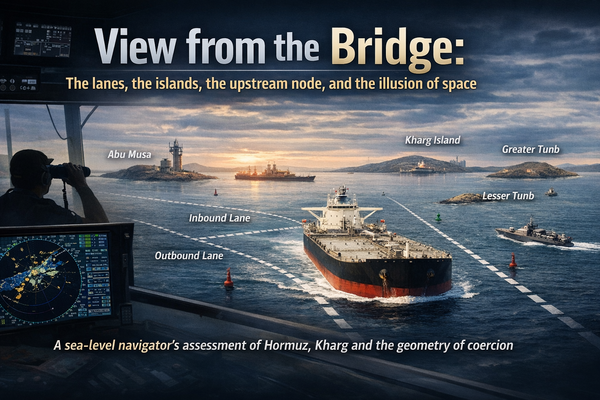
But our economic reality is maritime. Energy flows through Hormuz and Malacca. Undersea cables carry our digital economy. Trade exposure defines our growth. The Indo‑Pacific is not theoretical — it is our operating environment.
Unlike China, India does not seek territorial maritime control. Unlike the United States, India does not seek to underwrite a global system. India’s position is subtler. We depend on maritime openness, but we lack the luxury of geographic insulation. In Paine’s terms, India is a continental state living in a maritime economy. And that creates a choice.
The Larger World View: A System in Transition
Globally, we are witnessing something more complex than a new Cold War. The post‑1945 maritime order has not collapsed. But it is under strain. Continental powers assert spheres of influence. Maritime routes are contested. Supply chains are securitised. Trade agreements are strategic hedges. Middle powers — from Europe to Japan to Australia — are recalibrating.
The India–EU FTA that I anchor this three-part essay to fits into this larger worldview. It is not an ideological bloc. It is not anti‑China. It is not anti‑America. It is a maritime adjustment — an attempt by two trade‑exposed actors to widen access and reduce vulnerability in a system where predictability is declining. That is precisely what maritime powers historically do when order frays: they build coalitions to keep routes open.
Strategic Autonomy Reframed
In this global setting, what does strategic autonomy mean? In a continental frame, it means insulation. In a maritime frame, it means no single actor can deny your access.
India’s behaviour increasingly reflects the second. We diversify our energy suppliers rather than rely on a single one. We pursue multiple trade agreements rather than depend on a single market. We maintain relations across geopolitical divides. We avoid formal blocs while expanding partnerships. This is not indecision. It is maritime rationality. But rhetoric must match posture.
The Budget as Geographic Evidence
If strategic autonomy is maritime, then fiscal allocation must reflect maritime exposure. This is where the conversation becomes uncomfortable.
India’s defence budget is growing. Capital outlay has risen. Modernisation is underway. But when we examine its structure — aviation allocations, land systems, border infrastructure — the continental gravitational pull remains powerful.
Again, this is not about interservice competition. It is about strategic alignment. If our prosperity is maritime but our fiscal instinct remains continental, asymmetry develops. China is attempting to secure maritime routes through expansion. The United States is recalibrating its maritime posture amid internal debate. India must decide whether its autonomy lies in guarding land borders alone or in ensuring access security across the wider Indo‑Pacific.
Paine’s warning is clear: maritime systems weaken when they neglect the capability required to defend access.
The Quiet Strategic Question
India does not need to dominate oceans. But it must be able to hold its own. That means the ability to secure sea lanes in crisis, to protect undersea infrastructure, to operate in coalition without dependence, and to ensure that access cannot be casually constrained.
Autonomy in a maritime world is not isolation. It is resilience through access.
Aligning Trade and Defence
The India–EU FTA is not merely about Europe. It is a signal that India understands the world is entering a phase where access is contested — where routes, standards, and supply chains are no longer politically neutral. It is a statement that India seeks to widen its options, reduce single‑point dependencies, and anchor itself in a rule‑based pocket of the global economy that still values restraint.
But signalling must be matched by structure.
If the FTA represents our economic bet on open routes and diversified partners, then our defence allocations must represent our security bet on keeping those routes open under stress. This does not require us to re‑litigate every line item. It requires us to ask different questions when we look at the numbers.
Does the budget move India meaningfully closer to securing critical sea lanes that underpin trade with Europe, East Asia, and Africa?
Does it build the surveillance, anti‑submarine capability, logistics, and repair capacity needed to protect undersea cables and energy flows?
Does it treat naval modernisation and maritime infrastructure as long‑cycle investments in national resilience, rather than as discretionary margins that can be squeezed when other pressures arise?
If the answer over time trends toward “yes”, then the FTA and the budget will begin to reinforce one another.
If the answer remains “not yet”, we will live with a widening gap between our rhetoric and our resources. This is not a call for naval exceptionalism. It is a call for alignment.
A continental state can, in theory, survive with territorial security alone. A maritime trading power cannot.
India is no longer an inward‑looking economy protected by import substitution. It is a trade‑exposed, energy‑dependent, digitally integrated Indo‑Pacific actor. Our strategic thinking — and our budgeting habits — must catch up with our economic geography.
The Budget as Grand Strategy
Viewed in isolation, the 2026–27 defence budget is a stabilising budget rather than a transformative one. It pushes capital outlay above ₹2.19 lakh crore, strengthens modernisation, and nudges procurement further towards Indian industry — all necessary steps in a difficult neighbourhood.
Viewed over a decade, however, it is part of a slow but discernible strategic turn. Since the mid‑2010s, the defence outlay has more than tripled in nominal terms, and the share of capital in total spending has risen steadily even as revenue and pensions continue to press from below. The pattern is cautious but clear: India is trying to move from a manpower‑heavy, land‑anchored force towards a more technology‑intensive posture that can operate across air, sea, cyber and space.
From a grand strategic perspective, the question is whether this gradual rebalancing can keep pace with the world India is entering. A live Line of Actual Control with China, a Pakistan whose core security outlook remains largely unchanged despite periodic crises and reform attempts, and a militarising Indo‑Pacific together impose simultaneous continental, maritime and technological demands that no budget, however generous, can fully satisfy. Choices are unavoidable.
If India continues to spread resources thinly across every legacy commitment, the result will be incremental power and enduring gaps. If, instead, we treat the India–EU FTA, the Indo‑Pacific rhetoric, and the maritime pieces of the budget as parts of a single design, we can gradually tilt the system towards what our geography already dictates: a continental state that has accepted its maritime destiny.
Budgets, in that sense, are grand strategy in slow motion. Each year’s line items look technical and constrained. Over ten or twenty years, they reveal whether a state has truly internalised the risks and opportunities of its time. India’s defence budgets are edging towards a maritime‑aware strategic autonomy.
The real test is whether we have the discipline to let that edge become a decisive tilt.
The Quiet Strategic Reckoning
Nations rarely lose because they lack courage. They lose because they misread geography. India’s geography is not only Himalayan. It is oceanic.
Our trade is oceanic.
Our energy security is oceanic.
Our data cables are oceanic.
Our economic future is oceanic.
Yet our strategic psychology remains shaped by mountains. There is nothing dishonourable in that inheritance. It reflects history.
But strategy is not memory. It is an adaptation.
The India–EU Free Trade Agreement signals that we understand something fundamental: access can be constrained; interdependence can be weaponised; predictability must be built, not assumed. That recognition is maritime in instinct. But recognition must be followed by alignment.
Thucydides reminds us that power reasserts itself.
Grotius reminds us that rules endure only when shared interest sustains them.
Mahan reminds us that openness survives only when backed by capability.
Paine reminds us that geography shapes instinct — and instinct shapes destiny.
India does not need to dominate the oceans. But India must be able to hold its own in them.
Strategic autonomy is not achieved by guarding every border more tightly. It is achieved when no single actor can choke your routes, dictate your access, or narrow your options. That is not a continental condition. It is a maritime one.
This is not a call for sudden rebalancing or service rivalry. It is a call for coherence. If India chooses to think maritimely while budgeting continentally, the gap will widen.
If India aligns access, allocation, and geography, strategic autonomy becomes durable rather than declaratory.
The India–EU FTA is one decision. The defence budget is another. Together, they reveal whether India is merely reacting to a changing world — or redesigning itself for it.