IRIS Dena: A Sailor’s Epitaph
A frigate’s last watch, and the quiet remaking of Iran’s navy

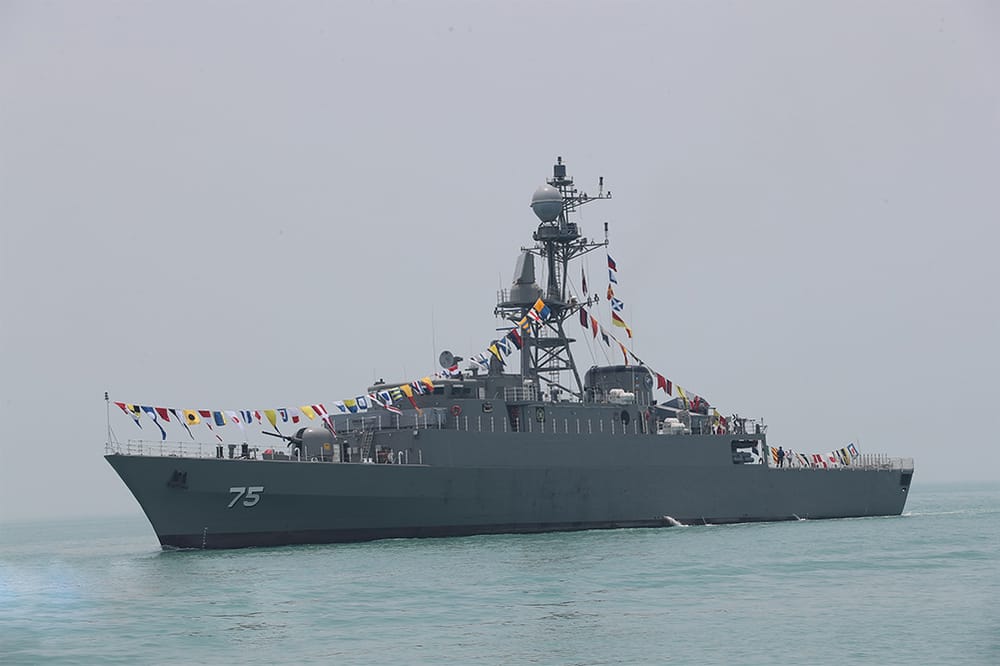
War at sea is often reduced to maps, missiles and headlines. But every sinking is also something else: a ship’s last watch, and the end of the lives of sailors who went to sea knowing that the ocean has never forgiven mistakes, nor spared those caught in war’s path. The loss of IRIS Dena in the Indian Ocean deserves to be remembered in that spirit first. Not as a talking point. Not as a triumph. But as the final chapter of a ship and her crew who sailed under orders into danger.
Thanks for reading नीतिविद्या | Nitividya – Strategy, Institutions, Power! This post is public, so feel free to share it
From Fleet Review to Fireball
IRIS Dena sailed to Visakhapatnam as a guest among other navies. Off Galle, she passed from a visiting frigate into a memory shared by all who go to sea.
Only days before her loss, IRIS Dena had been part of a scene that symbolised the opposite of war. The frigate had sailed to Visakhapatnam to participate in the International Fleet Review and the multinational naval exercise MILAN 2026, hosted by India and the Indian Navy, joining ships from across the world in the ritualised diplomacy of fleet reviews and naval gatherings. For Iran, Dena's presence was a statement: despite sanctions and isolation, its navy could still build ships, sail them far from home, and participate in the professional fraternity of the sea. For India, inviting Iran reflected a longstanding philosophy of maritime engagement: that the Indian Ocean should remain open, plural, and connected.
In such moments, ships represent more than themselves. They carry a nation’s flag, its sailors, and its claim to a place in the maritime world. But diplomacy at sea exists in the shadow of war.
Days after the fleet review ended, Dena was transiting south of Sri Lanka on her homeward passage when she encountered something that every ship fears and few ever see: a waiting submarine. Somewhere in those waters, a torpedo found its mark. Within minutes, the frigate that had stood quietly in a ceremonial line-up of ships became a wreck on the seabed of the Indian Ocean.
When the Ocean Turns Hostile
Against a submarine, a lone frigate fights at a cruel disadvantage — a ship and her crew exposed to a weapon designed to end the battle before they know it has begun.
Modern submarine warfare can appear mysterious from the outside, but its essentials remain brutally simple. Once a submarine manoeuvres into firing position, the outcome is often decided before the target ever realises it is under attack. A modern heavyweight torpedo detonating beneath a mid-sized frigate is not meant to damage a ship. It is meant to destroy it. The explosion creates a violent gas bubble beneath the hull. The ship lifts, the keel breaks, and the structure that holds the vessel together fails in seconds. Damage control — the proud art of sailors fighting to save their ship — rarely has time to intervene.
In that sense, the fate of Dena was not unusual in naval history. Ships have always been vulnerable to unseen enemies below the waterline. But the loss of this particular ship points to a larger story. Ships sink in war. Navies endure. To understand what Dena’s loss means, one must look beyond the wreck of a single frigate to the structure of the navy that sent her to sea.
Two Navies, One Maritime Strategy
Iran effectively operates two different maritime forces.
The first is the Islamic Republic of Iran Navy (IRIN) — the conventional navy that fields frigates, corvettes, submarines and auxiliary ships capable of sailing into the Indian Ocean and beyond. This is the navy that appears in international exercises and port visits, the navy that sent Dena to India.
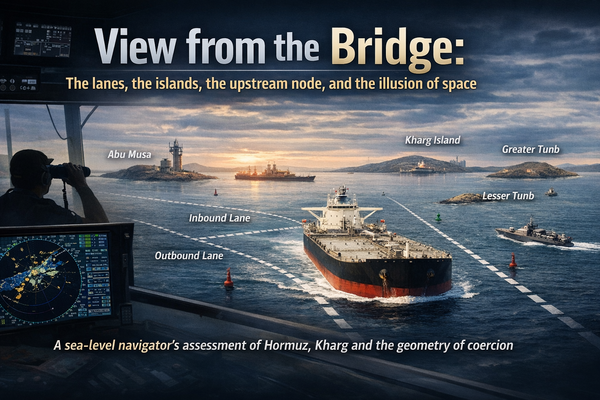
Alongside it exists another force: the Islamic Revolutionary Guard Corps Navy (IRGCN). This navy does not primarily seek blue‑water visibility. Its tools are different — fast attack craft, coastal anti‑ship missiles, mines, drones and small submarines concentrated in the confined waters of the Strait of Hormuz and the Persian Gulf.
Together, these two forces form Iran’s maritime strategy: a conventional navy that signals presence abroad, and a dense littoral force designed to deny adversaries easy access to regional waters.
The sinking of Dena, therefore, does not erase Iranian naval power. What it does is underline the vulnerability of the most visible part of that power — the ships that venture far from the protective umbrella of defences and layered sensors.
Under Sail and Sanctions: The Making of a Modern Iranian Navy
Iran’s surface fleet was never just about steel and sensors; it was about proving that a sanctioned state could still send its own ships into distant seas.
IRIS Dena, a Moudge‑class frigate built in Iran and commissioned in 2021, was one of those symbols — a compact warship carrying the weight of a larger political story. Dena did not stand alone in her vulnerability. Other Iranian frigates of her lineage — older Alvand‑class ships and newer Moudge‑class hulls — have also been damaged or lost in accidents and in war over the years. She and the other ships of her class were presented as proof that Iran could build, arm and deploy its own “destroyers”, even if the rest of the world quietly classified them as light frigates.
Yet the reality behind that symbolism was more fragile. These ships were derivatives of older designs, stretched and modernised under embargo, with incremental improvements in weapons and electronics but persistent gaps in area air defence and anti-submarine warfare. They could show the flag in the Indian Ocean and call at foreign ports, but they did so without the layered protection — long-range sensors, escorts, and overhead air cover — that major navies take for granted when sending surface groups into contested waters.
Over the last decade, the regular Iranian Navy has worked hard to project itself as a blue-water service. Its task forces have rotated through the Gulf of Aden and the northern Indian Ocean, escorting merchant ships, deterring pirates, and occasionally reaching farther afield to signal that Iran remained a maritime state with ambitions beyond the Strait of Hormuz. To Tehran, these deployments were statements of endurance: that despite economic pressure and technological lag, Iranian warships could still appear in distant sea lanes under their own power and on their own terms.
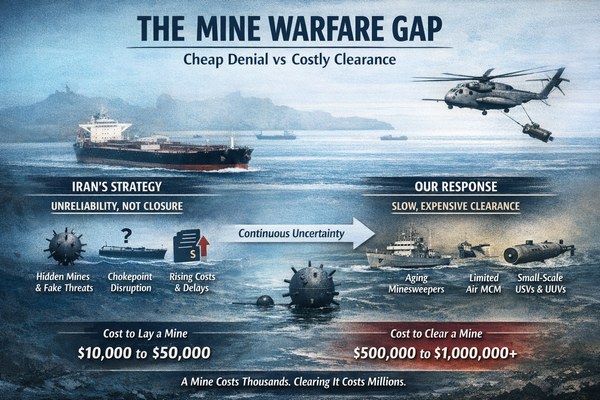
But Iran’s real maritime leverage has increasingly shifted elsewhere. While its conventional frigates and corvettes sail abroad for presence, much of its investment at sea has flowed into submarines, fast attack craft, coastal missiles, drones and mines — the tools of a denial navy built for the Gulf and the narrow seas around it. In that larger structure, Dena was both a proud outlier and a vulnerable one: a visible emissary of a navy whose most survivable strength now lies in quieter hulls, hidden batteries ashore, and small platforms that do not carry a single name or a single ship’s company.
IRIS Dena at a Glance
Class and type: Moudge-class frigate, Iranian-built derivative of earlier foreign-designed hulls.
Displacement: Roughly 1,300–1,500 tons standard, a light frigate in size and role.
Commissioning: Entered service with the Islamic Republic of Iran Navy in 2021 after a prolonged construction period under sanctions.
Main roles: Escort duties, surface warfare, limited air defence, and presence missions in the Gulf of Aden, Arabian Sea and wider Indian Ocean.
Key vulnerabilities: Modest sensors, limited organic anti-submarine capability, and the absence of a robust layered air and ASW screen when operating far from Iran’s coast.
A Shift Toward a Denial Navy
In strategic terms, Dena's lesson will likely reinforce a trend already visible in Iranian thinking and asymmetric strategies. Surface ships project presence. But submarines, missiles, drones and mines complicate control of the sea.
The destruction of a handful of visible warships rarely removes a state’s maritime leverage if its real strength lies in denial — the ability to make waters dangerous rather than to dominate them outright. Iran’s naval future may therefore lean even more heavily toward those tools: the quiet submarine, the land-based missile battery, the drone that appears without warning, the mine that waits patiently on the seabed.
In that sense, the loss of Dena may shape Iranian naval doctrine for years to come.
The Human Cost of Going to Sea
Strategic analysis often forgets something fundamental.
Warships are not symbols alone. They are communities of sailors. Men (and women) who stand watches through the night, maintain engines that never truly rest, and trust one another with their lives when steel begins to fail, and the sea comes in. Whatever the politics surrounding this war, the sailors aboard IRIS Dena were professionals doing the work that navies everywhere recognise: going to sea under orders, prepared for risks very different from what most civilians ever confront.
Across navies, there exists an unspoken fraternity. Ships may sail under different flags. Their crews may meet as adversaries. But sailors everywhere understand what it means to take a vessel into harm’s way.
The Last Watch
War at sea has always been unforgiving. Ships vanish quickly, but the memory of those who sailed them does not. Among those who go to sea, there is an old understanding: ships may fight as adversaries, but the ocean receives them all alike.
IRIS Dena now rests on the seabed of the Indian Ocean, her watch ended, and her log closed. The sailors who went down with Dena served their ship and their country as mariners have always done. The long watch is over. They have ‘crossed the bar’. Ships may sink, but ships never die. Can nations and navies forget?
To the sailors who went down with their ship — fair winds and following seas.