Part I - Naval Aviation and the Physics of the Deck
How the Naval LCA became a necessary “planned failure”.

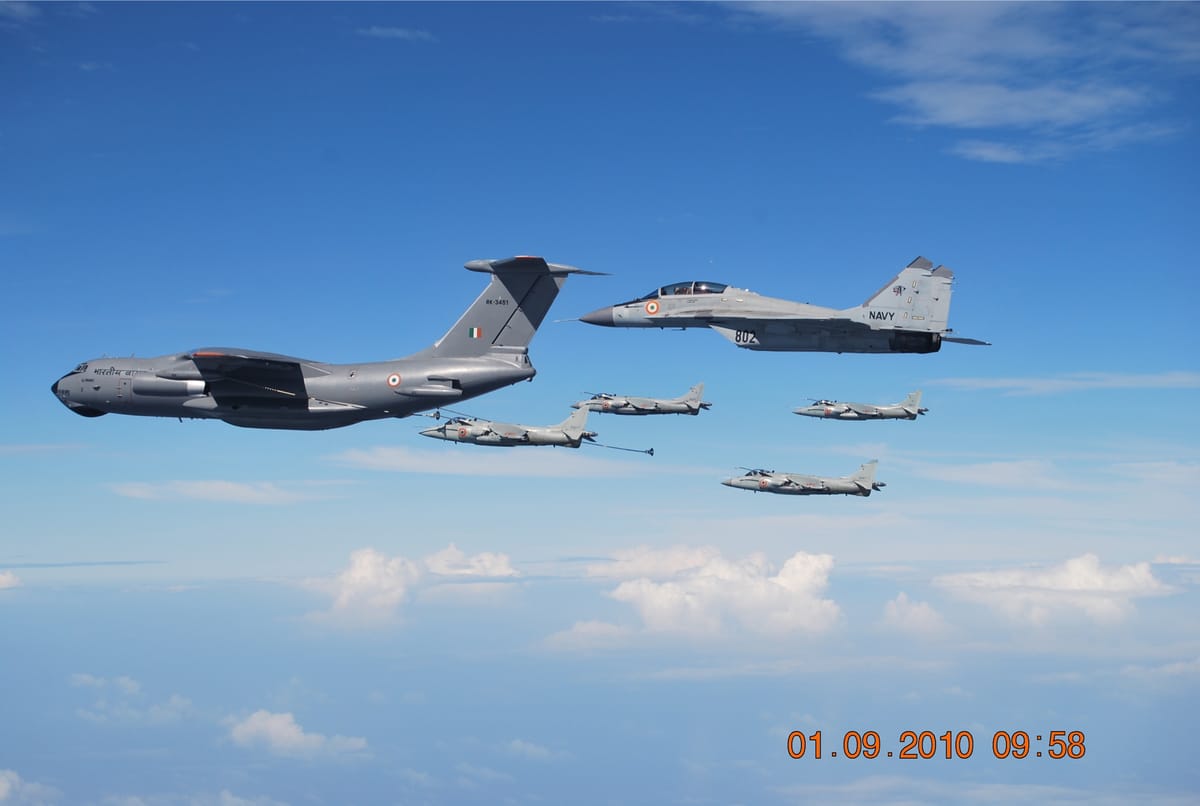
Naval aviation sits at the intersection of three unforgiving domains: the sea, the air, and the ship as a fighting system. We often talk about platforms and programmes, but not enough about how fundamentally different the design, acquisition, and risk calculus becomes once an aircraft is expected to operate on a moving deck in a harsh, salt-laden environment.
Recent commentary around the Naval LCA – a tweet calling it a jugaad air‑force derivative, and the accompanying reference to Commodore Jaideep Maolankar’s description of it as “kind of locked into planned failure” as a frontline product – has brought these questions back into focus. This essay tries to unpack that complexity from a naval aviation vantage point, without turning into a post‑mortem of any individuals or institutions.
Thanks for reading नीतिविद्या | Nitividya – Strategy, Institutions, Power! This post is public so feel free to share it.
Carrier aviation is governed by physics
For a land‑based force, runway length, diversion options, and infrastructure provide a certain elasticity. A carrier, by contrast, is a small, finite, and deeply unforgiving operating surface.
A naval aircraft has to:
Launch at useful weight from a short deck, often via ski‑jump or catapult.
Land at high angles of attack, with high sink rates, into an arrestor‑gear envelope that is not negotiable.
Survive constant corrosion, salt spray, and structural fatigue from repeated arrested landings.
Integrate seamlessly into deck cycles, spotting plans, and shipborne maintenance rhythms.
Those conditions drive structural and handling margins that are tighter than most land roles. Once you accept that an aircraft must go to sea, these margins stop being “nice to have” and become hard constraints on design, propulsion, and weight growth. Decisions that can look like “institutional hesitancy” from outside often turn out, up close, to be simple consequences of physics.
When a navy declines to operationalise a technology demonstrator on its decks, it is very often saying: *this is still an experimental asset, and our flight deck is now a war‑fighting asset*.
Why the Naval LCA was “locked into planned failure”
Maolankar’s ‘Blue Skies interview’, which is also quoted in those tweets, is clear about how the Naval LCA painted itself into a corner.
Tejas was already an ambitious leap: from a minimal design base to a compact, fourth‑generation, multi‑role fighter. On top of that, we decided that we would create a carrier‑borne variant by piggybacking on the investments in the LCA Tejas.
Part of the attraction was scale: if the Air Force Tejas became the volume programme, a naval derivative could, in theory, ride the same production learning curve and cost base rather than demand a separate, smaller‑series design of its own.
We would minimise changes: wings essentially frozen; front and rear fuselage largely common; major structural changes restricted to the centre fuselage.
We would even bring commonality into the front fuselage with the twin‑seat trainer to save variants, while still expecting the lightest‑in‑class, multi‑role, carrier‑borne fighter.
This piled constraints exactly where a clean‑sheet naval designer would want freedom: wings, landing‑gear attachments, fuselage depth, and hook‑load paths. When you then ask that aircraft to withstand carrier sink rates of 4.5–7 m/s rather than the 0.5–3 m/s regime of a runway fighter, you are suddenly in a different structural universe. Housing much larger, stronger landing gear in the same centre‑fuselage volume squeezes out fuel and systems, while arrestor‑hook loads propagate through parts of the fuselage that were never conceived to carry them.
The Naval LCA ended up substantially heavier than planned, with shed systems and compromised volume margins. There was simply no way, as Maolankar puts it, that it could meet the original mandated specs as a frontline fighter. That is the sense in which it was “locked into planned failure” as I read it: not because anyone wanted it to fail, but because the programme definition all but guaranteed that outcome.
Jugaad, Balaji, and what we actually achieved
Commodore Balaji’s ‘Paper to Flight’ – from the online published descriptions I have seen – provides the complementary view from design: just how much had to be re‑engineered to make the Air Force‑spec Tejas even demonstrably carrier‑capable. New landing‑gear geometry, strengthened fuselage frames, arrestor‑hook attachments, LEVCONs, carrier‑specific control laws, and adjustments to ski‑jump geometry and deck‑run assumptions all had to be developed and tested.
In that light, calling the Naval LCA jugaad is not an insult to its designers or test teams. It is an accurate description of a navalisation retrofit under severe constraints:
A land‑optimised airframe stretched to meet deck requirements it was never designed for.
Structural and software assumptions imported from the Air Force variant, only to be painfully discovered as risk factors in a carrier environment.
A programme that remained valuable as a technology demonstrator even as it became clear it would not mature into the frontline squadron some had hoped for.
Failure as a product and success as a technology‑exploration programme can coexist. The Naval LCA is a case study in that uncomfortable duality. There are many in the system, particularly within the MoD and departments such as DRDO (outside the attached Service Headquarters), who are instinctively reluctant to acknowledge this distinction: they are the ones who must fund a programme, and it is hard to justify expenditure on something that may never be bought in quantity and might end its days as a gate guardian near Cubbon Park Metro station.
In service, I was always wary of a familiar pattern: developmental trials quietly being labelled as “acceptance trials”, and then, almost before we realised it, being told that acceptance trials were done and dusted and that it was now time to place orders.
The Navy’s engagement with “failed” programmes is deeper than it looks
From a distance, when a naval programme does not transition into an operational squadron, it looks like a failure or a loss of nerve. Up close, naval aviation forces the service to stay engaged far beyond a simple “yes/no” induction decision.
When a naval variant is on the table, the Navy typically:
Commits scarce test pilots and engineers into the development loop, often pulling them away from essential career and promotion milestones.
Modifies ship designs – ski‑jump geometry, arrestor‑gear layout, deck markings – to create viable test regimes; in the LCA case, the Navy even accepted a lengthened carrier with the design creep that implies for propulsion, displacement and, potentially, top speed.
Carries the aircraft for years as a technology demonstrator, exploring whether the envelope can be nursed into something operational.
It is entirely possible to be deeply committed to an indigenous effort and yet ultimately compelled to walk away from it as a frontline asset. That is not a repudiation of indigenisation; it is an acknowledgement that operational thresholds cannot be negotiated indefinitely, especially when adversary capability – in this case, the PLA Navy’s carrier aviation – is rising.
Seen from the outside, it is tempting to treat the Naval LCA story as either a morality play about technological ambition or a simple tale of failure. From the deck, it looks more like a costly, imperfect, but necessary apprenticeship in how physics, programme definition and institutional incentives collide on a carrier. That apprenticeship is the only reason we are now in a position to ask harder questions about what comes next.
Fleet stabilisation versus indigenisation: a false binary
Much of our public debate pitches “import” against “indigenous” as if these were moral positions. From a naval operator’s point of view, the question is usually more prosaic: how do we keep the fleet combat‑credible over the next 10–15 years while we grow our own ecosystem?
In the Indian case, several hard realities collide:
A legacy MiG‑29K fleet whose availability and reliability have been uneven.
A new carrier, INS Vikrant, is commissioning without a fully mature, bespoke air group.
Indigenous programmes – Naval LCA, then Twin‑Engine Deck‑Based Fighter (TEDBF) – that are promising but not yet ready to shoulder the required operational loads.
In that setting, an imported carrier fighter such as Rafale‑M functions as a fleet stabiliser rather than a philosophical retreat. It buys time, preserves deck competence, and raises the baseline of sensors, weapons and data‑links that indigenous designs must match or exceed. Whether it also becomes an enabler of indigenisation – via design collaboration, MRO ecosystems and domestic content – depends entirely on how the contract is structured. I explored some of those design‑collaboration and MRO questions in an earlier three‑part post on the Rafale–AMCA link.
In Part II that follows, I turn from the Naval LCA as an apprenticeship to the harder question: how Rafale‑M, TEDBF, and unmanned systems will decide whether India still flies off its own decks on its own terms.