Part I – The Security–Insecurity Paradox in the US–Israel–Iran War
Why Military Strategies Can Produce Spirals of Insecurity

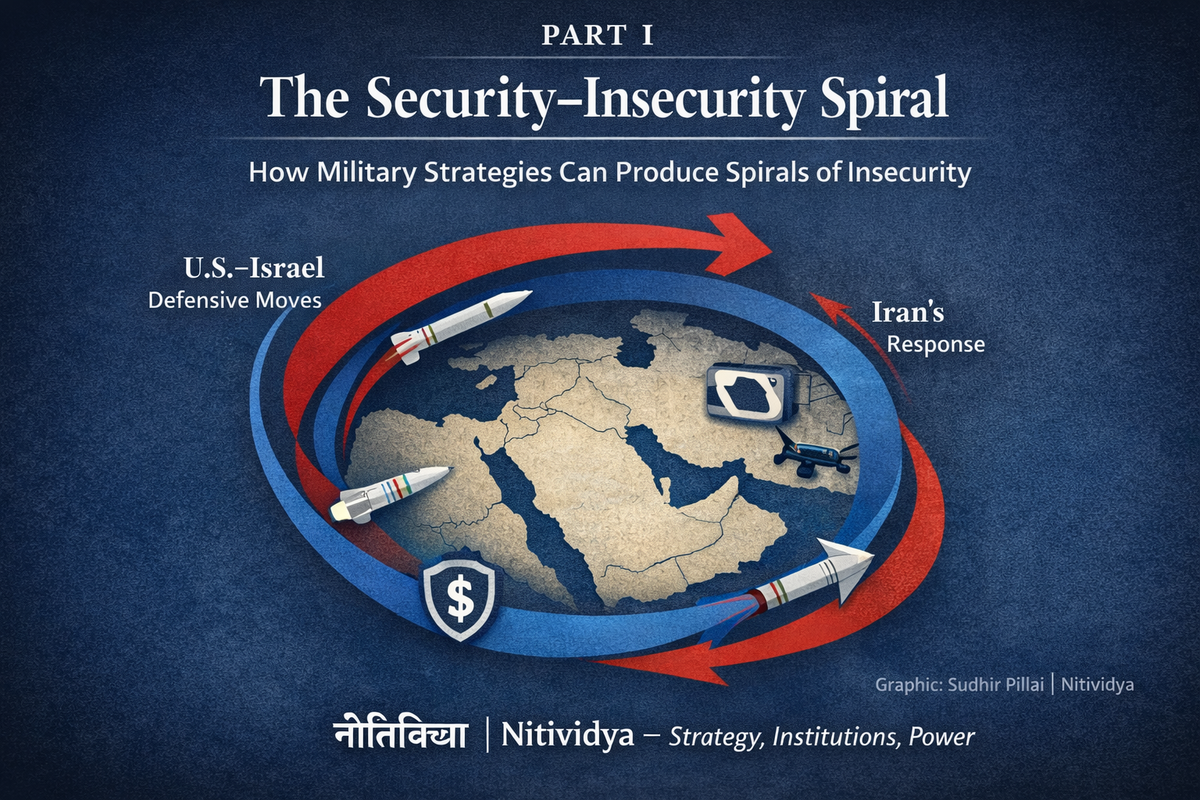
Across the Middle East today, military power is being mobilised on a wide scale, and all players are justifying it as a matter of defence.
United States carrier strike groups patrol the Gulf and the Arabian Sea in the name of protecting global commerce and freedom of navigation. Israel’s layered missile-defence systems scan the skies for incoming rockets and drones. Iran launches missiles and drones in retaliation for strikes on its territory. Proxies fire from Lebanon, Iraq, Syria and Yemen, each claiming to defend allies or resist encirclement.
The language used by each actor is revealing, and a striking pattern emerges. The vocabulary is almost identical: deterrence, self-defence, stability.
Yet the cumulative effect of these actions is unmistakable. The region is sliding toward wider confrontation, energy markets are characterised by instability and volatility, and global anxiety about escalation is rising.
How can so many actors claim to be acting defensively while the strategic environment becomes steadily more dangerous?
International relations theory has long had an answer to this puzzle. It is known as the security dilemma, or more evocatively, the security–insecurity paradox: the idea that measures taken by states to increase their own security can end up making everyone less secure.
In an earlier essay, I argued that theory matters not because it predicts events with precision but because it disciplines judgment when events become confusing. The security dilemma is one such conceptual tool. It allows us to see how escalation can emerge even when none of the actors consciously seek war.
This essay, therefore, again uses theory to foster understanding of why measures intended to enhance security can instead generate spirals of insecurity.
It first explains the logic of the security–insecurity paradox and traces its intellectual lineage through the work of John Herz and Robert Jervis, as well as the broader tradition of defensive realism. It then applies that framework to the unfolding US–Israel–Iran confrontation.
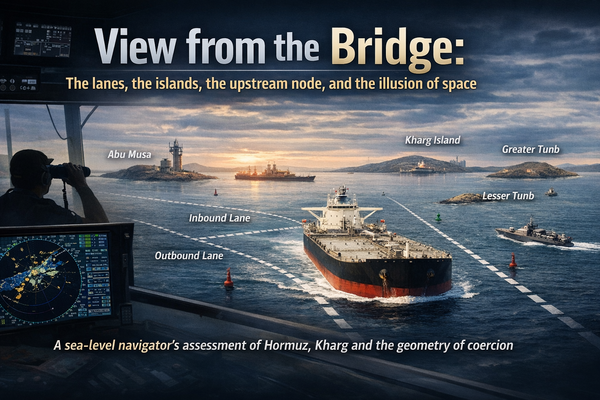
The next article in this series will move from theory to geography, examining how this spiral of insecurity is now playing out most visibly at sea, particularly in the Strait of Hormuz, where naval deployments, asymmetric tactics and maritime insurance markets intersect.
What is the security–insecurity paradox?
The security dilemma arises from a simple structural fact about international politics: there is no central authority capable of reliably enforcing order between states. In the absence of such authority, governments must ultimately rely on self-help to guarantee their survival.
International institutions such as the United Nations exist, and they can mediate disputes, establish norms and sometimes coordinate collective responses. Yet they do not possess the independent coercive power of a sovereign government. The UN cannot enforce order on its own; it depends on the political will and military capabilities of its member states, particularly the major powers that dominate the Security Council.
As a result, the international system remains fundamentally anarchic in the technical sense used by international relations theory. States may cooperate, negotiate, and create institutions, but when they perceive their vital security interests to be threatened, they cannot rely on an impartial global authority for protection. They must therefore prepare to defend themselves.
It is this structural condition that produces the security dilemma.
Because states cannot know with certainty the intentions of their rivals, military preparations that appear defensive to one actor may look offensive to another. A government that deploys missile defences or expands its armed forces may believe it is merely strengthening its protection. A neighbour observing the same development may conclude that an attack is being prepared.
The result is a spiral.
Each side responds to the other’s defensive measures with defensive measures of its own. Each step appears rational in isolation. In interaction, however, the result is growing insecurity for all.
The paradox lies precisely here: behaviour that is individually rational can produce collectively dangerous outcomes.
The gap between self-perception and external perception lies at the heart of the dilemma.
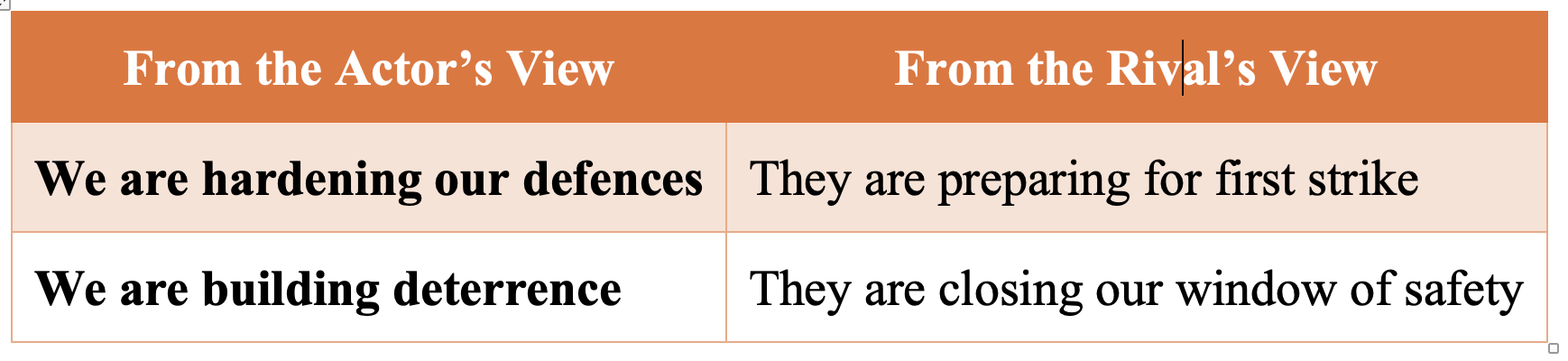
It is this divergence of interpretation that drives escalation. States are not responding to what their rivals intend but to what they fear their rivals might intend.
Herz, Jervis and the tragic logic of insecurity
The concept of the security dilemma was first articulated by the political scientist John H. Herz in 1950. Herz argued that in a world lacking what he called a “higher unity”, states inevitably seek security by accumulating power. Yet every increase in one state’s power produces insecurity in others. Attempts to escape insecurity, therefore, reproduce it elsewhere.
Herz’s insight was deeply tragic. War, in this view, does not necessarily arise from malevolent intent. It can emerge even when states seek only to defend themselves. The structure of international politics itself produces incentives for behaviour that unintentionally generates mutual suspicion.
The concept was later refined by the American scholar Robert Jervis, who developed what became known as the spiral model. Jervis argued that defensive actions are often misinterpreted as offensive preparations because states lack reliable information about one another’s intentions. Misperception then generates cycles of escalation in which each side believes it is responding to aggression even while the other sees itself as acting defensively.
For Jervis, the security dilemma is therefore structural and largely unintentional. It can produce conflict even when no actor deliberately seeks war.
These ideas were subsequently incorporated into the broader school of defensive realism, associated with scholars such as Kenneth Waltz and Stephen Walt. Defensive realists argue that states primarily seek survival rather than domination. Yet because intentions can change and the future is uncertain, prudent leaders must prepare for worst-case scenarios.
Fear, in other words, becomes rational. Yet rational fear can produce irrational outcomes. When powerful states behave as if their security is rapidly deteriorating, they can generate the very instability they seek to avoid.
Arms races, balances and nuclear ceilings
The security dilemma is often confused with several related concepts in strategic analysis. Distinguishing them clarifies how these dynamics interact in real crises.
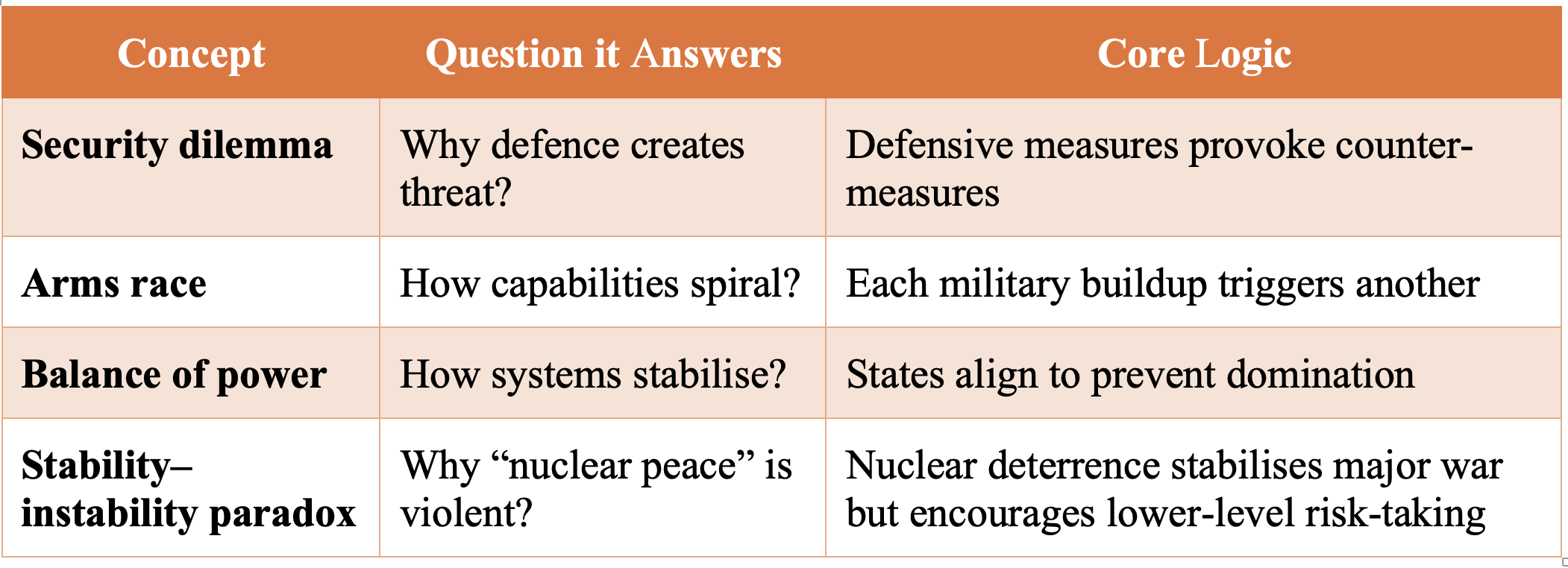
Among these, the stability–instability paradox (distinct from the security-insecurity paradox that anchors this article) is particularly relevant to the present conflict. First articulated by Glenn Snyder during the Cold War, the idea suggests that nuclear deterrence stabilises relations at the highest level by making total war catastrophic for all sides. Yet precisely because nuclear escalation is so dangerous, states may take greater risks at lower levels of conflict.
Proxy wars, limited strikes, and grey-zone operations are becoming more common because each side assumes the other wishes to avoid crossing the nuclear threshold.
In the current US–Israel–Iran confrontation, these two dynamics operate simultaneously. The security dilemma drives escalation at the conventional and proxy levels as each actor interprets the other’s defensive moves as threats. At the same time, nuclear considerations – including Israel’s undeclared nuclear capability and Iran’s advancing enrichment programme – create a ceiling that discourages all-out war.
The result is a layered strategic environment where fear and restraint coexist uneasily.
A contemporary spiral of insecurity
Seen through this lens, the US–Israel–Iran confrontation looks less like a morality play of aggression and resistance than a classic spiral of insecurity.
From Tehran’s perspective, the strategic environment is deeply hostile. The country faces economic sanctions, regional rivals supported by the United States, and repeated hints of regime-change strategies. Iran has therefore invested heavily in ballistic missiles, proxy networks such as Hezbollah and various regional militias, and a nuclear enrichment programme that provides technological latency.
In Tehran’s narrative, these capabilities are defensive shields designed to deter invasion and coercion.
For Israel, however, the same developments appear profoundly threatening. Iranian missiles already cover Israeli territory. Iranian leaders have periodically questioned Israel’s legitimacy. A nuclear-capable Iran would dramatically shorten warning time for a potential catastrophic attack.
Israel’s response has therefore been a doctrine of preventive defence: sabotage of nuclear facilities, assassinations of key personnel, cyber operations, and increasingly overt precision strikes against Iranian infrastructure and military assets.
From Tehran’s perspective, these actions confirm its worst fears. Israeli and American pressure appears designed not merely to constrain Iran but ultimately to weaken or overthrow the regime.
Iran responds accordingly. Missile forces are dispersed. Proxy networks expand. Nuclear capabilities move ever closer to threshold status.
The cycle tightens.
Iran builds deterrence → Israel fears attack
Israel strikes → Iran fears regime change
Iran escalates proxies → Israel escalates strikes
Result: everyone becomes less secure.
This sequence captures Herz’s vicious circle and Jervis’s spiral model in contemporary form.
The nuclear ceiling
Yet despite the intensity of this confrontation, it rarely crosses the threshold into total war.
The reason lies in the destructive potential of modern conflict. Nuclear deterrence and the overwhelming costs of large-scale escalation impose powerful constraints on decision-makers. Each side assumes the other ultimately wishes to avoid catastrophe.
Paradoxically, that assumption can encourage risk-taking at lower levels. Missile exchanges, drone strikes, cyber attacks and proxy warfare become tools of competition precisely because leaders believe escalation will remain bounded.
This combination of conventional escalation and nuclear restraint is what gives the present conflict its distinctive character. The region feels continuously on the edge without tipping into systemic war.
Why the spiral is now most visible at sea
The sharpest manifestation of this dynamic may now be emerging at sea.
In the Persian Gulf and the Strait of Hormuz, American and allied naval deployments are presented as necessary measures to protect global commerce and ensure freedom of navigation. From Washington’s perspective, these deployments safeguard the world’s most critical energy artery.
From Tehran’s perspective, however, the same forces can appear as instruments of economic pressure and potential blockade.
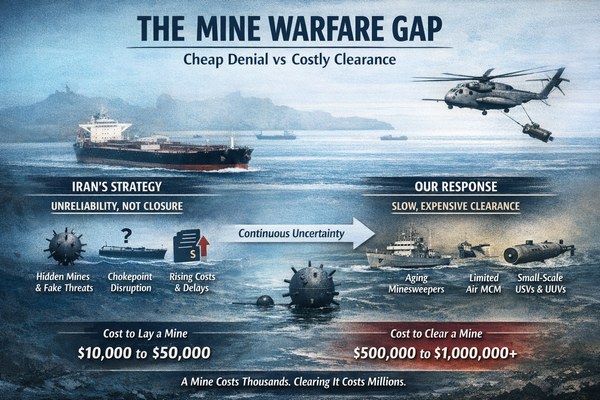
Iran’s response has therefore been asymmetrical. Rather than attempting to match the United States ship for ship, Tehran relies on naval mines, anti-ship missiles, drones and swarms of fast attack craft. These tools are designed not to defeat the US Navy outright but to raise the costs of operating in the Gulf.
Even limited attacks can disrupt shipping, increase war-risk insurance premiums and create uncertainty in global energy markets.
In the Gulf, escalation therefore runs less through armoured divisions than through shipping lanes, maritime insurance and the fear of sudden energy disruption.
The Strait of Hormuz has become the strategic pressure valve where the security dilemma, asymmetric naval strategy and global economic vulnerability intersect.
The next article in this series will examine whether Iran’s maritime harassment represents a rational adaptation to overwhelming US naval superiority – and how the real battlefield may increasingly lie not only at sea but in the financial and insurance systems that sustain global trade.