Part I - The US NSA
Persona, Process, and the Road to Epic Fury

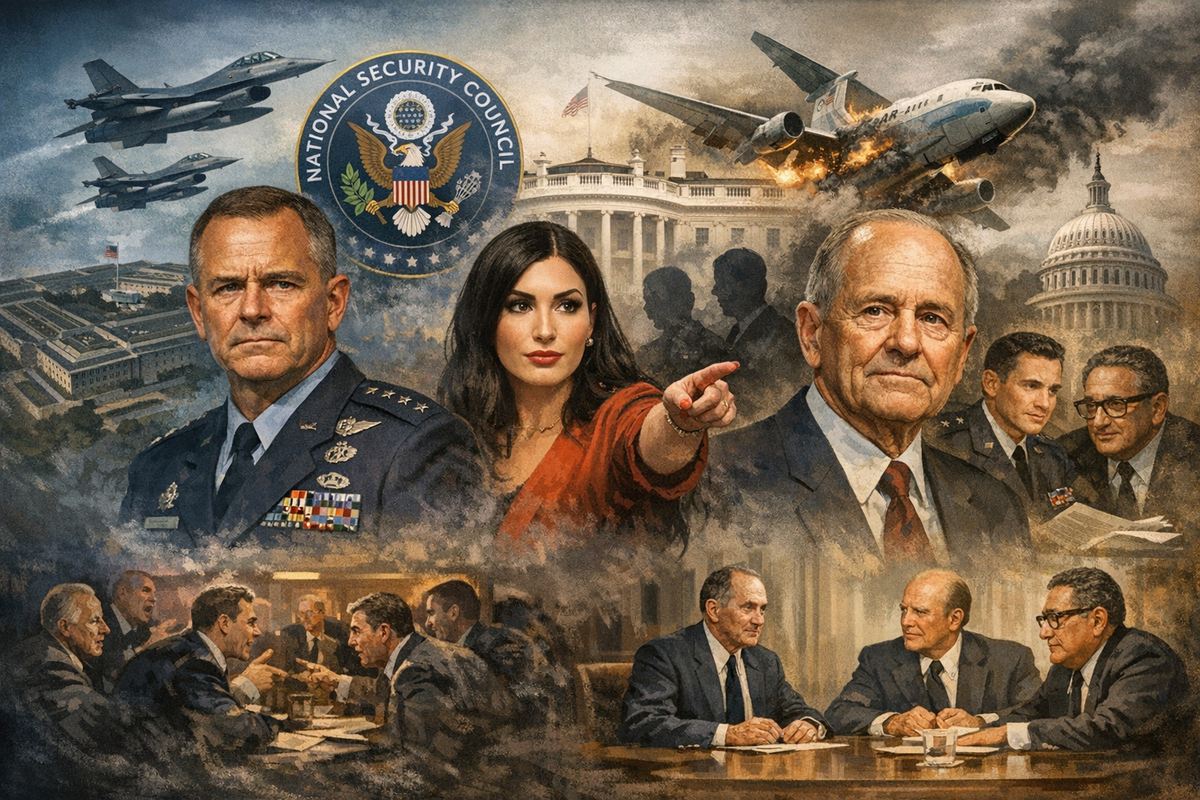
A subscriber commented on an earlier post on the Chairman Joint Chiefs of Staff (CJCS) and perceptively asked whether Gen Caine is also responsible for assessing the impact of U.S. choices on global supply chains, oil markets, and financial markets, and whether there is any American equivalent of India’s Cabinet Committee on Security (CCS) still functioning—or whether that kind of structure has been hollowed out in the quest for speed, leaving a United States that no longer believes in “if you break it, you own it.” The reference is to an earlier look at Gen Dan Caine, the Trump 2.0 Chairman of the Joint Chiefs and former Air Force and National Guard fighter pilot whose professional military education and staff seasoning sit firmly in the fighter–weapons‑school tradition.
It then follows the strange arc by which Laura Loomer—now familiar to many Indians from the India Today Conclave—and her widely reported role in agitating for the purge of “disloyal” NSC staff became part of that system’s staffing logic.
Finally, it turns back to another Air Force officer, Brent Scowcroft, whose flying career was cut short by a crash but who went on through operations, administration, and a Columbia PhD to replace Henry Kissinger as NSA and to serve multiple presidents, offering a very different model of what an NSA and an NSC can be.
If one tracks US Gulf operations from Earnest Will in the late 1980s, through the 1988 one‑day naval battle of Praying Mantis, to today’s Epic Fury strikes on Iran, the most important shift is not only in weapons and sensors. It is in Washington, where the National Security Council has evolved from a body that slowed, deliberated and disciplined decision-making into one that treats speed and expedience as a virtue in itself, with consequences that now spill into the maritime lanes and financial systems on which trading states like India depend.
This story matters beyond Washington because it offers useful lessons for India and the design of its own NSA, NSC, and NSAB arrangements, which face similar questions about how to balance centralised authority, access, and speed with robust processes.
Modern war begins with meetings, not missiles
Under US law, the National Security Council (NSC) exists to “assess and appraise the objectives, commitments, and risks of the United States” and advise the President before force is used. In its classic design, the NSC system – the Council, the Principals Committee (PC), the Deputies Committee (DC) and staff – is meant to ensure that no single impulse, however powerful, moves unchecked into policy.
At the centre of that system sits the National Security Adviser (NSA). Formally, the NSA is not a statutory decision‑maker. The role is more subtle and, in some ways, more powerful: the organiser of decision‑making itself, the person who decides which questions reach the President, in what form, and with what range of options.
In its ideal form, the NSA’s job is to make sure competing views are heard, trade‑offs are made explicit, and consequences are mapped before execution. That is not mere bureaucracy. It is strategic processes at play in their most disciplined form.
This White House decision‑making machinery is distinct from but tightly coupled to the military system that runs through the CJCS, the Secretary of Defence (now the Secretary of War), and the combatant commanders. The NSC and NSA shape what is to be done, under what political constraints and at what level of risk, while the CJCS–SecDef–CINC chain is charged with working out how it is done in military operational and tactical terms.
“The NSA exists to slow power down just enough for strategy to catch up with action.”
The Persona Problem
Institutions do not operate in abstraction. They operate through people.
Over time, the NSA has evolved from a role into a persona. The classical approach, associated with figures like Brent Scowcroft, was that of an “honest broker”: someone who kept their own policy preferences in check while ensuring that the President saw a real menu of choices, with structured dissent and clear consequences.
In this model, the NSA did not (openly) dictate outcomes. The NSA shaped how outcomes were arrived at through neutral framing of options, disciplined staffing and documentation, and deliberate exposure of the President to competing arguments
The system logic here is straightforward: Process → Debate → Decision → Execution
Under Donald Trump, this model has shifted.
Across Trump’s first and second terms, the NSA became less an honest broker and more a curator of presidential instinct steadily. The central question inside the West Wing of the White House changes from “What are the consequences?” to “How do we execute this?” “How Quickly?” The NSA’s persona is evidently being selected to align with the President’s narrative and tempo, rather than be aligned with a Scowcroft‑style process.
Selection, Not Instability
From the outside, the rapid turnover of Trump’s NSAs – Michael Flynn, H.R. McMaster, John Bolton, Robert O’Brien, Mike Waltz, now Marco Rubio – can look like pure chaos. It is more useful to read it as a kind of selection pressure.
Each NSA represents a test of what the system will tolerate.
Michael Flynn – A retired three‑star General who once ran the Defence Intelligence Agency (DIA), Flynn was Trump’s first NSA and collapsed almost immediately. He held undisclosed conversations about sanctions with the Russian ambassador during the transition and then misled the Vice President and the FBI about those calls, raising basic questions of tradecraft and integrity. His fall established an early rule inside the system: loyalty to the President’s narrative matters, but if you generate a public scandal that embarrasses the White House, you are expendable even if your legal record is later wiped clean.
H. R. McMaster – A decorated U.S. Army Lieutenant General and author of Dereliction of Duty, McMaster was brought in as the “adult in the room” to restore a classical NSC process. He pushed serious Deputies and Principals meetings (more about the staff system in a second part of this enquiry), a formal National Security Strategy (NSS), careful staff work, and publicly described Russian interference in 2016 as “indisputable” while urging caution about scrapping the Iran nuclear deal. Inside the West Wing, his briefings were seen as attempts to teach and a little too willing to bring uncomfortable facts to the President. Politically, he never fully convinced Trump’s inner circle that he was “one of them.” Since leaving in 2018, McMaster has returned to teaching and writing on strategy and, in later interviews, has been sharply critical of Trump’s management style while defending the need for a disciplined inter‑agency process. His competence was not in doubt; his problem was that he imposed friction on Presidential instincts in a system that was clearly selecting precisely against such traits.
John Bolton – A long‑time Republican hawk, former UN Ambassador and lawyer, Bolton became Trump’s third NSA as an ideological ally on Iran, North Korea and multilateral scepticism. The competence controversies around him focus on judgment and stewardship: he aggressively “streamlined” the NSC, including closing the dedicated global health/biodefense directorate – a move widely criticised when Covid‑19 hit, as it was seen as weakening pandemic preparedness at the White House level. Bolton also pushed escalatory options against Iran and North Korea more forcefully than Trump was prepared to own, and during the Ukraine impeachment saga, he withheld key details for a later book, leading critics to accuse him of putting personal positioning above timely internal warnings. And in case you’ve forgotten, Trump’s first impeachment grew out of how he used Ukraine policy for domestic politics.
Since his ouster, Bolton has become a prominent conservative critic of Trump’s competence, while still arguing for hard‑line policies toward Tehran and Pyongyang in U.S. media and on think‑tank platforms, and he is often seen on Indian TV channels.
Robert O’Brien – A California lawyer and former presidential envoy for hostage affairs, O’Brien was Trump’s fourth NSA and represented the adjusted model: lower profile, more politically attuned, and willing to slim the NSC further. He presided over additional staff cuts and a narrowing of the NSC’s coordinating role, making it more directly responsive to the President and less of a broad strategic think tank. Critiques of his tenure centre less on headline policy clashes and more on quiet politicisation and a reduced emphasis on systemic preparedness – from pandemics to election interference – as the NSC’s bandwidth shrank.
Mike Waltz – A former Green Beret, defence contractor and Congressman, Waltz was Trump 2.0’s first NSA and arrived as a declared hawk on Iran and China whose instincts on coercion were not far from where the system ultimately finds itself in Epic Fury. His ouster followed the “Signalgate” episode – accidentally including a journalist in a Signal chat about impending Yemen strikes – and reporting that he had privately explored heavier Iran options with Netanyahu without Trump’s full blessing, at a time when the White House was still calibrating its escalation. Waltz was quickly sidestepped as U.S. Ambassador to the UN and has since used that platform to push a hard public line against Tehran and Moscow, casting doubt on any new Iranian leadership and insisting that sanctions and “all options” remain in play. His “sin” was not hawkishness per se, but rather moving ahead of the President’s narrative and timing, rather than shaping his options from within.
- Marco Rubio – A long‑serving Florida senator turned Trump 2.0 Secretary of State, Rubio is now dual‑hatted as acting NSA as well (the second after Kissinger to don the two hats). He is a career politician, rhetorically hard on China, Cuba, Venezuela and Iran, and comfortable with a narrower, burden‑shifting conception of America’s global role. Under National Security Presidential Memorandum No. 1 (NSPM-1), he chairs the Principals Committee, controls much of the PC/DC attendee list, and sits atop a sharply reduced NSC staff that has been formally fused with the Homeland Security Council.
In the first Trump term, NSPM‑1 (2017) was titled “Rebuilding the U.S. Armed Forces” and addressed readiness, budget amendments, and force expansion. NSC organisation in that period was instead covered by NSPM‑2 and then NSPM‑4, which set out how the NSC, Homeland Security Council, and subcommittees were structured and, at one point, controversially elevated Steve Bannon to the Principals Committee while downgrading the CJCS and DNI to “as needed.”
In the current configuration, Rubio has evolved into a hybrid figure: an adviser whose portfolio fuses diplomacy and NSC coordination, whose political identity is deeply tied to Trump’s America‑First project, and whose practical role is less to enforce a Scowcroft‑style process than to consolidate and centralise presidential authority.
On paper, Trump’s NSAs are well credentialed – one soldier‑scholar with a PhD, several lawyers with elite JDs, and multiple war college master’s degrees. The issue was never competence. It was whether the NSA imposed friction on power — or removed it. In summary, one could infer that Epic Fury’s problems are not about educational deficits; they are about what the system rewards in terms of judgment, process, and loyalty.
The pattern is unmistakable: align rather than question the President’s choices.
The Compression of Strategy
As the NSA persona shifts, so does the system’s internal logic. Three structural effects follow.
First, deliberation shrinks. Repeated cuts to NSC staff and the preference for smaller, leader‑centric meetings mean fewer layers of review, fewer full‑dress Deputies Committee processes, and tighter timelines for option papers. The result is faster cycles, but less room for red‑teaming or serious alternative courses of action.
Second, consequences are deferred. A classical NSC process would interrogate, in advance, how a campaign affects energy flows, maritime choke points, war‑risk insurance, global credit conditions, alliance cohesion and adversary escalation options. Under a compressed, leader‑centric model, these questions are still asked somewhere in the bureaucracy, but they are easier to treat as “mitigation issues” to be handled after a decision in principle is taken.
Third, strategy becomes personal. Policy sequencing increasingly tracks the President’s narrative – what he has promised, what he wants to signal, what plays domestically – rather than a long‑range plan that disciplines day‑to‑day moves. The NSA’s job, in that world, is to align the system with personal sequencing and give it a veneer of process.
The system’s logic is inverted: Decision → Alignment → Execution → Consequences
From Praying Mantis to Epic Fury
The operational contrast makes the institutional shift visible.
Operation Praying Mantis (1988) was a punitive U.S. response to Iranian mining in the Gulf and the damage to USS Samuel B. Roberts during Operation Earnest Will. The objectives were bounded: destroy specific Iranian naval and IRGC assets, signal that mining and harassment would carry costs, but avoid regime‑change or a wider war. Escalation control and political signalling to Gulf allies and the Soviet Union were central. This conservative approach to objectives reflected cautious intelligence community “truth to power” assessments and carefully reasoned national intelligence estimates. These assessments sat uneasily alongside elements of military leadership who were more sanguine about how Tehran might respond to Earnest Will and its follow‑on operations. Thus, it ended up as a strike designed to punish rather than transform.
The ongoing Operation Epic Fury (2026), four decades later, looks very different, with open‑source reporting and analysis describing the aims of Epic Fury as:
A large‑scale target set against nuclear infrastructure, IRGC command nodes and senior leadership
Explicit decapitation logic
AI‑enabled target nomination and multi‑domain kill chains integrating space, cyber, air and maritime assets
A clear intent not only to degrade Iran’s nuclear program, but to reshape elements of the Iranian state and its regional posture.
It appears to be a campaign designed to reshape, not simply restore, deterrence.
Technology makes an Epic Fury–type operation feasible. But this feasibility needs to be balanced against many other factors and cannot be taken as a green light or a sign of permission. That depends on the human decision system that translates technological impulse into action—one that must account for the complexities of the operating environment, the distinct cultural contexts, geographic constraints and cascading strategic consequences.
The Waltz Moment
The fall of Mike Waltz, illustrated above, shows how the current system polices its own boundaries. Alignment with presidential timing matters more than strategic correctness. An NSA who tries to rein in the President and an NSA who tries to leap ahead of him can both be discarded for imposing the wrong kind of friction.
The lesson from within is simple: not what you recommend, but when and how you recommend it, determines survival.
Epic Fury as Institutional Outcome
Seen through these lenses, Epic Fury is not an outlier. It is a logical output of a different kind of NSA/NSC system.
The sequence looks like this:
1. Expanded capability – precision strike, AI‑enabled targeting, multi‑domain integration, and a strong Israeli capability base.
2. Reduced institutional friction – a slimmed, politicised NSC with fewer staff layers and a dual‑hatted NSA.
3. Persona‑aligned NSA – Rubio as executor of Trump’s instincts and timeline.
4. Narrative‑driven decision making – Epic Fury framed as a necessary, decisive and controlled imperative.
5. Rapid execution – with consequence management delegated to follow‑on efforts rather than thought out ab initio.
What is missing is not expertise. The U.S. system still has world‑class analysts and planners. What is thinner is deep, institutionalised consequence ownership.
The Strategic Paradox
The result is a system of extraordinary power and growing imbalance.
On the one hand, operational strength is formidable: rapid targeting, high precision, multi‑domain synchronisation, and the ability to deliver shock at scale. An air‑power purist’s dream. On the other hand, strategic vulnerabilities are more exposed: coalition lag, escalation uncertainty, and economic spillovers that are not fully understood before the first wave is launched.
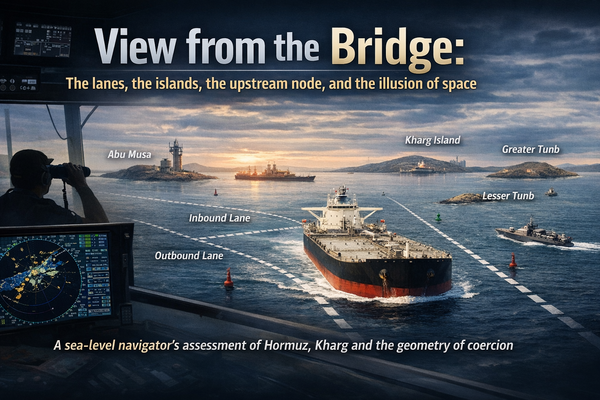
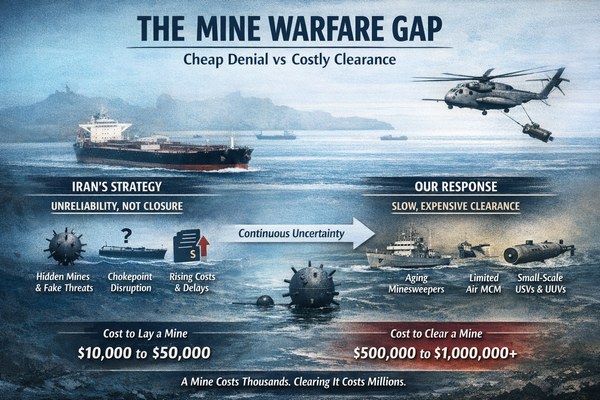
Nowhere is this clearer than at sea – in Hormuz, the Red Sea, Bab el‑Mandeb – where the consequences of Epic Fury show up not only in missile exchanges but in insurance withdrawals, diverted traffic, freight rates and energy markets.
“The United States can now strike faster, but has the pace put limits on thinking through what follows?”
From Persona to Machinery
Part I has focused on the NSA – the persona at the centre of the system. But no adviser, however powerful, operates alone. The deeper story lies in the staff architecture beneath the NSA, where intent is translated into options, estimates and execution.
If Praying Mantis asked, “What must be done?”, Epic Fury reflects a system that increasingly asks, “How fast can it be done?” The next step is to examine the staff system that makes that question possible.