Part II – Iran’s Sea Denial Strategies and the Strait of Hormuz
How Iran Uses the Sea to Challenge a Stronger Fleet

In Part I of this series, we examined how the security–insecurity paradox shapes the US–Israel–Iran confrontation. States seeking security through deterrence and defence can inadvertently create spirals of fear and escalation.
Nowhere is that paradox clearer than at sea.
In the Strait of Hormuz, the world’s most powerful navy faces a deliberately weaker opponent that has chosen not to compete symmetrically. The United States operates a global control navy, designed to project power across oceans and secure sea lanes. Iran, by contrast, has built what might best be described as a denial navy: a force designed not to command the sea but to make its use costly and uncertain for stronger rivals.
This distinction matters because not all navies pursue the same strategic objective.
Some seek command of the sea. Others seek merely to deny it.
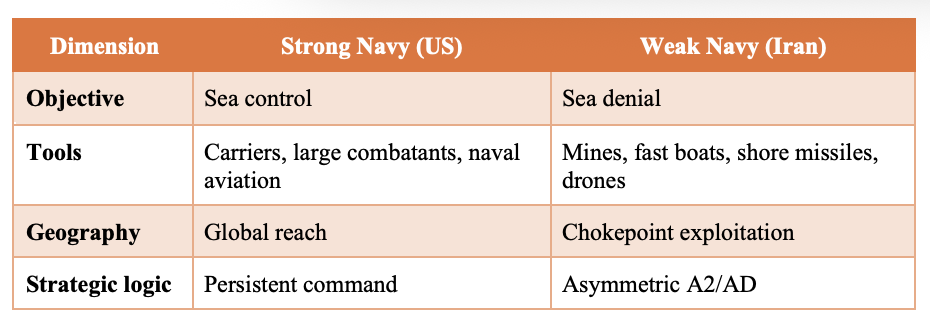
The logic here is deeply Corbettian. Command of the sea does not always require permanent occupation; it can also be contested through selective denial. In narrow waters, even a weaker navy can impose friction on a stronger one. Julian Corbett, a British naval historian and former barrister, argued that command of the sea is less about occupying every patch of water than about controlling key lines of communication. Narrow-seas warfare is the context in which the Gulf has to be understood: geography compresses the advantages of sea power, and missiles from shore, aircraft from nearby bases, mines, drones, and small craft can all threaten even powerful fleets operating close to land. Control, therefore, depends not only on naval strength at sea but also on influence over the land that frames the water.
Iran’s strategy in the Gulf is built on precisely this insight.
A navy that cannot win battles
The starting point for Iran’s maritime doctrine is a simple reality: it cannot match American naval power.
The United States deploys carrier strike groups, advanced naval aviation, and a global logistics network that allows sustained operations far from home waters. Iran possesses no aircraft carriers, limited blue-water surface forces, and a navy divided between the regular fleet and the Islamic Revolutionary Guard Corps Navy (IRGCN).
A direct contest for control of the Gulf would therefore be disastrous.
Iran’s answer has been to avoid such a contest altogether. Instead of trying to defeat American fleets, Tehran seeks to make its presence expensive, uncertain, and politically complicated.
This is the logic of the denial navy.
The aim is not to dominate the maritime battlespace but to create a persistent sense of risk within it. The measure of success is not enemy ships sunk but costs imposed, operations delayed, attention diverted, and leverage created. We will examine this logic in deeper strategic terms in Part III.
The asymmetric toolkit
Iran’s maritime toolkit reflects this logic.
Rather than investing in large warships, Tehran has concentrated on systems that are relatively cheap, difficult to detect, and well-suited to confined waters.
These include:
Fast Attack Craft: capable of swarm tactics against larger vessels.
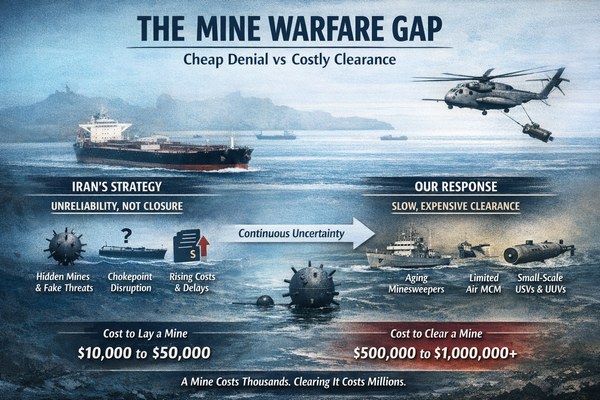
Naval Mines: historically, one of the most effective asymmetric maritime weapons.
Coastal Anti-Ship Missiles: able to strike shipping lanes from concealed launch sites.
Drones and Loitering Munitions: extending surveillance and strike reach.
Midget Submarines and Unmanned Underwater Vehicles: suited to shallow littoral environments.
Many of these systems share two features: they are inexpensive compared to major surface combatants, and they are difficult to attribute quickly amid the confusion of a maritime incident. The IRGC Navy has built its doctrine around distributed harassment rather than decisive engagement. Open sources suggest it operates hundreds, perhaps over a thousand, small boats; earlier concepts favoured massed swarms, while more recent exercises point to dispersed, multi‑axis attacks intended to overload the defensive attention of larger escorts.
Against that background, U.S. claims to have struck sixteen Iranian “minelayers” sound decisive on paper but are less reassuring in practice. The point of these systems is less to sink ships than to stretch defences and create persistent uncertainty. In that sense, destroying sixteen visible hulls is not a solution so much as another move in the spiral: it trims Iran’s most obvious platforms and signals resolve, but also pushes minelaying into covert channels and keeps insurers focused on a threat that cannot be bombed away.
Strategically, the mine problem is not how many Iranian minelaying vessels remain afloat; it is Iran’s enduring, low‑cost ability to generate uncertainty in a narrow, crowded sea lane – and the way global risk capital responds to that uncertainty.
Geography as a weapon
Geography amplifies this strategy.
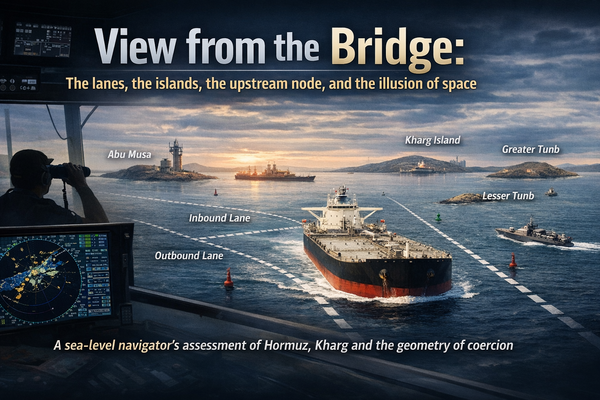
The Strait of Hormuz is often described as a major waterway. In physical terms, however, it is remarkably narrow. At its tightest point, the strait is roughly thirty miles wide. Within that space, the inbound and outbound shipping lanes used by tankers are each only about two nautical miles across, separated by a small buffer zone.
These narrow traffic corridors leave ships with limited room to manoeuvre.
Even a small number of mines or the threat of coastal missile fire can force shipping to slow down or alter course. Warships escorting tankers face similar constraints. The geography compresses the battlespace and shortens reaction time.
Control of territory further complicates matters. While the official shipping lanes lie largely in Omani waters, Iran controls the northern shoreline of the strait. From this coastline, missiles, drones, and fast craft can reach the shipping lanes quickly before dispersing back into complex littoral terrain.
In such an environment, small systems can generate outsized leverage.
A single missile strike or mine incident may cause limited physical damage. Yet the psychological and commercial effects can be far larger, particularly when energy markets and maritime insurers are watching closely.
From sinking ships to scaring insurers
This brings us to the real centre of gravity in the Gulf.
Nearly one fifth of global oil and gas exports transit the Strait of Hormuz. Any disruption, therefore, resonates far beyond the immediate region.
But Iran does not need to physically close the strait to achieve strategic effects. Instead, it can target behaviour.
Shipping companies, charterers and insurers must constantly evaluate risk. War-risk clauses in marine insurance contracts allow coverage to be withdrawn or premiums sharply increased if a region becomes dangerous. When attacks occur or threats escalate, insurers and reinsurers reassess their exposure.
Recent events illustrate how quickly this mechanism can operate.
Following missile and drone attacks linked to regional escalation, several war-risk insurers suspended or restricted coverage for parts of the Gulf. P&I clubs and reinsurers began reassessing risk aggregation in a waterway where hundreds of vessels may be transiting simultaneously.
The effect was immediate. Traffic slowed. Some ships have delayed departures. Others rerouted or waited for further clarity. Reports suggested that tanker movements through the Strait of Hormuz dropped sharply for several days following the attacks. Insurance premiums rose. Freight costs adjusted. Oil markets reacted.
In the Strait of Hormuz, Iran does not need to defeat the US Navy. It only needs to persuade insurers and shipowners that transit is no longer worth the risk.
In other words, the strait did not need to be closed. It only needed to look unsafe.
The maritime security dilemma
Seen through the theoretical lens developed in Part I, the dynamics at sea reproduce the same spiral of insecurity.
American naval deployments are intended to stabilise the region and protect global commerce. From Washington’s perspective, they deter Iranian disruption. From Tehran’s perspective, those deployments look different. Carrier groups, escorts and surveillance assets near Iranian waters appear as instruments of coercion or even preparation for a blockade.
Iran responds by strengthening its asymmetric naval posture and signalling its ability to threaten shipping. The United States responds by increasing patrols and escorts.
Each side believes it is acting defensively. Each step deepens the other’s sense of vulnerability.
The maritime security dilemma, therefore, mirrors the broader regional one.
A precedent from the Tanker War
History offers a revealing precedent.
During the Iran–Iraq Tanker War of the 1980s, the United States launched Operation Earnest Will to escort Kuwaiti tankers through the Gulf. The objective was to ensure safe passage and deter Iranian attacks.
Yet even this formidable naval presence could not eliminate risk.
In July 1987, the reflagged tanker Bridgeton struck an Iranian mine while under US naval escort. The damage was limited, and the vessel remained afloat. But the incident demonstrated a crucial point: even overwhelming naval superiority could not guarantee immunity from asymmetric threats. The psychological effect was significant. A single mine had exposed the vulnerability of a massive escort operation.
The lesson remains relevant today. Naval control in confined waters is never absolute. Small, cheap weapons can create uncertainty that large fleets cannot fully eliminate.
Rational strategy, dangerous consequences
From Iran’s perspective, the strategy is rational.
Facing a far stronger naval adversary, Tehran has chosen tools that maximise leverage while minimising cost. Mines, missiles and fast boats allow Iran to threaten shipping and impose economic pressure without confronting the United States in direct sea battles.
The objective is deterrence through uncertainty.
Yet rational strategies can produce dangerous systemic effects. Even calibrated harassment increases the risk of accidents, misinterpretation or escalation. A missile fired at a tanker, a mistaken identification of a vessel, or an overreaction by an escorting warship could rapidly transform a limited confrontation into open naval conflict.
The denial strategy, therefore, deepens the very security dilemma it seeks to exploit.
Why this matters for India
For countries far beyond the Gulf, including India, the stakes are substantial.
A significant portion of India’s crude oil imports and liquefied natural gas supplies transit the Strait of Hormuz. Any disruption in this corridor quickly translates into higher import costs, pressure on domestic inflation, and potential balance-of-payments strain. Even if one is ready to pay the higher costs, the issue is the denial of supplies, as we currently see with LPG stocks depleting.
Yet the critical decisions that determine whether ships sail through Hormuz are often made far from the region.
War-risk insurance pricing is largely determined in global financial centres such as London. Reinsurers in Europe and Asia evaluate risk exposure and decide whether coverage remains viable. Shipping companies adjust routes and schedules accordingly.
In practice, therefore, India’s vulnerability lies not only in the possibility of a naval confrontation but also in the financial architecture governing maritime trade. If insurers conclude that Hormuz is too dangerous to cover, tankers will not sail regardless of the number of warships in the Gulf.
This suggests several strategic implications.
First, energy importers must diversify supply sources and transport routes wherever possible. Second, there is a case for strengthening regional marine insurance and reinsurance capacity so that risk decisions are not entirely external. Third, policymakers must recognise that maritime risk capital is now a core component of national security planning.
In the modern maritime economy, security is not only about ships and missiles. It is also about finance, compliance and insurance markets.
Hormuz as a pressure valve
The Strait of Hormuz has therefore become more than a geographic chokepoint. It is the pressure valve of the wider US–Israel–Iran confrontation.
At this narrow chokepoint, naval power, asymmetric tactics and global capital markets intersect. Iran’s denial navy cannot defeat the US fleet in battle. But by raising uncertainty, it can influence behaviour across the global shipping and energy system.
And that influence may be strategically sufficient.
In Hormuz, naval strategy meets financial reality.
Warships patrol the strait, but insurers decide whether ships will sail.
What does victory means at sea
Part I of this series examined how the security dilemma generates spirals of insecurity. Part II has shown how those spirals manifest in maritime strategy and economic risk.
But this raises a deeper question.
If weaker powers can impose costs without winning battles, and stronger powers can dominate militarily without eliminating risk, what does victory actually mean in such conflicts?
For Iran, survival and leverage may constitute success. For the United States and its allies, keeping the sea lanes open without triggering wider war may be the objective.
The next essay in this series will therefore examine the idea of the theory of victory in asymmetric maritime conflict. It will trace the escalation ladder from harassment to systemic war and ask what each side is actually trying to achieve.
Because in modern conflict, the decisive question is no longer simply who controls the sea: It is who controls the risks that shape behaviour in response to them.