Part II - The National Security Council
The Staff System Behind Epic Fury that Needs Closer Scrutiny

Why the Machinery Beneath the Adviser Matters
Even a powerful NSA does not draft every paper, run every game, or provide insights behind every call. In any serious military or political system, there is a staff layer: people who expand the Commander’s view of the problem, test assumptions against reality, map second- and third‑order effects, and, at their best, say “no” when an idea is not ready.
The key question for Epic Fury is therefore not only “What did the US President want?”, “What Role has the NSA Played?” but “What has happened to that staff system inside the NSC?”
Commander’s Intent and the Estimate of the Situation
The military analogy would be familiar to many. In a functioning command system:
Commander’s Intent sets direction.
The Estimate of the Situation tests feasibility and risk.
Staff work exists to turn the commander’s intent into multiple suggested Courses of Action (CsOA) and a single, argued recommendation; the decision, the risk, and the responsibility for execution remain the commander’s alone.
Good commanders make decisions. Good staff make those decisions safe to execute. The NSC staff was designed as exactly this layer for the President.
What the NSC Staff Was Meant to Be
The NSC staff is not, in theory, a policy‑making cabal. It is a strategic staff system for the US President and the NSA/Principals Committee (PC)/ Deputies Committee (DC) structures.
Its core functions mirror a joint headquarters:
Inter‑agency integration across State, Defence, Treasury, Intelligence, Energy, and Homeland Security.
Preparation of option papers and decision memos, with clear pros, cons and risks.
Scenario planning and red‑gaming (game enemy likely CsOA).
Sequencing Diplomatic, Informational, Military, Economic (DIME) lines of effort.
This is where, ideally, the implications of an Iran campaign for Hormuz, the Red Sea, insurance, oil markets and alliance cohesion are worked through before the US President gives a green light.
In an ideal flow:
Intent → Staff Analyses → Structured Options → Consequence Mapping → Decision
Thinning, Politicisation, Compression
Across Trump’s presidencies – and especially in the second term – this staff system has changed in three ways.
1. Thinning
In May 2025, after Waltz’s departure, the White House moved to cut NSC staff by roughly half. Personnel nominated from State, Defense (now Dept of War) and other agencies were sent back; several regional and functional directorates were merged or eliminated.
The rationale was to reduce the influence of “bureaucracy” and the “deep state.” The effect was to remove bandwidth for deep, cross‑domain analysis just as the system was contemplating its largest Iran operation in decades.
2. Politicisation
A second shift has been the formal fusion of the NSC and Homeland Security Council (HSC) and the elevation of political loyalists into key staff roles.
Under Trump’s fused NSC–Homeland structure, political outsiders are displacing national‑security professionals: Alex Wong is out after Laura Loomer’s “China inside the NSC” conspiracy barrage, and in his place Andy Baker, an Oxford‑trained international‑relations PhD and former Foreign Service officer, sits alongside Trump loyalist Robert Gabriel Jr., a New York University economics graduate whose career has run through the campaign and Fox News production, in deputy‑level NSC roles that gatekeep papers, briefings, and access to the president.
3. Compression
Finally, the process has been compressed.
NSPM‑1 (read Part I) and subsequent practice shift more work into small, tightly controlled gatherings, with fewer full Deputies Committee meetings and shorter timelines for memos. The staff is expected to turn around “decision‑ready” packages quickly, rather than to run prolonged inter‑agency debates.
“When staff shrinks, intent analysis takes a back seat & can even flow unchecked.”
Dual‑Hatting Rubio: Coordination vs Scrutiny
Overlaying this is the dual‑hatting of Marco Rubio as both Secretary of State and NSA.
In theory, that promises better coordination: one person aligning diplomatic and NSC perspectives. In practice, it removes a key source of friction. In previous administrations, differences between the State and the NSC could be brought to light and adjudicated before the President. Now, that disagreement, if it exists, is resolved inside a single office.
At the staff level, the signal is clear:
The NSA and the Secretary of State are one voice.
Challenging that voice is challenging the US President’s closest foreign‑policy lieutenant.
Dual‑Hat Effect: Coordination rather than independent scrutiny.
What Happens to the Estimate of the Situation?
The casualty of these changes is the Estimate of the Situation.
Instead of multiple CsOA with honest pros and cons, explicit articulation of risk, including markets and maritime flows, and second‑ and third‑order analysis that can delay or block a favoured option, the tendency is toward:
A preferred Course of Action inferred early from Presidential and NSA rhetoric. In the Staff College, we called this Situating the Appreciation rather than Appreciating the Situation.
Compressed risk discussions framed around mitigation, not veto.
Post‑facto adjustments once adversaries, allies and markets react.
The expert work continues to be done in agencies – at the State’s Policy Planning, Treasury, Energy, the Joint Staff, and the intelligence community. What is weaker is the NSC staff’s ability, and willingness, to force that work into the decisive moments.
Epic Fury Through the Staff Lens
Viewed through this staff lens, Epic Fury looks less like a bolt from the blue and more like a predictable output. A campaign of that scale requires:
Target list generation against nuclear, IRGC and leadership nodes
Cross‑domain synchronisation between space, cyber, air, maritime and special operations forces
Escalation and de‑escalation modelling by planners and war‑gamers
Economic and maritime impact assessments reaching from Tehran to Lloyd’s to Singapore
The machinery to do all this exists and was almost certainly engaged. The key question is not “Did they analyse the risks?” but “How deeply were those risks allowed to contest the decision trajectory?”
A plausible internal pattern looks like this:
1. Capability‑driven planning dominates. Once Epic Fury is on the table, most staff work flows into refining target sets and multi‑domain kill chains, demonstrating feasibility and precision.
2. Staff aligns with the decision trajectory. In a thinned and politicised NSC, energy is focused on enabling the favoured option rather than building politically awkward alternatives.
3. Inter‑agency friction is reduced. With fewer people in the room and a culture wary of dissent, objections from economic and maritime angles are softened or held at a working level.
4. Consequences shift to “manage later.” Follow‑on packages for convoy operations, insurance backstops, Strategic Petroleum Reserve (SPR) releases, and alliance reassurance are prepared but are second‑phase tasks, not conditions for launch.
Epic Fury executes systems of targeting, but appears to be a system that doesn’t target its own assumptions.
Inversion Complete
Combine the NSA persona and the staff evolution, and the inversion is clear.
In the old model, the staff’s first duty was to test, not to echo. The system assumed that serious professionals would challenge Presidential intent, interrogate assumptions and stress‑test proposed CsOA before they ever reached the Oval Office. The NSA existed to enforce that process, not to short‑circuit it: to stage dissent in front of the President, ensure that the PCs and DCs surfaced genuine alternatives, and keep any single agency or personality from rushing its preferred option through.
Classic white demonstrations of this style range from Eisenhower’s methodical NSC, with its structured policy papers and explicit choice among options, to key episodes in Kennedy’s term, when the process during the Cuban missile crisis forced the US President to listen to and weigh sharply conflicting views.
By contrast, the black demo examples—Lyndon Johnson’s Vietnam‑era NSC above all—show what happens when the forms of process remain, but the room shifts toward managing rather than confronting presidential preferences. In that older NSC, the US President still decided, but does so within structured constraints that make the trade‑offs and risks impossible to ignore.
The new model reverses that hierarchy. The US President now sets the broad direction early, often in response to media stimuli or political cues rather than through a worked‑up options process. The NSA’s role tilts away from enforcing procedure toward aligning the system, compressing options around that initial direction, and ensuring that nothing “off message” slows momentum. Staff work follows the same logic: instead of acting as a tester that probes assumptions and friction points in advance, it becomes an enabler that accelerates execution and picks up the pieces afterwards. The pattern is unmistakable: the system now rewards alignment over interrogation, and the NSC that once slowed and disciplined decisions increasingly exists to translate Presidential impulses into action at speed.
Situating the Appreciation rather than Appreciating the Situation.
Strategic Consequences – Especially at Sea
The strategic consequences are not abstract.
Decisions are faster, but the conceptual frame is narrower.
Execution outruns integration: military action precedes alliance‑building and economic stabilisation.
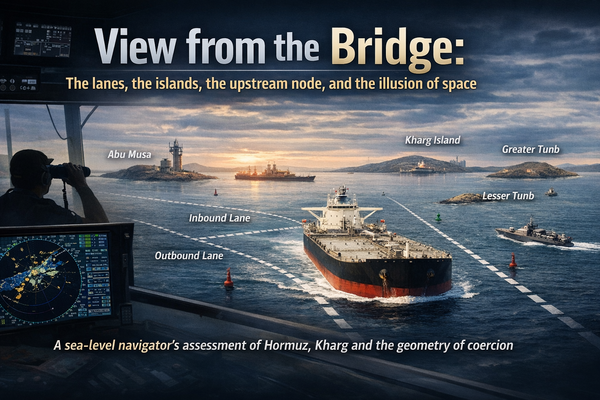
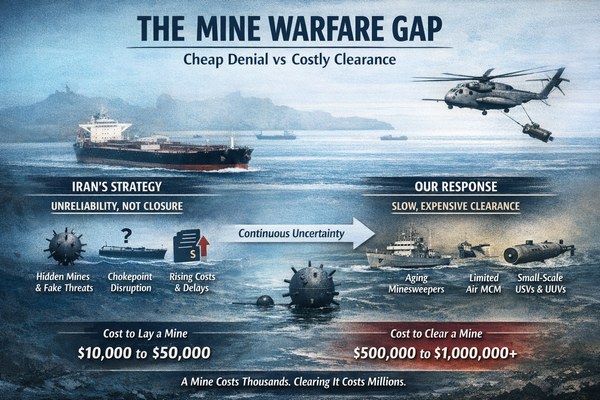
Maritime and economic blind spots widen, particularly at chokepoints such as the Strait of Hormuz and the Red Sea.
For trading states that live by the sea – including India – this matters. An Epic Fury‑style campaign can be operationally impressive and still leave the global system struggling with war‑risk withdrawals, rerouted traffic, and price spikes that were never fully confronted in Washington’s pre‑strike deliberations.
The U.S. still has immense capability and deep expertise. What has changed is how its national‑security machinery organises and filters that expertise before it is allowed to discipline presidential intent.
“The most dangerous system is not one that cannot decide. It is one that decides without fully testing what follows.”
Why Epic Fury Should Worry a Trading State
For a continental power with global financial reach, Epic Fury can appear as a demonstration of unanswerable capability and political will. For a trading state that lives by the sea, it looks rather different: a reminder that the system in Washington that now designs campaigns of this scale is better at accelerating power than at owning the consequences that follow.
India sits downstream of those decisions. Many of its crude and LPG tankers have to pass through Hormuz; its container traffic depends on Suez and Bab el-Mandeb; its refiners and exporters operate within an insurance and freight system that reprices risk faster than navies or diplomats can stabilise it. When a campaign like Epic Fury is launched without fully pricing war-risk premia, route diversions, and alliance responses, the shock does not remain local. It travels outward, into precisely the maritime and financial arteries on which India depends.
This is not an argument that the United States has become irrational or incapable. The expertise to map such consequences still exists across its departments and services. The problem is structural. The national security system’s central node, the NSC and its adviser, has evolved to smooth and accelerate Presidential Intent rather than to hold it within a full and uncomfortable Estimate of the Situation.
That is the real lesson of Epic Fury. Not simply that the United States can strike at scale, but that the burden of managing what follows is increasingly displaced outward. For countries like India, which cannot choose when Washington acts but must absorb the effects when it does, the implication is stark: in future crises, consequence management at sea will not be optional. It will be the price of dependence.