Part II - Using Theory to Read the Iran–Israel–US War
Revisiting Theories on Day 10

Have chosen to write out Part II of a series that began on Day 4 of the air war; Part I laid out certain theoretical lenses. This essay revisits the conflict with Day 10 as a base to see what those theories—and a prominent American Clausewitzian view—now reveal.
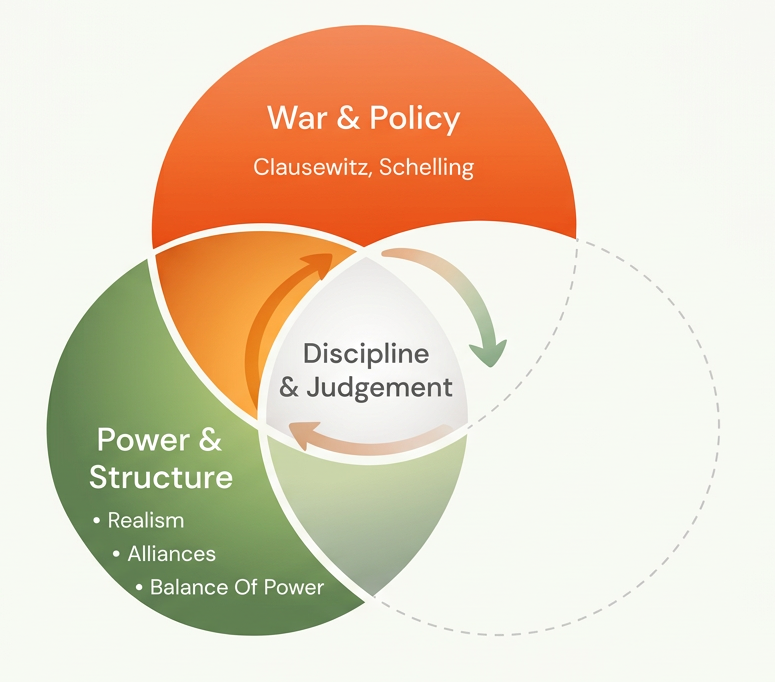
On Day 4 of the Iran–Israel–US air war, I argued that training prepares us for planning, but that education—grounded in theory—is what disciplines judgement when events outpace commentary. By Day 10, that distinction matters more, not less.
Missiles have continued to fly. Iranian leaders and IRGC commanders have been killed. Launch rates have fallen under sustained U.S.–Israel strikes. The public narrative in Washington is increasingly confident that the campaign is “working”.
John Spencer’s widely circulated Day‑7 essay crystallises that optimism through a Clausewitzian lens: clear political objectives; force systematically reducing the enemy’s capabilities; an adversary compelled to react rather than shape events. It is a tidy picture.
Clausewitz is a good place to start, but not a framework to stop with. The real test, as we roll past Day 10, is whether theory still disciplines how we read this war, or whether it is being bent to fit the story we want to tell.
Clausewitz: from clean purpose to creeping ambition
On Day 4, I used Clausewitz in a stripped‑down way: war is a tool of policy, so military action should remain tied to clear political goals, and we should be alert to the point at which pushing harder yields diminishing strategic returns.
At that point, U.S. aims sounded fairly limited: stop Iran’s nuclear weapons push, badly damage its missile arsenal, keep the Strait of Hormuz open, and stop short of openly trying to overthrow the regime. Spencer largely takes those aims at face value and argues that the war is being fought in an orderly way against them: use force to weaken Iran until it changes its behaviour.
Ten days on, the Clausewitz questions are still the right ones, but the picture is messier.
In practice, the war has gone far beyond nuclear sites and missile depots. It is hitting senior leaders, IRGC command systems and the wider proxy network. Missile and drone launches are down, parts of the navy are damaged, and the leadership is clearly under pressure.
At the same time, the real political goal has stretched. The demand is no longer just “no nuclear weapons and fewer missiles”, but also “no proxies, no terrorism, and lasting limits on Iran’s regional role”. That is very close to asking for strategic capitulation, even if no one calls it “regime change”.
Clausewitz helps us notice that shift, but cannot tell us whether such a goal is realistic at an acceptable cost, or whether U.S. politics will sustain it once casualties, economic shock and unintended consequences mount. That is where education, not just training, should force us to ask whether this has already slipped beyond the “limited war for limited aims” that Spencer describes.
Schelling: escalation ladders and the missing end‑state
In the Day‑4 essay, I borrowed Thomas Schelling’s idea of war as bargaining: force is not just about destruction; each strike sends a message about what you want and how far you are prepared to go. The danger is not escalation as such, but climbing an escalation ladder with no clear way down.
Spencer’s Day‑7 piece notes that U.S. planners are using uncertainty as a weapon—keeping Iran unsure about how long the campaign will last, how wide it could spread, and whether ground invasion or internal revolt are real possibilities. He treats that ambiguity as a deliberate use of the “fog of war” to keep Tehran off balance.
By Day 10, the ladder has many rungs already in play: killing senior leaders, large strike packages, proxy attacks from Lebanon, Iraq and Yemen, naval moves around Hormuz, and rhetoric about “unconditional surrender”. What we still do not see is a political destination Iran could recognise as a stopping point. If “unconditional surrender” really means giving up nuclear options, missiles and proxies, then for Tehran, there may be no acceptable compromise short of humiliation and exposure.
The core lesson is straightforward: pressure works best when paired with a credible offer—an off‑ramp. Training can show us how to climb the escalation ladder; education must keep asking where, if anywhere, the landing is.
Realism, alliances and balance‑of‑power: structure under the noise
On Day 4, realism shifted attention from speeches to the underlying power picture. In simple terms, it asked: how does the balance of capabilities and commitments push states toward certain choices, whether they like it or not?
Seen through that lens, and taking offensive realism as a starting point, the United States and Israel look at Iran and see a closing window: a country edging toward nuclear capability, plugged into Chinese and Russian economic networks, protected by thicker air defences and a growing missile‑drone arsenal. When you expect the future to be worse for you, you are more willing to take risks now to avoid a weaker position later.
Defensive realism, in contrast, warns that trying to reduce a threat can backfire by triggering counter‑moves and widening the circle of danger.
Ten days on, those basic pressures have not changed. What has changed is the politics wrapped around them.
Spencer’s analysis mostly takes alliances and other players as background. A wider view reminds us that alliances create their own risks. Israel experiences Iran as an immediate, existential threat; Washington has to juggle a global posture and domestic fatigue. As strikes deepen, kill leaders and destroy more infrastructure, arguments about “credibility” and “not wasting sacrifices” make it harder for the United States to step back even if its own aims are more limited than Israel’s.
Meanwhile, the broader balance‑of‑power picture is behaving exactly as textbooks suggest. China and Russia criticise the U.S., tighten economic and diplomatic links with Tehran and use the crisis to paint Washington as reckless—but stop short of moves that could drag them into a direct clash with American forces. Gulf states hedge: they quietly enable parts of the campaign while also keeping options open with Iran and other great powers.
Realism’s value here is not that it tells us who is right, but that it injects humility into analysis. Ten days of impressive strikes do not erase the deeper incentives and fears driving each actor. That should make us wary of confident claims that this campaign has already produced “irreversible” strategic change.
Maritime strategy and India: from abstract risk to priced‑in exposure
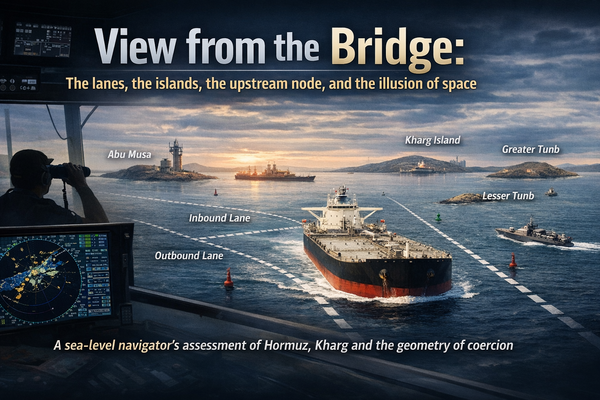
In the first essay, I leaned on Mahan, Corbett and basic choke‑point logic to make a simple point: for India, the Strait of Hormuz and the Red Sea are not distant geography, they are pressure points. If shipping through these narrows is threatened—or even seen as risky—insurance costs jump, routes shift, and the Indian economy feels it quickly. I used that to provoke thought from a maritime perspective, because India’s strategic reflexes remain overwhelmingly continental; we still tend to think in terms of land borders and the LAC, even though our growth, energy security and diaspora are now tied far more tightly to sea lanes than to mountain passes.
By Day 10, it is clear that we are sliding towards a full‑blown maritime crisis, and the risk is no longer hypothetical. Markets are already pricing in the possibility of prolonged tension around Hormuz, and shipping and energy companies are quietly adjusting. For New Delhi, that confirms the earlier argument rather than weakening it. Plans for naval presence, diaspora evacuation and energy buffers cannot be occasional add‑ons; they are the practical face of strategic education and maritime strategy. Training will move ships and run Noncombatant Evacuation Operations (NEO) once the order is given. Education is what helps us see the need early, from patterns and structure, and not only when the headlines scream.
The gap that Part III will address
The aim of this Day‑10 exercise has not been to predict outcomes, but to test whether the theories we reached for on Day 4 still sharpen our questions instead of merely buttressing arguments. A theoretical examination should help us notice drift in political aims, gaps in escalation logic, the quiet pull of structural incentives, and the way India is increasingly exposed when Hormuz shifts from a feature on a map to a risk. Those are only the first layers.
If education is to be more than the ability to quote Clausewitz and Schelling, we need to broaden the toolbox further. The next step is to look directly at additional frameworks—cognitive, organisational and ideational—that further discipline how we think about war and about ourselves. That is the blank space in the graphic above; it is where Part III will pick up.
I have, in the past, used some, if not all, of these frameworks in places like DSSC Wellington to strengthen critical thinking among our budding middle‑level leadership and to push education beyond our familiar penchant for training.
Part III follows.