Part III - Using Theory to Read the Iran–Israel–US War
Certain additional frameworks to discipline judgement as Day 12 brings no respite in rhetoric, and no tankers cross the Strait of Hormuz.”

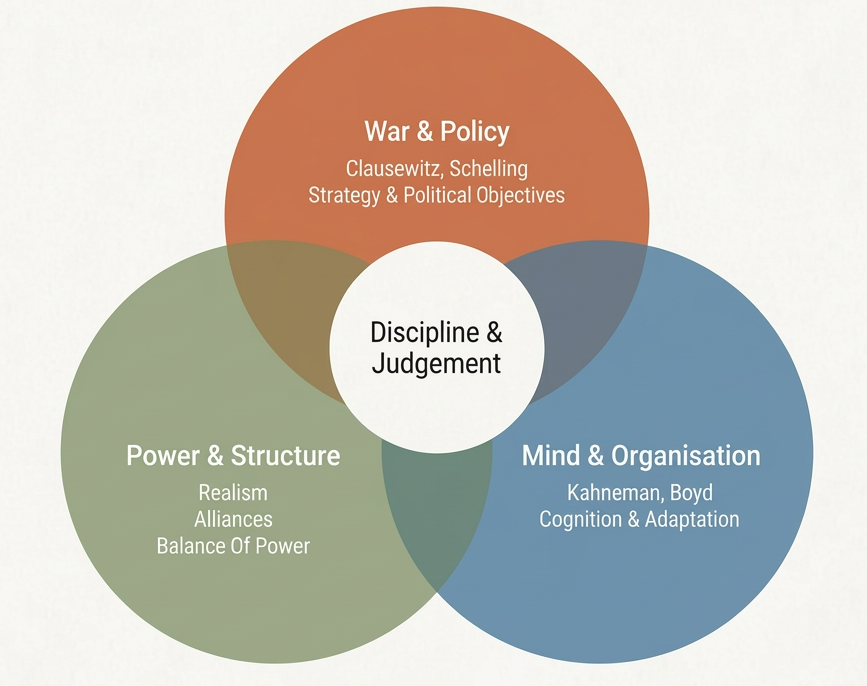
First, the simple Ends–Ways–Means framework and basic victory theory are brutally clear. They force us to state political ends, the strategic and operational ways chosen to reach them, and the means—military, economic, diplomatic, societal—we are actually prepared to spend. Looked at this way, the United States and Israel appear to be pursuing a very ambitious end (transforming Iran’s nuclear, missile, proxy and maritime posture) with deliberately constrained means (no declared ground invasion, finite domestic tolerance, alliance frictions), while the “ways” keep expanding as success builds confidence. Victory theory then adds the uncomfortable question John Spencer (introduced in Part II) largely brackets: what post‑war political condition, inside Iran and across the region, would count as success—and is the current campaign really steering toward it?
Second, cognitive and behavioural lenses remind us that leaders and analysts are not rational actors sitting outside events; they are humans inside them.
Prospect theory—developed by Daniel Kahneman and Amos Tversky—suggests that actors in a perceived domain of losses become more risk‑acceptant, not less. Daniel Kahneman was a cognitive psychologist, best known for his work on judgement, decision‑making under uncertainty and behavioural economics, for which he received the Nobel Prize in Economics. That helps explain why Tehran might escalate even under severe material damage, and why Washington and Tel Aviv may find it harder to trim objectives as sunk costs and reputational stakes rise. Research on crisis decision‑making shows that three very human habits tend to distort judgement just when leaders can least afford it:
Confirmation bias: We look for and trust information that supports what we already believe, and we discount or ignore information that contradicts it. In a war room, that means staff and leaders latch onto reports that show the plan is working, and mentally push aside signals that things are going wrong or that the enemy is adapting.
Framing effects: The way a choice is described can make it look riskier, even when the underlying numbers are the same. A plan presented as “preventing losses” feels different from an option described as “chasing gains”, and people tend to take more risks to avoid losses. In crises, leaders become more willing to gamble to avoid admitting defeat than to achieve an equivalent advance.
Overconfidence: Under pressure and with incomplete information, leaders often feel more certain than the facts justify—about what the enemy will do, how allies will react, or how controllable escalation really is. This false confidence can lead them to discount worst‑case scenarios, underestimate timelines and costs, and keep doubling down on a failing approach.
Put simply, when the stakes are highest, these biases make it easier to talk ourselves into staying on the same path, taking bigger risks, and ignoring warning signs—just when we most need scepticism and humility.
If Indian PME does not explicitly teach officers how to recognise and check these biases—in ourselves as much as in adversaries—we will mistake psychological momentum for strategy. It was for this reason that, at the Staff College in Wellington between 2015 and 2023, I used Kahneman’s work and prospect theory in a Critical Thinking series, including the British campaign in Helmand as a live case of how “winning hearts and minds” can be quietly distorted by heuristics and bias.
A contemporary example relevant to the ongoing crisis is President Trump’s and even Israeli PM Netanyahu's (as now being reported) call for Iranians to rise, with promises of support: in prospect‑theory terms, a classic set‑up for disappointment. In conflict, both militaries and development actors tend to over‑promise and under‑deliver, raising expectations and then dashing them; people then seek to avoid further loss rather than buy into overstated “gains”, precisely the opposite of what strategy intends.
Third, organisation theory and the OODA loop draw our attention to how institutions think. John Boyd’s Observe–Orient–Decide–Act cycle has been oversimplified into a fetish for speed in decision-making, but his real emphasis was on orientation: how organisations make sense of information and update their mental models under pressure. Frans Osinga’s Science, Strategy and War: The Strategic Theory of John Boyd is particularly useful here, because it shows that Boyd’s real project was not just energy–manoeuvrability theory in fighter aviation but is a general theory of adaptive organisations in conflict—how to build forces and headquarters that continuously refine their mental models faster than an adversary, rather than simply process more data more quickly.
The current war is, among other things, a contest between organisations: U.S. and Israeli structures designed for fast, networked targeting; Iranian structures struggling to adapt under leadership decapitation and damage to command‑and‑control.
In India, we should be trying to learn the right lessons from what is unfolding, not just the most dramatic ones. Education must produce officers who can re‑orient doctrine, not merely execute it, and institutions that allow such re‑orientation to cascade into real decisions and revised plans as circumstances change. The Iraq “surge of ideas” under Petraeus and Ukraine’s rapid adaptation in the face of a Russian assault both show what is possible when doctrine, structure and education align; the slow British learning curve in Helmand shows what happens when they do not.
Finally, constructivism reminds us that wars are fought not only over interests but over identities and narratives. Iran’s self‑conception as a revolutionary Islamic republic, Israel’s identity as a besieged Jewish state, and the United States’ domestic story about strength, credibility and “never another humiliation” all shape what each side sees as acceptable risk or tolerable compromise. Spencer’s Clausewitzian confidence that the United States is “imposing its will” is, in this sense, only half the story. The other half is what each protagonist believes this war is about and what it would symbolically mean to bend—or not bend.
For Indian decision‑makers, any education worthy of the name has to include this uncomfortable insight: material power matters, but how we and others name a war often decides how far we are willing to go, and how hard it is to stop.
Beyond Clausewitzian logic
Spencer’s Day‑7 essay is, in many ways, good professional work. It keeps asking what the military campaign is supposed to achieve politically. It treats the war as a clash of wills rather than a scoreboard of destroyed targets, and it treats uncertainty as something to manage rather than as a cause for panic. In that sense, it sits squarely in the Clausewitz tradition, and it is far more serious than most commentary around this war.
The problem is what happens when we use only that one way of thinking. If we just check whether the force matches the stated aims, we quietly start treating those aims as fixed and wise, instead of asking how they change under pressure. If we equate damaged missiles and dead commanders with “our will” being imposed, we forget that the enemy has politics and choices of its own, and that war is an ongoing relationship, not a one‑sided performance. If we think of uncertainty only as a weapon against the other side, we miss the way the same fog creeps back into our own headquarters and cabinets.
The point of reaching for theory on Day 4 was never to forecast outcomes. It was to give ourselves a disciplined way to frame questions.
As the tenth day rolled by, such approaches are still relevant. Clausewitz, Schelling, realism, alliance theory, balance‑of‑power thinking, maritime strategy, and the additional lenses I have sketched do not tell us who will “win” this war, even if many tactical victories are proclaimed. What they do is more modest and more useful: they keep our questions sharper than the slogans and our sense of risk wider than today’s headlines.
For India, that is the real test of education. In war, training wins tasks; theory disciplines judgement. The question our institutions must face is simple and uncomfortable: as this conflict evolves, are we just watching events unfold, or are we educating ourselves fast enough to truly read what is happening?