Series: Asymmetric Warfare in the Modern International System
Foreword: Asymmetric Warfare and the US–Israel–Iran Crisis

Modern wars rarely end with clear victory parades. Since 1945, many conflicts have been contests not of conquest, but of endurance.
Modern wars rarely resemble the decisive interstate struggles that shaped earlier centuries. The vast conflicts of the twentieth century often ended with surrender ceremonies and redrawn borders. Yet most wars fought since the end of the Second World War have unfolded very differently. They have taken place under conditions of deep asymmetry, where one side possesses overwhelming military and technological superiority while the other adopts strategies designed not to defeat that power outright but to survive, disrupt and impose cumulative costs.
This pattern has recurred throughout the post-1945 international system. In Vietnam, Afghanistan and Iraq, materially stronger powers achieved rapid battlefield dominance yet struggled to translate military superiority into durable political outcomes. Their adversaries rarely sought victory in the conventional sense. Instead, they pursued strategies of endurance, denial and political leverage, shaping wars whose outcomes were measured less by territorial conquest than by the sustainability of pressure over time.
The result has been a distinctive form of asymmetric conflict in which victory itself becomes difficult to define. Stronger powers seek to restore stability, suppress disruption and maintain control of critical systems. Weaker actors pursue survival, strategic denial and the ability to remain dangerous enough to influence the political outcome.
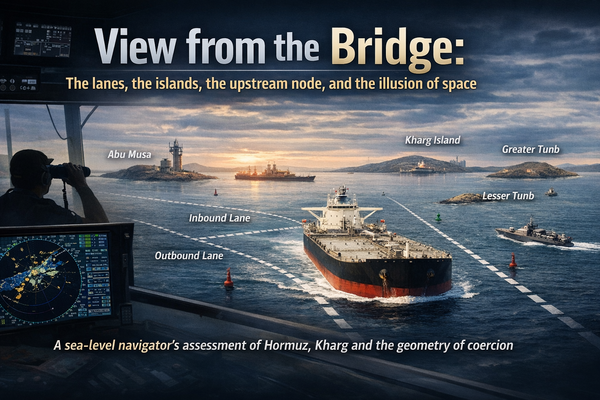
The current crisis around the Strait of Hormuz has once again drawn global attention to the vulnerability of maritime trade and the strategic importance of the Gulf. Yet the events unfolding in the region offer more than a news story. They provide a window into a recurring strategic pattern that has shaped many wars since 1945.
Across conflicts from Vietnam to Afghanistan, from Iraq to numerous post-colonial insurgencies, stronger and weaker actors have repeatedly confronted the same structural dynamics: military asymmetry, political constraints and limits on escalation.
Understanding these patterns is essential if we are to make sense of why powerful states so often struggle to convert battlefield superiority into decisive political outcomes. The diagram below captures the structural logic that has repeatedly shaped asymmetric wars in the modern era.
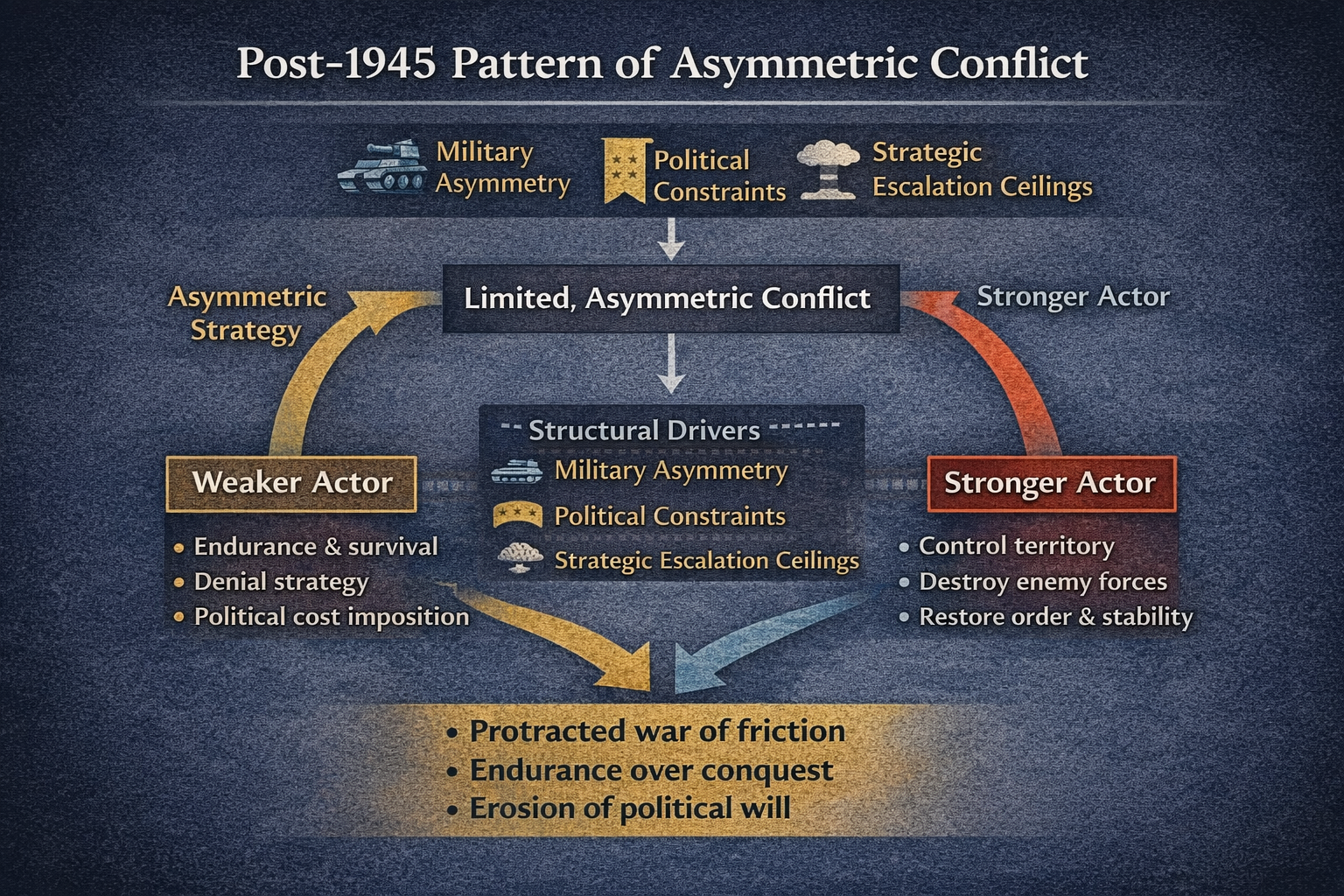
A structural pattern of modern war
Three structural conditions repeatedly produce these kinds of conflicts.
First, military asymmetry. One actor enjoys overwhelming advantages in conventional military capability, technology and logistics.
Second, political constraint. Domestic opinion, alliance management and international legitimacy limit the stronger actor’s freedom of action.
Third, strategic ceilings. Nuclear weapons and global economic interdependence discourage escalation toward unlimited war.
When these conditions combine, wars rarely resemble the decisive interstate conflicts of earlier eras. Instead, they produce prolonged contests in which endurance, signalling and political will matter as much as battlefield outcomes.
In an asymmetric war, the weaker side need not win.
It only needs to avoid losing.
Lessons from recent conflicts
The pattern is visible across many conflicts of the modern era.
During the Vietnam War, the United States possessed overwhelming military superiority. Yet its adversaries adopted strategies aimed at eroding political support for the conflict rather than defeating American forces outright.
In Afghanistan, both the Soviet Union and later ISAF/NATO discovered that conventional dominance did not translate easily into political control when confronted with an adversary willing to fight a long war.
The Iraq War followed a similar trajectory. The rapid collapse of Iraqi state power in 2003 was followed by prolonged instability as insurgent groups adopted strategies aimed not at battlefield victory but at making the occupation politically unsustainable.
These examples reveal a structural truth about asymmetric war: the weaker actor rarely seeks decisive military victory. Instead, it seeks to survive, impose costs and stretch the timeline of conflict.
The Gulf crisis as a contemporary example
The present confrontation involving the United States, Israel and Iran appears to follow many elements of this broader strategic pattern.
Recent reporting on the unfolding crisis in the Gulf illustrates this dynamic in real time. American officials have indicated that the immediate military effort is focused on degrading Iran’s ability to threaten shipping by targeting missile launchers, drone infrastructure and naval assets associated with maritime harassment. Only after those capabilities are sufficiently reduced might the United States and its partners consider escorting commercial tankers through the Strait of Hormuz, possibly under an international coalition framework.
The sequence reflects a familiar logic in maritime strategy: first suppress the denial capability, then attempt to restore access.
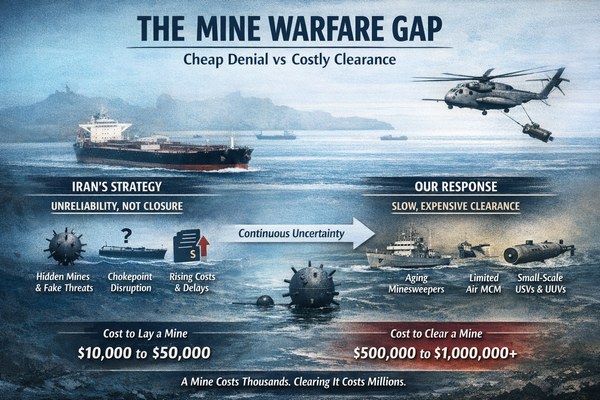
Yet the asymmetry remains clear. Iran does not need to defeat a stronger navy in battle in order to shape outcomes in the Gulf. It only needs to create enough uncertainty and episodic disruption to affect shipping behaviour, insurance pricing and the political calculations of energy-importing states.
In such circumstances, the decisive effects of maritime conflict may appear less in naval engagements than in freight rates, war-risk premiums and the willingness of commercial actors to sail.
At Hormuz, the battlefield is not only the sea.
It is also the global energy market.
Asymmetric War - A Trilogy
The crisis in the Gulf is therefore not simply a regional confrontation. It is also a contemporary illustration of how asymmetric conflict unfolds in the modern international system. The essays that follow examine this dynamic through three connected lenses.
Part I — The Security–Insecurity Spiral
How defensive strategies can unintentionally generate escalating insecurity between adversaries.
Part II — Hormuz and the Maritime Battlespace
Why the Strait of Hormuz has become the arena where military competition intersects with global energy flows, maritime risk and the hidden financial architecture of trade.
Part III — Theories of Victory in Asymmetric War
How stronger and weaker actors define success differently, and why such conflicts often produce competing narratives of victory.
The essays that follow move deliberately from cause to arena to outcome — tracing how insecurity spirals into confrontation, how geography and markets shape the battlefield, and how rival theories of victory ultimately determine the political meaning of war.
The crisis in the Gulf is therefore not only a regional conflict. It is also an example of the deeper strategic pattern that has shaped many wars since 1945. Understanding that pattern is the purpose of this series.
Part I — The Security–Insecurity Spiral
Part II — Hormuz and the Maritime Battlespace
Part III — Theories of Victory in Asymmetric War
The full Trilogy will be released to Nitividya Subscribers over the weekend.