The Gulf Crisis as a Strategic Audit of India’s Maritime Strategy:
Missiles, Mines and the Multi-Domain Test at Sea


This essay follows my three‑part series, India’s Defence Budget in an Age of Strategic Compression, which argued that India’s grand strategy remains tilted toward continental reflexes even as its real vulnerabilities are increasingly maritime.
I had other posts planned in this series, but the Gulf crisis demands a pause in that schedule: it offers a live audit of what India’s maritime strategy actually delivers at sea.
The current joint United States–Israel strikes on Iran, followed by Iranian retaliation, have already begun to spill into the maritime risk picture. Shipping advisories now explicitly warn of missile and drone threats, regional escalation, and even interference with vessels’ navigation systems.
For India, this matters for two structural reasons that go well beyond short-term oil price spikes or evacuation planning.
First, India’s economy is fundamentally shipping-dependent. Official data consistently indicate that roughly 95 per cent of India’s trade by volume — and around 68–70 per cent by value — moves by sea. Maritime disruption, therefore, is not a sectoral disturbance. It is a macroeconomic shock vector.
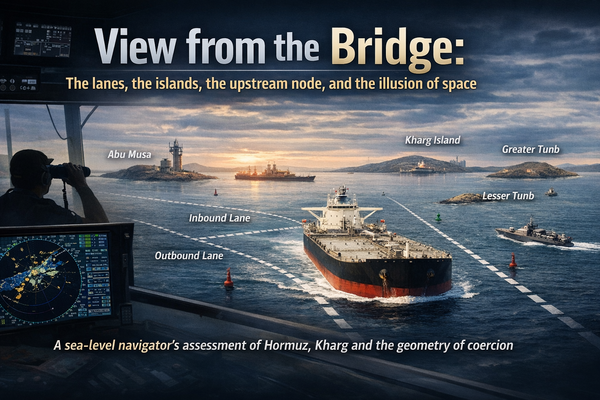
Second, the risk arena is concentrated and geographically predictable. The Persian Gulf–Strait of Hormuz corridor remains the principal artery through which critical energy flows and significant commercial traffic transits before entering the Arabian Sea.
The present crisis should therefore be read not as a distant geopolitical episode, but as a live strategic audit of India’s national design. The question is whether India can assure vital sea lines of communication under modern threat conditions — missiles, drones, mines, boarding or seizure risks, and electronic interference — rather than under peacetime assumptions of benign passage.
“The Gulf crisis is not an oil‑price story. It is a live strategic audit of India’s ability to keep its seaborne lifelines open in bad times, not just in good.”
From Tanker War to a Multi-Domain Contest
During the 1980s Tanker War phase of the Iran–Iraq conflict, what mattered strategically was not the precise tally of attacks, but how maritime security was organised. Large external navies established escort and protection regimes to keep oil flowing through Hormuz despite the sustained risk of attack. The most prominent was the United States’ reflag-and-escort framework known as Operation Earnest Will, under which Kuwaiti tankers were reflagged and convoyed through the Gulf beginning in July 1987.
Two features of that episode foreshadow today’s dilemmas.
First, escort regimes were explicitly designed to assure energy flows under threat conditions. Contemporary U.S. Congressional Research Service reporting in 1987 makes clear that the purpose of the reflag-and-protect plan for eleven Kuwaiti tankers was to sustain commercial traffic despite the risk of missile, air, and small-boat attacks. Maritime security architecture was deliberately designed to prevent disruption from becoming a strategic lever.
Second, mines proved to be the quintessential “cheap disruption” tool. In July 1987, the reflagged tanker Bridgeton, sailing under U.S. escort, struck a mine. The incident was strategically revealing: a single mine event embarrassed a high‑visibility convoy and instantly elevated mine countermeasures to operational priority. The lesson was not that escorts were redundant. It was that sea control without a credible mine-clearing capacity is structurally incomplete.
“Sea control without mine‑clearing capacity is incomplete by definition — and in a Gulf contingency, that incompleteness would become visible very quickly.”
The British experience underscored the same constraint. Parliamentary records from 1988 show that the Royal Navy’s Armilla Patrol accompanied hundreds of entitled merchant vessels through the Strait. Yet escort capacity was finite and had to be prioritised. Security at scale required sustained naval presence, coordination and deliberate trade-offs.
The strategic baseline of the 1980s is therefore clear: security architecture in the Gulf was built and led by external powers. Third‑party trading states benefited unevenly, depending on political alignment and proximity. India, though economically exposed, was not a primary rule‑setter in Gulf convoy practice.
In early 2026, the Royal Navy withdrew its last permanently stationed warship from Bahrain, ending a continuous British fighting-ship presence in the Gulf dating back to the Armilla Patrol era. The dense European-led escort frameworks of the Tanker War years cannot be assumed any longer.
“In the 1980s, others decided how much risk India’s tankers would bear. Today, India is expected to help decide that risk for itself — and for others.”
That is precisely the contested question today.
The Gulf–Hormuz Corridor as India’s External Maritime Front Line
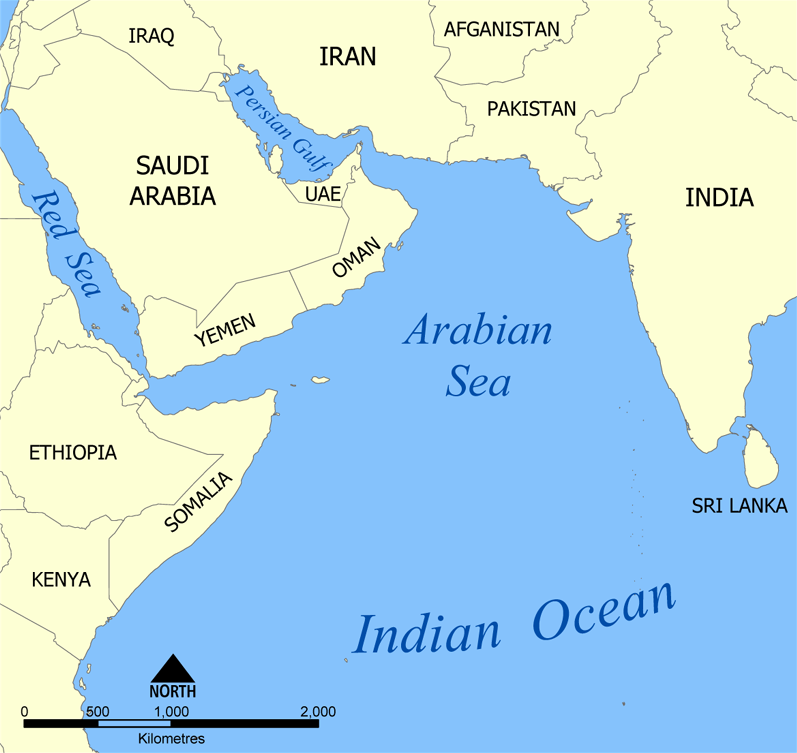
Describing the Persian Gulf–Strait of Hormuz corridor as India’s “external maritime front line” is not a rhetorical flourish. It rests on three hard structural facts: energy dependence, chokepoint centrality and diaspora exposure.
1. Energy Dependence and Fiscal Sensitivity
India imports roughly 85 per cent of its crude oil requirement. Budget analyses and parliamentary research notes consistently underscore that oil imports remain a primary driver of the trade deficit and a direct transmission channel into inflation and fiscal stress.
There has been diversification since 2022. Russia’s share in India’s crude basket has risen sharply, while the proportional share of some Middle Eastern suppliers has declined. This reduces the risk of concentration, but it does not eliminate Gulf exposure. A significant portion of total crude and LNG still transits the Gulf–Hormuz–Arabian Sea corridor.
“Diversifying crude suppliers is not the same as diversifying sea lanes. When Hormuz is under stress, India’s energy security is under stress.”
The vulnerability is therefore not only about price spikes. It is about physical flow assurance under threat conditions.
2. Hormuz as a Quantitatively Decisive Chokepoint
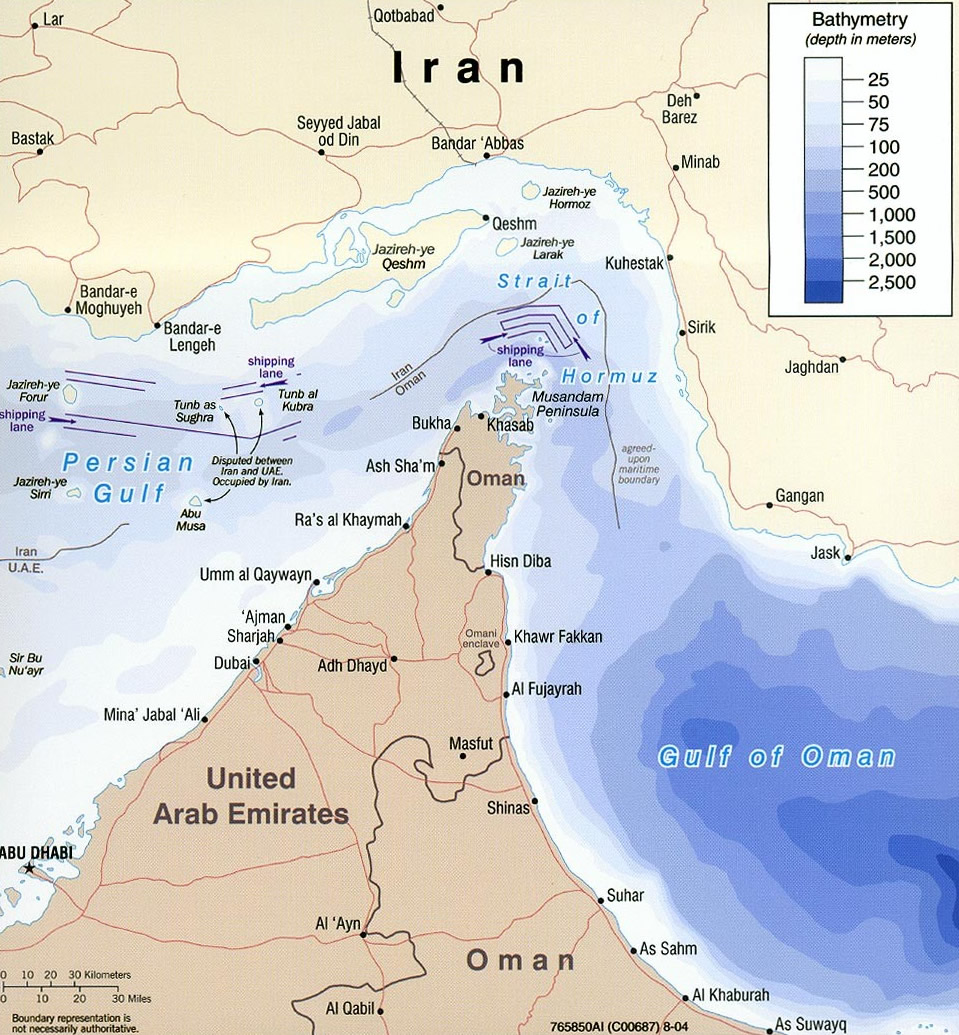
The Strait of Hormuz is not merely “important”; it is systemically central. In 2024, oil flows through Hormuz averaged about 20 million barrels per day — more than one‑quarter of global seaborne oil trade and roughly one‑fifth of global oil and petroleum product consumption. Around 84 per cent of the crude and condensate, and 83 per cent of the LNG, moving through the strait went to Asian markets; China, India, Japan and South Korea together accounted for about 70 per cent of these flows.
This reframes the strategic question.
The issue is not whether Iran could “close Hormuz” in some absolute, binary sense; closure is dramatic and unlikely to be sustained. The real question is more granular: how much assured flow can India count on if a prolonged crisis produces intermittent mining threats, missile risk, boarding or seizure incidents and elevated insurance premiums?
Most cargoes transiting Hormuz have limited immediate alternatives, and existing bypass pipelines cannot replicate Gulf seaborne flows at scale, so even partial disruption has implications.
3. Diaspora, Evacuation and Remittance Stakes
The Gulf is not only an energy corridor. It is also home to large Indian resident populations across the Gulf Cooperation Council states, particularly in the United Arab Emirates and Saudi Arabia, with substantial communities in Oman, Qatar, Kuwait and Bahrain.
This anchors a recurring logistical reality. In crisis scenarios, evacuation planning cannot rely exclusively on air corridors. Airspace disruption, port congestion, and regional spillover make maritime lift capacity integral to contingency planning.
Remittances reinforce the point. While advanced economies now contribute a larger aggregate share of India’s inward remittance flows, the UAE remains among the top single-country sources. Gulf labour markets and stability, therefore, continue to matter for India’s external account resilience in stress periods.
From Episodic to Routine Maritime Security
The strongest evidence that India’s position has changed lies not in declaratory policy, but in operational record.
Over the past decade, “Mission Based Deployments” have institutionalised near‑continuous naval presence across key maritime theatres — the Gulf of Oman, the Persian Gulf approaches, the Gulf of Aden and the Red Sea corridor.
The numbers matter. Anti‑piracy patrols in the Gulf of Aden began in 2008 and have continued without interruption; since then, around a hundred Indian naval ships have rotated through the theatre — an endurance signal of both operational capacity and political will. The earliest deployments sailed as essentially lone escorts, refuelling at ports such as Salalah and Djibouti before gradually plugging into a denser web of coalition logistics and coordination, but the patrol line itself never broke.
More recently, in the period up to late 2024, the Navy deployed over thirty ships in response to Houthi shipping attacks and renewed piracy risks in the Red Sea–Arabian Sea arc, responded to more than 25 maritime incidents, and escorted over 230 merchant vessels carrying around 9 million tonnes of cargo. In the Red Sea–Western Arabian Sea and Gulf of Aden, India’s role has been defensive and protective at sea — escorting, investigating and rescuing ships caught up in Houthi attacks or piracy — while leaving offensive strikes against Houthi targets in Yemen to the US–UK coalition.
These are not symbolic deployments. They represent sustained maritime security operations under contested conditions; incidents involving commercial shipping in the Red Sea have required Indian naval vessels to conduct evacuation and crisis‑response tasks amid active missile and drone threats.
“Rescue and escort are no longer benign constabulary functions. They occur in environments where kinetic risk is real.”
They are how India now lives its maritime strategy, under missile, drone and mining risk
What This Reveals About Strategy
India’s maritime strategy is no longer confined to white papers or doctrinal exposition. It already functions as a standing operational system across the north-west Indian Ocean.
Surveillance. Escort. Evacuation. Incident response. Presence. These are no longer episodic tasks but the nature of India’s maritime security operations in the Gulf–Hormuz–Arabian Sea arc. This matters because the Gulf–Hormuz–Arabian Sea arc is precisely the arena that becomes decisive when regional conflict spikes.
The question, therefore, is no longer whether India is present.
The sharper question is whether routine presence scales into assured sea control under multi-domain stress — particularly when mines, missile saturation and electronic disruption enter the equation.
Capability Audit Under Modern Threats: Escorts, Surveillance and the Mine Warfare Gap
The “strategic audit” framing becomes most meaningful when tied to the actual threat spectrum that contemporary shipping advisories now highlight: missile and drone strikes, port attacks, harassment or boarding risk, electronic interference, and spillover across the Arabian Sea and toward the Bab al-Mandeb.
This is not a theoretical escalation ladder. It is an observed threat menu.
Escorts and Air Defence Density
The key analytic issue is not a raw ship count — which quickly becomes outdated — but the mathematics of convoy protection under multi-domain stress.
Convoy operations are ship-intensive. Effective escort requires layered defence:
· Point defence against drones and small missiles
· Area air defence against higher-end threats
· Aviation support and surveillance
· Sustainment, replenishment and rotation
The Tanker War illustrated how quickly force requirements expanded once escort extended beyond a narrow set of flagged vessels. Protection at scale requires depth, not symbolism.
Today’s environment poses a risk of air and missile defence saturation. Even shipping advisories now warn explicitly of missile and drone attack threats, as well as navigation disruption. That implies requirements beyond hull presence:
· Modern sensor integration
· Electronic warfare resilience
· Sufficient interceptor inventory
· Crew endurance for sustained high-alert operations
For India, escort credibility is not demonstrated by presence alone. It is measured by whether protection can be sustained for weeks or months without stripping other theatres and without relying on another power’s air umbrella.
That is the real audit standard.
Surveillance, Cueing and Maritime Domain Awareness
India’s posture in this domain is more robust.
Mission-based deployments are explicitly designed to enhance surveillance and maritime security operations. The Indian Navy now operates within an incident-response ecosystem that integrates international maritime reporting channels, partner inputs and sensor fusion rather than relying solely on platform visibility.
This shift from platform-centric surveillance to information-fusion surveillance is strategically important.
Operational reporting in recent years shows Indian naval units responding to incidents flagged through multinational reporting mechanisms, demonstrating functional integration within a wider maritime security architecture.
Investment signals reinforce that this layer is considered enduring. Recent procurement approvals for additional long-range maritime reconnaissance aircraft indicate that the requirement for persistent ISR across the north-west Indian Ocean is not episodic but structural.
In surveillance and cueing, India has moved beyond symbolic presence toward a standing system.
The stress question is scalability — not conceptual validity.
Mine Countermeasures: The Structurally Damaging Gap
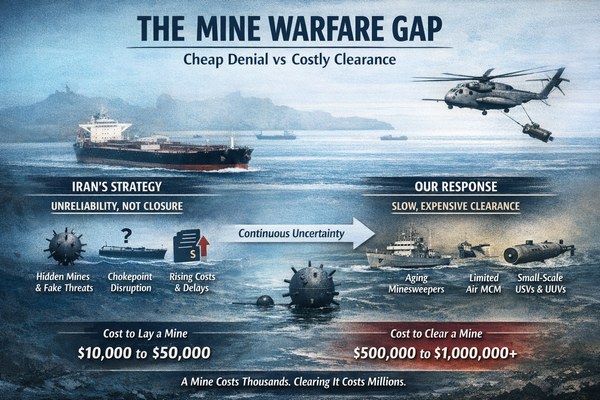
The mine warfare deficit remains the most consequential capability gap in precisely the kind of Gulf scenario under discussion.
Mines are not spectacular weapons. They are strategic friction tools. They:
· Create uncertainty without attribution
· Drive up insurance premiums
· Slow traffic without sustained high-end operations
· Convert a naval contest into a logistics and confidence crisis
Open‑source reporting has stated clearly that India currently has no dedicated mine countermeasure vessels in service; earlier minesweeper classes were decommissioned, and a long‑running programme to acquire new MCMVs was cancelled after procurement disputes. In practice, this has meant leaning on non‑specialist surface combatants, diving teams and ad hoc arrangements with partners to manage mine risk, rather than fielding a purpose‑built MCM force. In effect, the Navy has had to rely on temporary or improvised solutions while awaiting revival of a dedicated programme, and only recently has a fresh hunt for new MCM vessels been launched and accorded procurement approvals — an explicit institutional acknowledgement of the gap rather than its closure.
India has also begun to explore airborne mine‑detection systems for its MH‑60R and other naval helicopters through new iDEX problem statements, but these initiatives remain at the development stage; they are potential complements, not substitutes, for dedicated mine‑countermeasure vessels in a Hormuz‑centred contingency.
The strategic question, therefore, is temporal: whether these corrective moves mature before or after a crisis in which intermittent mining becomes the chosen tool of disruption.
If intermittent mining were used in Hormuz during a sustained crisis — the historically common pattern — India would face a stark choice:
· Rely on partner navies for mine clearance and safe-lane assurance; or
· Accept higher economic costs and operational risk while waiting for clearance capacity to materialise externally.
Either outcome weakens the credibility of a “net security provider” narrative if dedicated mine countermeasure capability is absent when most needed. Sea control without mine-clearing capacity is incomplete by definition.
In a multi-domain Gulf contingency, that incompleteness becomes visible very quickly.
What This Means for India’s Maritime Strategy
The core focus of this post is simple: the Gulf crisis should not be read merely as an oil-price story. It is a flow-assurance stress test.
The evidence suggests three analytical upgrades that sharpen the argument.
1. Make “Assured Flow” the Central Metric
The debate over whether Iran can “close Hormuz” is strategically misleading. Closure is dramatic but unlikely to be sustained. The more meaningful metric is dependable flow under elevated risk.
Hormuz carries a material share of global seaborne oil and LNG trade, with the overwhelming majority of those flows destined for Asian markets, including India. Even partial disruption — intermittent mining, missile risk, electronic interference or tanker harassment — can degrade confidence, increase insurance premiums and slow throughput.
Recent shipping advisories already reflect this logic. Route adjustments and heightened security postures follow immediately after strikes, even without formal closure. The market reacts to risk probability, not just to physical denial.
India’s maritime strategy should therefore be judged by one question: How much critical energy and trade flow can be assured under stress?
2. Define “Independent but Interoperable” Behaviourally
India’s posture is best described as tactically cooperative but politically guarded.
Operationally, the Navy shares information, conducts deconfliction, escorts shipping, responds to incidents and participates in multinational maritime security architectures. Institutionally, India now occupies leadership roles within the Combined Maritime Forces (CMF) architecture in Bahrain, including command of Combined Task Force 154 (CTF 154) a multinational training task force focused on maritime awareness, interdiction, rescue and assistance, and leadership development across the Middle East.
At the same time, India avoids automatic incorporation into campaign coalitions that could constrain political autonomy.
This behavioural pattern — cooperate tactically, retain strategic discretion — is the most defensible expression of multi-alignment at sea.
But such a posture retains credibility only if India has sufficient capability to act independently when required.
3. Expose the Timeline Mismatch in Mine Countermeasures
The minesweeper story is not merely a procurement anecdote. It is a structural vulnerability.
The last dedicated minesweeper was decommissioned in 2019, reducing specialised mine countermeasure capability to zero. Acceptance of Necessity (AoN) for new MCM vessels has since been approved, signalling institutional recognition of the gap. Yet approvals are not hulls in water.
Meanwhile, the operational environment has already shifted. Shipping advisories now warn of missile, drone and navigation risks in precisely the theatre where mining has historically been used as a low-cost disruption tool.
The timeline mismatch is stark: Capability gap emerges → procurement delays → operational risk materialises → capability regeneration remains pending.
In a Hormuz-centred contingency involving intermittent mining — the historically common pattern — India would face a choice between relying on partner navies for clearance or accepting economic and operational friction while waiting for external capacity to build.
A Four-Pillar Framework for Strategy in Bad Times
If the Gulf is India’s external maritime front line, then its strategy under stress should rest on four pillars:
1. Assured SLOC Function
Sustained escorting, rerouting and coordination under missile, drone and mining risk — not for days, but for extended periods.
2. Rescue and Diaspora Protection
Routine crisis-response capability scalable to evacuation-relevant logistics for large regional and Indian diaspora in Gulf communities, potentially under airspace disruption.
3. Credible Autonomy
The capacity to act without default reversion to the 1980s pattern of dependence on external mine-clearance or air-defence umbrellas.
4. Order-Shaping Participation
Selective leadership roles within regional maritime architectures to shape procedures and interoperability norms — without automatic alignment with any one power’s campaign objectives.
Strategic Bottom Line
India has built a credible presence-and-operations model in the north-west Indian Ocean.
What remains under audit is whether that model can scale into assured sea control under multi-domain stress — particularly in the niche that history suggests adversaries are most likely to exploit.
In bad times, maritime strategy is not measured by communiqués.
It is measured by flow.