The International Law of Military Operations, IRIS Dena and Self‑Defence at Sea
How a US submarine strike in the Indian Ocean tests Article 51, warship immunity and the limits of “anticipatory” self‑defence

This winter, I convened and taught an elective at the National Law School of India University (NLSIU), Bengaluru, titled “The International Law of Military Operations” (ILMO). LLB and LLM students spent weeks wrestling with a deceptively simple sentence: Article 51 of the UN Charter, the clause that preserves the “inherent right of individual or collective self‑defence if an armed attack occurs.” We walked through the Caroline incident, key judgments of the International Court of Justice (ICJ), and India’s own practice after 2016.
This afternoon, the news broke that a US submarine had sunk an Iranian warship, IRIS Dena, off Sri Lanka. What makes this attack poignant and will shock Indian sensibilities is that the ship was at Vizag on the east coast for the International Fleet Review and MILAN as a guest of India and the Indian Navy.
Suddenly, the elective’s hypotheticals turned into a live case to be discussed and debated.
Thanks for reading नीतिविद्या | Nitividya – Strategy, Institutions, Power! This post is public, so feel free to share it.
What happened in the Indian Ocean?
Public reports are still evolving, but the outline is clear enough for legal analysis. IRIS Dena, a Moudge‑class Iranian frigate, was transiting south of Sri Lanka after participating in the International Fleet Review and the MILAN 2026 exercises off India. Somewhere beyond Sri Lanka’s territorial sea, in international waters, a submarine torpedoed the ship. The vessel sank; some sailors have been rescued, many are reported by Sri Lankan authorities as dead, and many remain missing. US defence secretary Pete Hegseth has since confirmed that a US submarine carried out the attack, presenting it as one move in a wider US campaign to protect its forces and degrade Iran’s military capabilities in self‑defence.
The geography matters. This was not an engagement in the Persian Gulf or the Red Sea, but the deliberate sinking of a foreign warship on the high seas of the Indian Ocean, close to a third state’s coast. Many lawyers would see it as part of a broader pattern of low‑level US–Iran clashes rather than a formally declared war. Some would go further and say that, whenever regular armed forces of two states exchange fire, you already have an international armed conflict, even if neither side wants to use the word “war”.
On any of those views, though, each strike still needs its own legal story. Either it must be justified as self‑defence under Article 51 of the United Nations’ Charter (Charter), or it must comply with the rules on targeting in an armed conflict, including distinction, necessity and proportionality.
At the time of the attack, Dena was reportedly beyond Sri Lanka’s territorial sea, in waters where foreign warships enjoy freedom of navigation and full immunity. The usual debates about “innocent passage” and coastal‑state security, therefore, do not apply. That combination brings three bodies of law into immediate contact: the broader International Law of Military Operations, the law of the sea, and the rules on when states may lawfully resort to force.
Warship immunity and the baseline rule
Under the law of the sea, warships occupy a special position. On the high seas, they enjoy complete immunity from the jurisdiction of other states. Coastal states have certain rights in their territorial sea and contiguous zone, but even there, the default is that foreign warships are not subject to enforcement measures short of expulsion. The system assumes that, in peacetime, warships will shadow, signal, or protest—but not torpedo—each other.
That baseline reflects a deeper norm: the Charter’s prohibition on “the threat or use of force against the territorial integrity or political independence of any state.” A deliberate torpedo strike on a state’s frigate by another state’s submarine is a textbook use of armed force. There is no plausible “law of the sea” exception that treats this as a routine policing action. If it is lawful at all, it has to be lawful as an act of self‑defence under Article 51, or as part of an ongoing international armed conflict in which the ships are enemy military objectives.
Some will argue that US–Iran interactions have already crossed into an armed conflict, in which enemy warships are lawful targets. Some American legal arguments go further and claim that the United States and Iran are already engaged in a dispersed conflict through proxy forces and maritime confrontations, so that Iranian warships are legitimate targets wherever encountered. That position, however, is very contestable, and even its proponents still need to explain how particular strikes comply with necessity, proportionality, and the UN Charter.
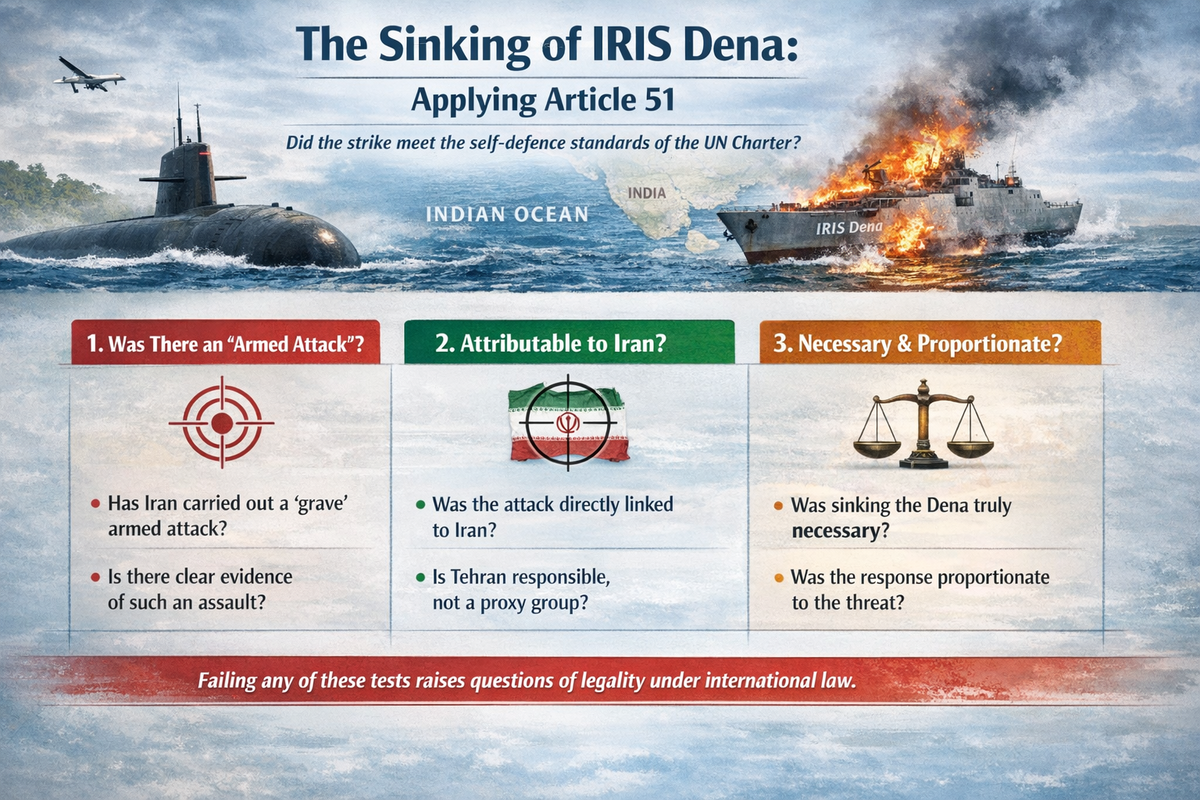
Article 51 in three questions
When lawyers ask whether an operation is justified under Article 51, they are really asking three questions at once.
1. Was there an “armed attack”?
Not every hostile act qualifies. Only the “most grave” forms of force count as an armed attack that can trigger self‑defence; lesser incidents, while unlawful, sit below the line.
2. Is it really that state?
The attack has to be pinned on the state you want to hit back at. Past judgments make it clear that you cannot just say “armed attack” and “self‑defence” and leave it there: you have to show that this state carried out a qualifying armed attack, and that what you did in response was aimed at that specific attack, not at a vague pattern of bad behaviour or a wish to “send a message.”
3. Is the response necessary and proportionate?
Even after an armed attack, self‑defence permits only force that is needed to stop or prevent further attacks and is proportionate in scale and effects. Necessity and proportionality are treated as hard limits, not political slogans.
If a state cannot give convincing answers on all three, its “self‑defence” story starts to look like exactly the sort of force that the Charter was meant to restrain.
It also helps to remember the two short Charter provisions that frame everything here. Article 2(4) lays down the general ban on the threat or use of force; Article 51 keeps a narrow door open for self‑defence “if an armed attack occurs”, and requires that any such measures be reported to the UN Security Council.
In legal terms, the torpedoing of a warship in an ongoing international armed conflict is first and foremost regulated by IHL and the law of naval warfare. Article 51 enters the picture one level up, as part of the background debate on whether particular uses of force between the same states are justified at all.
Applying Article 51 to IRIS Dena
Seen through that lens, the sinking of IRIS Dena raises three immediate questions.
First, what is the armed attack that the US says it is defending against? If the claim is that Iran has already carried out armed attacks on US forces, ships or allies, those incidents need to be identified with some precision. Not every drone launch, cyber operation or proxy clash qualifies. Past decisions have drawn a line between the “most grave” uses of force and lower‑level interference that, while unlawful, does not open the self‑defence door.[1]
Second, why was sinking this frigate, at this point in time, in this location, “necessary” to repel or prevent that armed attack? Necessity in the self‑defence sense is not a broad policy judgment about long‑term deterrence; it is an operational claim that no reasonably effective, less‑forceful alternative existed. Could the US have shadowed, warned, disabled, or targeted assets more directly linked to the attack? The greater the physical and temporal distance between the trigger and the chosen target, the harder it is to meet the kind of strict necessity test first set out in the Caroline correspondence.[2]
Third, how is the strike “proportionate” to the attack? Proportionality is not eye‑for‑an‑eye symmetry, but it does require that the scale and effects of the defensive action be limited to what is needed to stop or prevent further armed attacks. Sinking a frigate in the Indian Ocean after the fact, especially when the ship is returning from exercises, will be seen by many as punishment or signalling rather than a strictly defensive measure.
If the US can make a credible case on all three elements—armed attack, attribution, necessity, proportionality—then the torpedoing of Dena might be defended as an exercise of the inherent right of self‑defence, even far from the immediate theatre. If it cannot, then as a matter of jus ad bellum many international lawyers will characterise the strike as an unlawful use of force, layered on top of an international armed conflict that is already governed at the operational level by IHL.
Anticipatory self‑defence and the “imminence” problem
Recently, South Africa’s president asserted that “anticipatory self‑defence is not permitted under international law, and self‑defence cannot be based on assumption or anticipation.” That strict reading of Article 51—self‑defence only once an armed attack has actually occurred—has deep support in the case law and in parts of the literature.
But it is not the only view. The Caroline correspondence and a strand of state practice accept that some anticipatory action may be lawful where an attack is genuinely imminent and no alternative exists: necessity must be “instant, overwhelming, leaving no choice of means and no moment for deliberation”, and the response must remain within strict bounds of proportionality. The difficulty is obvious: “imminence” can easily become a euphemism for strategic convenience, and anticipatory self‑defence can collapse into preventive war.
US doctrine pushes this further in operational terms. The US Department of Defense’s Law of War Manual accepts a right of anticipatory self‑defence against imminent armed attacks, explicitly invoking the Caroline standard and translating it into a “last window of opportunity” test for commanders at sea and in the air. Non‑binding restatements of the law of armed conflict at sea, such as the Newport Manual, start from peacetime warship immunity but assume that, once an armed conflict exists, enemy warships are lawful military objectives wherever encountered, subject to distinction, necessity and proportionality. That is a more permissive view of imminence and of the geographic scope of targeting than many international lawyers would accept, and it is precisely this gap that makes the IRIS Dena strike such a sharp case study for ILMO.
Where does the sinking of IRIS Dena sit on this spectrum? If Washington sells it primarily as a response to a concrete armed attack that has already taken place, we are in the “reactive” self‑defence box and can judge it against the usual self‑defence criteria. If, instead, the narrative leans heavily on deterrence, signalling and the need to “send a message” before Iran does something worse, it looks much more like a loose anticipatory or preventive strike.
Either way, the episode is a hard test case for both strict and expansive readings. If one insists that self‑defence can never be anticipatory, the legality question becomes: what specific Iranian armed attack is this reacting to? If one accepts some space for imminence‑based action, one then has to say something concrete about how “imminent” a threat must be before torpedoes in the Indian Ocean become lawful.
ILMO in practice: advice you can live with
For ILMO, this is exactly the kind of scenario that legal education should prepare officers, diplomats and advisers to navigate. I often reframe the doctrine‑heavy debates into a simple question: what would you be comfortable telling a commander, knowing your advice might later be read out in The Hague?
In the case of IRIS Dena, my answer—based on the law as it stands—would be cautious:
The use of force against a foreign warship on the high seas is presumptively unlawful unless clearly justified as self‑defence or as part of an armed conflict.
Any self‑defence claim must identify the armed attack, show why it is attributable to Iran, and explain why this particular target and timing were necessary and proportionate.
The farther you move from repelling an ongoing attack toward signalling, punishment or general deterrence, the weaker the legal position becomes.
ILMO cannot tell one whether torpedoing Dena was strategically wise. But it can tell you what needs to be true, in law, for the operation to be defensible—and how thin the ice becomes when states stretch “self‑defence” to cover whatever they wish to do to their adversaries at sea.
For India, the Caroline formula still captures the core instinct behind most official statements on cross‑border force: from international law perspectives, any action must respond to a real attack or concrete threat, be strictly necessary to stop it, and be kept within clear limits, not used as a licence for open‑ended punishment.
Notes:
[1} In its judgment in Nicaragua v United States, the International Court of Justice distinguished “the most grave forms of the use of force (those constituting an armed attack) from other less grave forms,” holding that some lesser but still unlawful uses of force do not, by themselves, open the Article 51 self‑defence door.
[2] The Caroline incident was an 1837 cross‑border raid in which British forces crossed from Canada into US territory, seized an American steamer supplying Canadian rebels, and burned it on the Niagara River, killing at least one American. Its legal significance came later, in an 1842 exchange where US Secretary of State Daniel Webster argued that self‑defence is lawful only when the necessity is “instant, overwhelming, leaving no choice of means and no moment for deliberation,” and the response stays within reasonable, proportionate limits. The Caroline correspondence is now a standard reference point for customary limits on self‑defence—especially necessity and proportionality—even though lawyers still debate how demanding its idea of “imminence” should be today.