The Law of Neutrality
India’s Rights & Responsibilities

When the Iranian frigate IRIS Dena was sunk by a US submarine in the Indian Ocean, the immediate discussion centred on the legality of the strike itself. Was it lawful self‑defence under Article 51 of the UN Charter, a discrete episode in an emerging armed conflict between the United States, Israel and Iran, or an unlawful use of force. Put differently, the incident sits at the junction of jus ad bellum (whether force could lawfully be used at all) and jus in bello (how force was used in practice: the status of IRIS Dena as a military objective, the proportionality of the attack, and the precautions taken for those on board). These are important questions, and international lawyers will debate them for some time.
If one looks at the episode from India, however, a third body of law comes to the forefront. India is not a party to any US–Iran confrontation at sea, nor was the attack carried out in Indian waters, so its rights and duties are not determined by the rules that govern belligerents. Instead, India’s legal position is shaped by the older law of neutrality, codified for naval warfare in Hague Convention XIII of 1907, which regulates how non‑belligerent coastal states must conduct themselves when other states fight near their coasts.
The sinking of a warship that had recently visited India as a guest during the International Fleet Review and Exercise MILAN 2026 naturally provokes an emotional reaction. Yet India’s position in such a situation is anchored not in sentiment but in the Hague Convention regime governing neutrality in naval war, designed to keep states like India outside other people’s wars even when the fighting occurs close to their shores.
The Law of Neutrality
The central instrument here is Hague Convention XIII (1907), adopted at the Second Hague Peace Conference. Alongside the better-known conventions governing land warfare, Hague XIII set out the rights and duties of neutral powers in naval war. Despite its age, it remains the cornerstone of maritime neutrality law and continues to shape state practice.
Hague XIII is one of the thirteen conventions adopted at the Second Hague Peace Conference in 1907. The 1899 conference produced 3 main conventions (plus several declarations). The 1907 conference produced 13 numbered conventions, of which No. XIII is the “Convention concerning the Rights and Duties of Neutral Powers in Naval War.”
Its purpose was straightforward. Great-power conflicts were expected to occur at sea, and many states would remain non-participants. The law therefore sought to define what neutrality meant in practice and to reassure neutral states that exercising their rights would not itself be treated as a hostile act.
Three principles from Hague XIII are particularly relevant when considering India’s position in the Dena episode.
Respect for Neutral Territory
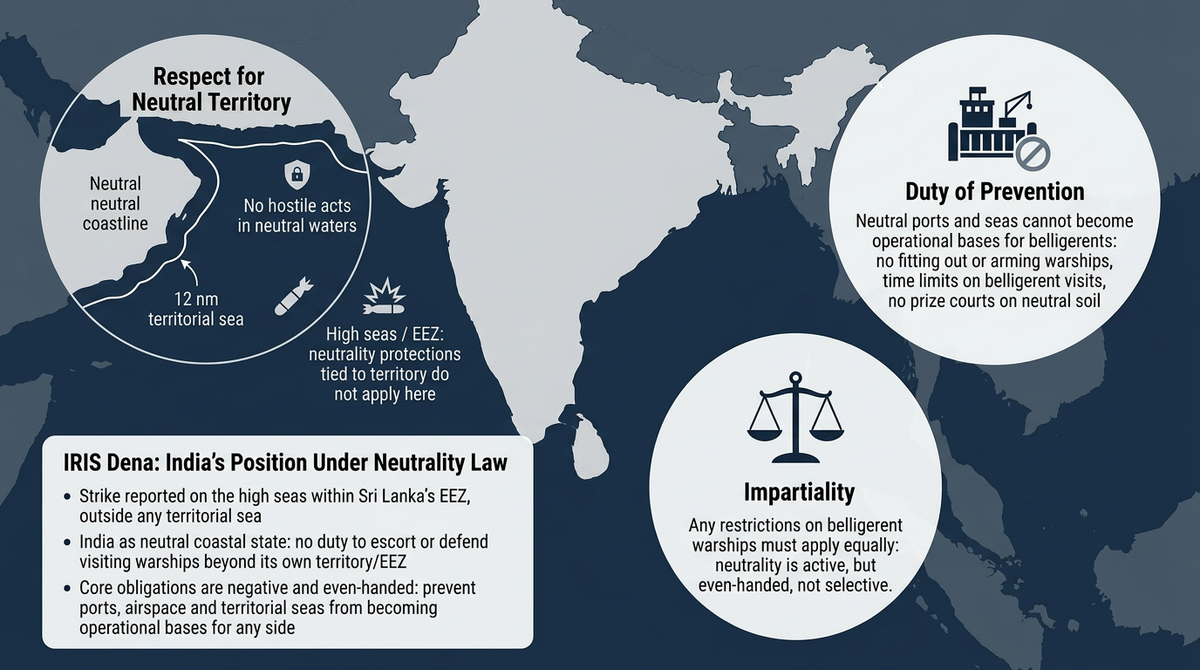
First, belligerents must respect the sovereign rights of neutral powers. Article 1 requires belligerents to abstain, in neutral territory or neutral waters, from acts that would constitute a violation of neutrality if knowingly permitted by the neutral. Article 2 adds that any act of hostility, including capture and the exercise of the right of search, committed in the territorial waters of a neutral power is strictly forbidden.
In the case of IRIS Dena, the attack reportedly occurred outside the territorial seas of both India and Sri Lanka, in international waters within Sri Lanka’s Exclusive Economic Zone. As a result, the specific Hague XIII protections for neutral territory—which attach to land territory and territorial seas—were not triggered. The engagement took place where neither India nor Sri Lanka exercises sovereignty, even though it was close to their coasts.
The Neutral Duty of Prevention
Second, neutrality carries obligations as well as rights. Neutral states must not allow their ports, airspace, or territorial seas to become bases of naval operations for belligerents. Hague XIII translates this duty of prevention into several practical rules.
These include:
Preventing the fitting-out or arming of warships for belligerents within neutral ports or other jurisdiction.
Limiting how long belligerent warships may remain in neutral ports and waters, typically to 24 hours in the absence of special rules.
Preventing the establishment of prize courts or similar wartime institutions on neutral territory.
These provisions were designed to ensure that neutral territory does not become an extension of a belligerent’s war effort, even if the neutral sympathises with one side more than the other.
Impartiality Between Belligerents
Third, neutrality requires impartiality. Article 9 obliges a neutral power to apply, impartially to both belligerents, the conditions, restrictions, or prohibitions it adopts regarding the admission of belligerent warships or prizes to its ports and territorial waters. A neutral may tighten or relax its rules, but it may not do so selectively for one side alone.
Neutrality is therefore not passive indifference. It is a structured legal status that requires the neutral state to apply its rules even-handedly, while ensuring that its territory and waters are not transformed into an operational asset for either belligerent.
India as a Classic Neutral Coastal State
Viewed through this framework, India’s position in the IRIS Dena episode is legally straightforward. India is best understood as a neutral coastal state in relation to the wider confrontation between the United States and Iran in the Indian Ocean.
Because the attack took place in international waters within Sri Lanka’s EEZ, and not within India’s territorial sea or EEZ, the neutrality protections attached to Indian territory were not engaged. India therefore had no legal obligation, under Hague XIII or the UN Charter, to intercede in the engagement that took place at sea.
Its responsibilities lay instead in the familiar duties of neutrality: ensuring that its ports, airspace, and territorial seas are not used as bases of operations by either side, and applying any restrictions it adopts in an impartial manner. These are obligations that can be discharged without physically intervening in a naval engagement that occurs well beyond India’s waters.
The Line Between Neutrality and Participation
Reportedly Kochi was the next port-of-call for IRIS Dena. Hague XIII therefore permitted limited, tightly regulated hospitality to belligerent warships. India was within its rights to have allowed a ship such as IRIS Dena to enter, refuel and take on food, water and basic stores, and to make essential repairs needed for seaworthy onward passage, but only for a short, defined period and without turning the port into an operational base.
The default rule is that belligerent warships may remain in a neutral port or territorial sea for no more than twenty‑four hours, save for strictly defined exceptions such as damage or stress of weather, and any conditions India chooses to impose must apply impartially to all belligerents. Supplying ammunition or specialised war materiel, permitting extended stays that facilitate combat operations, or providing escorts or targeting support from Indian forces would cross the line from neutral hospitality into operational participation, and with it the risk of India being treated as a party to the conflict.
Had India provided an armed escort to IRIS Dena or attempted to shield it from attack on the high seas, it would have moved from neutrality towards participation on Iran’s side. At that point, India would no longer be a neutral observer but a state taking part—politically and legally—in the confrontation.
Such a step would not only carry political and strategic consequences. It would also draw India directly into the legal debate surrounding the jus ad bellum: the body of international law governing when states may lawfully resort to force, including the contested scope of self-defence under Article 51.
The Quiet Endurance of an Old Legal Framework
The sinking of IRIS Dena is a reminder that even in an era of submarines, drones, and long-range precision strike, the legal architecture governing naval conflict still rests in part on rules written more than a century ago. The Hague neutrality conventions were drafted in an age of coal-fired battleships and imperial rivalries, yet their basic logic remains intact.
They recognise that wars at sea will occur, that many states will not be participants, and that a stable international order requires clear rules defining the rights and duties of those neutrals. For coastal states like India, that framework is what allows them to remain close to conflict geographically while staying outside it legally.
For India, the IRIS Dena episode illustrates how those rules continue to operate in practice. Emotional reactions may arise when a ship that recently visited Indian shores is sunk in nearby waters, especially after participating in a high-profile fleet review. But in legal terms, the old framework of neutrality places India where Hague XIII always intended neutral coastal states to be: outside the conflict, yet bound by rules that preserve that position.
Lot More to Explore
The IRIS Dena episode already shows how the 1907 Hague law of neutrality continues to shape the position of states such as India when conflicts unfold near their waters. But the neutrality framework goes much deeper than the brief application discussed here.
In future posts, it would be worth exploring some of the wider questions that flow from it:
The Hague Law of Neutrality (1907) — how this century-old framework developed, and why it still governs the rights and duties of neutral coastal states today.
Neutral Ports, Drones and Remote Warfare — why rules written for coal-fired fleets are becoming relevant again in an age of unmanned systems, long-range strike and satellite-linked operations.
The Forgotten Law of Air Warfare — the 1923 Hague Rules of Air Warfare, and the early attempt to regulate aerial bombardment long before modern air power had fully emerged.
This piece relies on open‑source reporting on the IRIS Dena incident and the text of Hague Convention XIII, and does not attempt to resolve contested factual claims about the engagement itself