Part I - Using Theory to Read the Iran–Israel–US War
Training, education, and reading the war on Day 4 of the I

This essay is now Part I of a series using strategic theory as a discipline, not a decoration, for reading the 2026 Iran–Israel–US war. Part II revisits the conflict on Day 10 and extends the framework.
Abstract
As missiles fly in West Asia and commentary accelerates, the real danger is not uncertainty—it is analysis without structure. This essay argues that training alone is insufficient in moments of crisis. Professional competence produces plans; education, grounded in strategic theory, disciplines how we interpret war when events outpace commentary. Using the unfolding Iran–Israel–US confrontation as a live case study, the piece reads the crisis through the lenses of Clausewitz, Schelling, realism, alliance theory, balance-of-power logic, and maritime strategy. The purpose is not prediction, but discipline. Theory disciplines the frame; intelligence and local knowledge fill it in. For India—energy-dependent, maritime-exposed, and diplomatically entangled—the stakes are structural. The question is simple but uncomfortable: “Do we train our leadership for war, or educate them about war?”
Why Reach for Theory in the Midst of War?
When events accelerate and commentary multiplies, the temptation is to react; theory disciplines us to interpret.
Wars today unfold in two theatres simultaneously: on the battlefield and among the plethora of commentaries. Missiles fly, drones strike, leaders issue statements—and before the smoke clears, narratives harden. Television compresses escalation into slogans. Social media converts ambiguity into certainty. The tempo of interpretation now rivals the tempo of operations.
This is not a crisis that can simply be followed. It must be read—through theory, because theory turns noise into structure and reaction into well-thought-out design.
Training produces plans. Education, grounded in theory, disciplines how we interpret wars when the fog of war obscures facts from fakes, commentary is in a hurry to be the first to arrive, and escalation happens faster than what leaders and institutions want. In such moments, the most dangerous posture is not ignorance; it is confidence without a framework.
The Iran–Israel–US confrontation is more than a regional crisis. It is a live test of whether theory truly matters for Indian strategy
Does our national security education produce leaders, military and civilian, capable of disciplined strategic interpretation under pressure?
Training Is Not Enough: PME and the Lambert Distinction
A familiar PME story—and an uncomfortable question
Most officers in India’s armed forces pass through serious institutions of Professional Military Education at the mid-career and senior levels: Staff College, Higher Command courses, and the National Defence College. Strategic theory appears on reading lists. Clausewitz is cited. Schelling surfaces in deterrence discussions. Realism and balance-of-power logic are not unfamiliar.
I encountered these ideas first as a student, later as a member of the Directing Staff (DS), and eventually as Chief Instructor (Navy).
Across that arc, a quiet question persisted: is exposure to theory sufficient to cultivate strategic judgement—or does it risk becoming an academic layer atop a system still structurally oriented toward training rather than education?
There is no doubt about the quality of training. Tactical competence is high. Operational planning standards are demanding. Staff work is rigorous. Exercises are serious. The system produces officers who can execute.
But military institutions—ours included—are structurally oriented toward what can be measured.
Instruction ensures proficiency. It prepares officers to plan, brief, write, and command within established frameworks. Its outputs are visible: campaign plans, operational orders, staff papers, and exercise performance.
Education operates differently. It cultivates intellectual flexibility, comfort with ambiguity, historical sensibility, and the ability to integrate politics, economics, and force into coherent strategic judgement. Its effects are harder to quantify—and therefore easier to underweight.
The tension is subtle. We teach what can be structured and assessed. But does that process reliably produce the kind of thinkers complex crises actually demand?
Lambert’s distinction: proficiency vs perspective
Andrew Lambert’s work on naval officer education makes the divide explicit. Training builds performance in tasks that can be objectively tested. Education cultivates perspectives—the capacity to connect events, interpret context, and decide under uncertainty.
Training answers: Can you execute this plan? Education asks: Should you—and to what political end?
Clausewitz’s own insistence that war must remain subordinate to policy (On War, Book I) reminds us that operational brilliance detached from political purpose is strategically hollow.
Lambert’s invocation of Hans Delbrück reinforces the point. Delbrück, a civilian, challenged official battle narratives by interrogating Prussian logistics and feasibility, insisting that war be analysed structurally rather than mythologically. The broader lesson is clear: a profession that shields itself from disciplined scrutiny risks reinforcing confidence rather than cultivating judgement.
If we stop at training, we produce officers who can execute plans. We do not necessarily produce leaders who can interrogate whether those plans serve coherent political purposes.
Training produces execution. Education produces judgement.
Why this matters now
This distinction would remain academic if wars were linear and contained.
The Iran–Israel–US war, now a widening confrontation, is not. It is a multi-domain contest involving military strikes, proxy activation, escalation signalling, alliance management, maritime choke-point vulnerability, energy risk, and great-power positioning. This is not a bounded problem. It is a dynamically evolving situation in which, if there is any clarity, it is that uncertainty dominates. Decision-making under conditions of uncertainty is where wars are won and lost. It’s to such ends that theory must justify its place in PME. It must demonstrate value here, while the crisis is unfolding, not retrospectively in a seminar.
Let us examine this war in real time—not through opinion, but through disciplined theory.
How Theory Reads the Current Crisis
Theory does not predict outcomes. It disciplines interpretation. It slows reactions long enough to discern the structures and patterns that emerge.
Clausewitz: Political Purpose and Drift
Clausewitz’s foundational insight is that war is the continuation of politics by other means (On War, Book I, Chapter 1). Force must serve a political object; if the object shifts, the character and scale of force must be reassessed.
The declared objectives in this crisis are layered:
Israel seeks to neutralise an existential threat by degrading Iran’s strategic capabilities and proxy network.
The United States aims to restore deterrence and protect forces and partners without becoming absorbed in another prolonged regional war.
Iran prioritises regime survival, sovereignty, and the credibility of its deterrent.
The Clausewitzian question is whether the operational pattern aligns with these political objects—or whether escalation is generating new realities. In Washington’s case, the movement from ‘nuclear denial’ to ‘deterrence restoration’ to broader talk of degrading Iran’s regional military reach suggests precisely the kind of objective creep Clausewitz warned against.
Clausewitz also warns of the “culminating point” of the offensive (On War, Book VII)—the stage at which additional effort produces diminishing strategic returns and rising systemic risk. Shock intended to disorient an adversary can instead consolidate its resistance. Strikes meant to compel moderation can harden defiance.
Seen through this lens, the United States’ shifting emphasis—from nuclear denial to regime change to punishing missile attacks to broader talk of ‘rolling back’ Iran’s military reach—signals a strategic ambiguity that is itself dangerous. When operational practice outpaces a clearly bounded political object, drift becomes more likely than design.
For India, this is not theoretical. A conflict drifting toward maximalist objectives increases the probability of spillover—proxy expansion, maritime disruption, and economic shock. A Clausewitzian education compels planners to ask continuously: has the war’s character exceeded its purpose—and what does that imply for us?
Schelling: Escalation and Missing Off-Ramps
Thomas Schelling reframed war as bargaining under the shadow of violence (The Strategy of Conflict, 1960; Arms and Influence, 1966). In this view, force is not only about destruction—it is also a means of communication. Each step up the escalation ladder carries a message, intended to shape the opponent’s choices. Yet Schelling also cautions that escalation is never perfectly controlled: signals can be misread, domestic pressures can narrow room for restraint, and deliberate signalling can slide into inadvertent conflict.
The present confrontation reveals a crowded escalation ladder—strategic strikes, retaliation, proxy mobilisation, naval deployment, economic pressure, and rhetorical framing.
The danger is not escalation per se. The danger is the absence of visible off-ramps.
Schelling emphasised that deterrence and compellence depend not only on capability, but on clarity about what constitutes compliance. Without a shared understanding of what “enough” looks like, each move invites a countermove. When the stated rationale keeps shifting—from nuclear denial to regime pressure to degrading military capabilities—adversaries cannot infer what level of concession would actually satisfy the United States, making every signal look like a prelude to the next demand. Domestic politics narrows manoeuvre space; restraint becomes costly.
Crises become most dangerous when neither side has defined the conditions under which it would stop climbing the escalation ladder. Training may teach us how escalation ladders work. Education must teach us when and how to stop climbing them.
For India, the lesson is institutional: termination logic must be embedded in crisis planning—not appended later.
Realism: Structural Incentives and the “Closing Window”
Realism directs attention to the distribution of power and the incentives it creates (Morgenthau; Waltz). States act not in a vacuum, but within structural conditions that both constrain and enable their choices.
Offensive realism (Mearsheimer) suggests that when leaders perceive a narrowing window in which they retain relative advantage, they may accept higher present risk to avoid future vulnerability. If Iranian capabilities are assessed as hardening and external backing deepening, preventive incentives increase.
Defensive realism (Waltz; Jervis), by contrast, warns that action intended to reduce threat can provoke balancing behaviour and widen the threat environment.
Realism does not justify action. It renders behaviour legible. States often accept present risk to avoid anticipated future disadvantage. Multiple public justifications can obscure a simple structural fear: that waiting will leave Iran harder to coerce at far greater cost.
For India, realism guards against surprise. What appears impulsive may reflect structural calculation. Policy must account for how actors perceive their windows—not merely how we assess them.
Alliance Theory: Entrapment and Divergent Ends
Alliance theory (Snyder) highlights the twin dangers of abandonment and entrapment. Shared enemies (common adversary) do not eliminate divergence in political aims or escalation thresholds. The more Israeli strategy drifts toward de facto regime weakening, the more the United States risks being dragged into an escalatory logic that goes well beyond its own initial, more limited public aims.
The United States and Israel are operationally aligned. Their strategic tolerances may differ. Washington manages global commitments; Israel’s threat perception is immediate and acute.
Credibility, in alliance terms, means being trusted to stay the course once you have committed yourself — especially when the costs rise. Alliance management becomes an exercise in calibrated reassurance and quiet boundary-setting.
For India, the implication is clear: in any strategic alignment, thresholds and ceilings must be explicit. Autonomy is preserved through design, not rhetoric.
Balance-of-Power: Calibrated Distance
Balance-of-power logic (Waltz) focuses on how major powers behave when rivals become entangled. China and Russia both criticise escalation and maintain strategic ties with Iran, yet neither appears willing to assume direct operational responsibility for the conflict. Beijing, in particular, deepens economic and energy linkages while avoiding military exposure; Moscow offers diplomatic backing but stops short of commitments that would risk confrontation with Washington.
This calibrated distance enables them to benefit from American strategic distraction, shape global narratives about overreach, and pursue economic opportunity—while others absorb the military and political costs.
For India, the lesson is structural, not regional: no major power offers a risk-free hedge. Great powers calibrate involvement according to their own interests, and that calibration hardens as costs rise.
Maritime Strategy: Choke Points and Systemic Shock
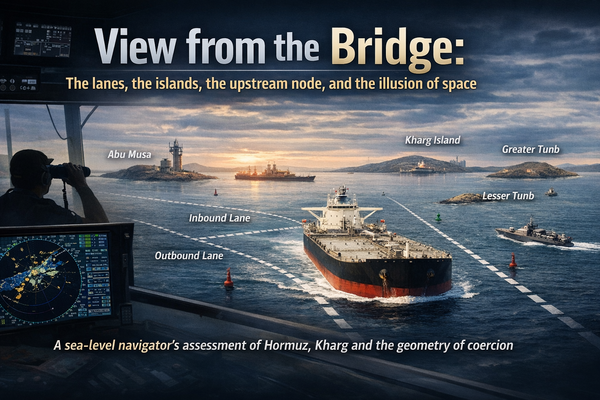
Maritime strategy (Mahan; Corbett) focuses on sea lanes and choke points as instruments of systemic leverage. The Strait of Hormuz and the Red Sea corridor are not regional details; they are global arteries.
When threatened, shipping routes shift, insurance premiums spike, and energy markets reprice risk.
For India—energy-dependent and trade-exposed—the Gulf is structural. A widening crisis that touches choke points translates directly into macroeconomic pressure and strategic distraction.
Maritime theory highlights three realities:
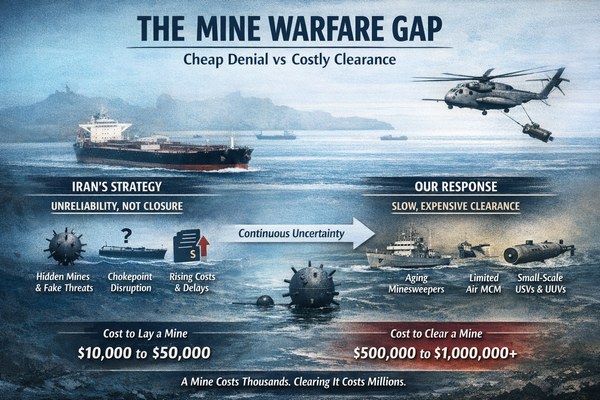
- Sea denial can generate disproportionate economic effects.
- Perceived risk can outlast actual violence.
- Sustained presence—not episodic reaction—reassures commerce.
What these lenses demand of India is design.
At a minimum:
Standing maritime contingency planning
Explicit Hormuz/Red Sea escalation triggers
Diaspora evacuation architecture
Energy diversification and reserve utilisation planning
Shipping assurance concepts
Integrated civil-military crisis routines
This is education translated into preparedness.
4) Pulling It Together: Education as Strategic Discipline
The Iran–Israel–US confrontation is not a distant spectacle. It is a test of whether Indian military education produces leaders capable of structured interpretation under crisis conditions:
Clausewitz disciplines political-object clarity.
Schelling disciplines escalation logic.
Realism disciplines structural interpretation.
Alliance theory disciplines alignment management.
Balance-of-power logic disciplines third-party analysis.
Maritime theory disciplines systemic exposure assessment.
Training wins battles. Education safeguards strategy.
Theory is not a luxury in conflict. It is the discipline that prevents reaction from masquerading as strategy, even as it must work with incomplete information and political constraint.
Further Reading (For Those Who Want to Go Deeper)
The lenses applied above are not improvised. They draw on a body of work that has shaped strategic thought for more than a century.
Carl von Clausewitz, On War (1832)
Especially Book I (“What Is War?”) and Book VII (“The Attack”), for the political-object framework and the concept of the culminating point.
Thomas C. Schelling, The Strategy of Conflict (1960); Arms and Influence (1966)
Foundational texts on coercion, signalling, escalation ladders, and the logic of controlled and inadvertent escalation.
Kenneth N. Waltz, Theory of International Politics (1979)
The structural realist account of how the distribution of power shapes state behaviour.
John J. Mearsheimer, The Tragedy of Great Power Politics (updated ed., 2014)
Articulates offensive realism and the “closing window” logic under shifting power balances.
Glenn H. Snyder, Alliance Politics (1997)
The classic treatment of abandonment and entrapment dynamics in alliance systems.
Julian Corbett, Some Principles of Maritime Strategy (1911)
For understanding sea control, sea denial, and why maritime geography magnifies strategic risk.
Andrew Lambert, “History as Process and Record: The Royal Navy and Officer Education,” in Gregory C. Kennedy and Keith Neilson (eds.), Military Education: Past, Present, and Future (Westport, CT: Praeger, 2002).
A powerful reflection on the distinction between training and education, and on history as a discipline of intellectual formation rather than institutional myth-making.