When a Gas Field Becomes a Food Crisis
South Pars, Air Power Doctrine, and the Blind Spot India Cannot Afford

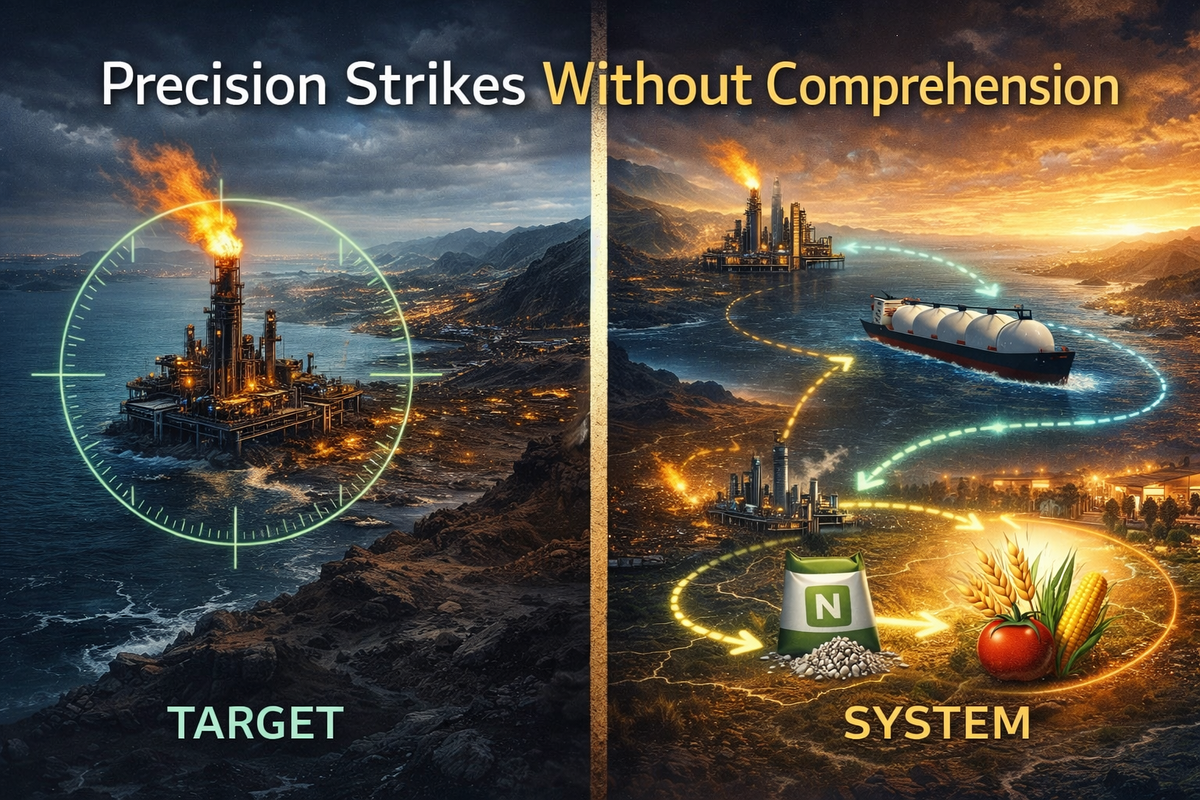
The question is no longer whether air power can hit a gas plant. It is whether those who direct it understand exactly what a strike actually strikes.
The Strike That Was Not Supposed to Happen
On 18 March 2026, Israel struck South Pars — the world’s largest gas field, straddling the Iran-Qatar maritime boundary in the Persian Gulf. Iran’s retaliation followed within twenty-four hours: ballistic missiles struck Ras Laffan Industrial City, Qatar’s vast LNG export complex and the anchor of the global ammonia and fertiliser chain. Qatar made urgent representations to Washington. President Trump told Israel to stand down from further strikes on energy infrastructure. The man without a targeting manual had grasped what the targeting logic had missed.
Most commentary focused on the language of energy security — oil prices, tanker risk, supply chain disruption. That framing, while not wrong, is insufficient. The more consequential chain runs further and faster than energy markets. Natural gas is not merely a fuel. Through the Haber-Bosch process, methane becomes ammonia, ammonia becomes urea, and urea becomes the nitrogen that drives cereal yields. Qatar’s alarm was not simply about LNG revenues. It was about the ammonia and fertiliser export chain anchored at Ras Laffan — a chain that reaches, among many destinations, into India’s agricultural system with consequences timed to the Kharif cropping calendar.

India imports a substantial share of its urea and DAP (Di-Ammonium Phosphate) requirements from Gulf-linked producers. Domestic production depends on imported gas from the same sources. Fertiliser that arrives late in India is not a delayed supply — it is a lost input. Crop response to nitrogen is non-linear: the first applications produce the largest yield gains. A fifteen to twenty percent disruption coinciding with the early Kharif application window can produce yield losses disproportionately larger than the supply shortfall. This is not a market problem. It is a biological constraint that operates on a timeline — weeks, not months — that outpaces any diplomatic or logistical response.
Trump’s instinct, prompted by Qatari self-interest, was strategically correct even if arrived at by the most transactional of routes. He had intuitively traced what the targeting professionals had not: the consequences of the strike through the LNG chain, the nitrogen system, the agricultural calendar, and the political economy of food prices across import-dependent Asia. That a property developer from Queens grasped this, and the targeting professionals did not, is a symptom of a doctrinal failure with a specific intellectual history.
Precision Without Comprehension
The intellectual architecture that produced the South Pars targeting logic has a traceable lineage. John Warden’s conceptualisation of the adversary as an interconnected system — leadership, system essentials, infrastructure, population, fielded forces — gave modern air power its most influential theoretical framework. David Deptula refined this into Effects Based Operations (EBO): strike the nodes, produce systemic paralysis, and achieve the political objective from altitude. Energy infrastructure became a preferred target set. The logic was analytically elegant and, within its assumptions, operationally validated by the 1991 Gulf War.
The targeting of South Pars stems from a lack of understanding of the fact that its effects extend far beyond the adversary’s state. South Pars had worldwide strategic implications, including for food security, fertiliser production, and sulphur-linked industrial chains in which sulphuric acid is indispensable. In 1991, Iraqi oil infrastructure was, in operational terms, largely an Iraqi problem. In 2026, South Pars is a global node, woven into the energy balances, fertiliser chains, and food systems of economies that are not party to the conflict. Once EBO logic is applied to infrastructure embedded in the global commons, the second and third-order effects do not remain local. They are simply displaced into someone else’s crisis. In India’s case, that displacement can become a food-security shock within a single growing season.
This failure of comprehension is not accidental. It is a product of how air power officers are educated — or not educated — to think about the systems their targeting decisions affect. Air power’s logic is targets, packages, kill chains, and effects at the point of impact. What it is not, structurally and by formation, is flows, routes, throughput, timing, and the downstream consequences of interrupting systems that cross state boundaries and agricultural calendars. Naval thinking instinctively inhabits the second logic. Air power instinctively inhabits the first. At South Pars, the first logic produced a strike. The second logic — arriving via Qatar and a transactional American President — stopped the next one.
The Indian Echo: A Retired Air Marshal’s Essays
India has its own version of this doctrinal overconfidence. It has found articulate expression in essays by a retired senior air marshal — a former Commander-in-Chief of both Eastern and Western Air Commands, and Defence Attaché in Tel Aviv. Writing after the Hormuz crisis, he argued that India should abandon its surface fleet, cancel its carrier programme, and rely on land-based missiles, island bastions, and air-delivered choke-point denial. In an earlier essay, he had argued for preserving the IAF as a unified, centralised instrument against theatre command reforms.
Both arguments deserve engagement because both contain real operational insights. But each also carries strategic myopia.
The first is correct that surface ships are increasingly vulnerable in contested littorals, and that geography — Malacca, the island chain — matters deeply. The second is correct that fragmenting scarce air assets risks losing concentration at the decisive point. These are valid concerns.
They do not lead to the conclusions drawn.
The first argument mistakes denial for strategy. It does not answer the question that strategy must answer: what happens when, say, India’s Andaman & Nicobar Island bastions are struck, isolated, and cut off from resupply across 700 nautical miles of contested ocean? What force sustains them, and what force retakes them?
The second rests on a conflation. It assumes that theatre commands require distributing air assets. They do not. The issue is not who controls aircraft, but who is responsible for the campaign. Unity of command is about accountability for outcomes, not ownership of platforms. Confusing the two has distorted the Indian debate.
Both essays remain within an airpower frame.
They see Hormuz as tankers, mines, salvos and kill chains, but stop where the problem becomes strategic. They do not follow the flow from Ras Laffan into ammonia, into DAP, and into the Kharif calendar, where disruption shows up not as ships sunk but as fertiliser missing at sowing time.
Nor do they ask what happens on the other side of that disruption: how India sustains and resupplies exposed positions such as the Andaman and Nicobar Islands across contested seas. Once both chains are traced — the global system outward and the logistics chain inward — the question is no longer about denial alone. It is about endurance, and what follows when endurance runs out.
“A strategy that models the adversary’s collapse but not its own endurance is not strategy.”
That is when the problem shifts from operational to economic, and quickly to political. Once that chain is traced, the question is no longer how to strike, but how long a system can endure disruption.
The Andaman and Nicobar Islands illustrate the gap. They are a hinge of denial, but also fixed, continuously observed, and dependent on a long sea line of supply across the Bay of Bengal. That distance is not incidental. It is the vulnerability. Remove carriers and escorts, and the means to secure that supply line disappear. What remains is an exposed logistics chain with no credible protection.
There is also a doctrinal silence. Anti-submarine warfare is an air–maritime system, not an air-only function. It requires ships, aircraft, helicopters, and sensors operating together. It is not a role the Indian Air Force carries out, and cannot be substituted for.
The result is a strategy that answers denial, but not sustainment. It explains how to hold, but not how to recover. And it does not address the possibility that the islands may be lost.
That omission matters.
Strategy is not tested when plans succeed. It is tested when they fail.
The Tel Aviv posting sharpens the irony. No military has documented more clearly the limits of airpower applied without joint integration.
The Winograd Commission’s assessment of the 2006 Lebanon war, and the lessons of 1973, are well known, widely published, and professionally taught.
The Agranat Commission that followed 1973 did not set out to critique airpower. The war it examined did. Israeli aircraft ran up against an Integrated Air Defence System that airpower alone could not dismantle. The lesson was that countering systems require joint solutions.
Access to these lessons was not the constraint. The question is whether they were institutionally absorbed.
The available professional record suggests a career shaped overwhelmingly within the IAF’s operational and technical stream. This is not a personal critique. It points to an institutional pattern. While not universal, the persistence of a test-pilot, fighter-stream worldview in the public strategic voice of senior veterans suggests a formation whose influence exceeds that of formal Professional Military Education.
That, ultimately, is the deeper issue. Not the correctness of any single argument, but the limits of the framework within which it is made.
The Harvest That Follows
The revealing measure of an institution’s seriousness about Professional Military Education is not whether it sends officers to higher command courses. It is which officers it sends, at what career stage, and for what purpose. When higher joint education becomes a terminal posting for officers whose operational trajectory has already concluded — a graceful conclusion rather than a genuine preparation — the institution has signalled what it values. This is what I witnessed during the Naval Higher Command Course, many decades ago. That signal is accurately received by every ambitious officer in the system. And its consequences appear, with equal accuracy, in the strategic doctrine those officers subsequently produce. Hopefully the younger generations are being better groomed for command at the highest levels.
Trump’s intervention about the South Pars targeting was not strategic maloom. It was transactional responsiveness to a Gulf ally’s economic alarm. But it produced the right outcome for the right systemic reason — Qatar’s argument was, at its core, the argument this essay has been making. A gas field is not a node in an adversary’s system. But it is a vital joint in a global chain whose consequences, if severed, appear not in megawatts and refinery throughput but in urea availability during a four-week Kharif window and the price of food in Indian mandis six months later.
An airpower doctrine that can precisely strike a gas plant, but is not institutionally required to think through Ras Laffan, Hormuz, India’s fertiliser dependence, and the Kharif calendar, is not demonstrating strategic maturity. It is demonstrating precision without comprehension. In today’s world, energy, fertiliser, and food are tightly coupled. The same strait that carries the tanker also carries the nitrogen. A strike that looks clean on a targeting map can travel through that chain and show up months later as stress in fields and markets far from the battlefield.
That is not a marginal oversight. It is a gap in how we educate for strategy.
The question is no longer whether Indian airpower can hit the target. It can. The question is whether the institutions that shape India’s senior officers ensure they understand what that target sits inside, what systems it feeds, and why different kinds of target systems demand different kinds of military approaches.
Because once targets are embedded in global flows, the problem is not just how to destroy them. It is about having strategic anticipations of what that destruction sets in motion.
***